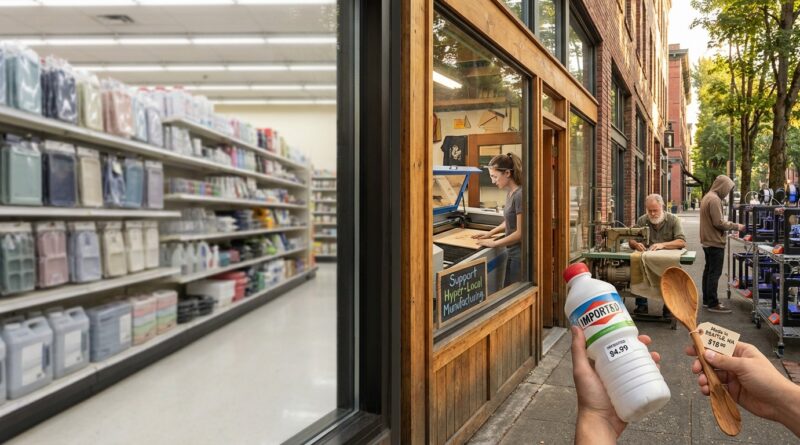
Beyond The Hype: How Hyper‑Local Makers Are Quietly Replacing Global Supply Chains
You feel it when the package is late again, the replacement part is backordered, or the “local” item turns out to be something shipped from three countries away and finished with a sticker in town. People are fed up with fragile supply chains. They want practical local options, not just cute one-off gifts at a weekend market. The trouble is that many small makers are hard to find, hard to compare, and often judged against mass-produced prices that were never honest to begin with. That is where the rise of hyper local manufacturing starts to matter. Quietly, neighborhood woodshops, metal shops, textile studios, 3D print labs, food producers, and repair-first businesses are stepping into gaps global supply chains created. The big shift is not hype. It is usefulness. If you know how to spot a real local replacement, you can buy better, wait less, and keep more money working in your own community.
⚡ In a Hurry? Key Takeaways
- Hyper-local makers can replace many everyday big-box purchases, especially home goods, repairs, custom parts, gifts, small-batch food, and simple business supplies.
- Use a simple checklist: ask where it is made, how fast it can be replaced, whether repairs are offered, and if the maker can handle repeat orders.
- The cheapest price on day one is not always the best value. Local goods often win on durability, lead time, service, and lower risk.
Why this shift is happening now
For years, global supply chains looked unbeatable. Low shelf prices. Endless choice. Fast delivery, until it was not fast at all.
Then the weak spots got hard to ignore. Shipping delays. Material shortages. Quality swings. Products that cannot be repaired. Small businesses waiting weeks for a simple fixture, sign, bracket, or packaging run. Families replacing the same flimsy item twice a year because the cheap version keeps failing.
That frustration is feeding the rise of hyper local manufacturing. Not as a slogan, but as a practical response.
Local makers can often do three things the global chain struggles with. They can make smaller runs. They can adjust quickly. They can talk to the buyer like a human being.
If you have noticed more neighborhood workshops, garage-based brands, maker spaces, and micro-factories showing up, that is not your imagination. It lines up with what we covered in From Grandma Hobbies to Neighborhood Micro‑Factories: Why Young Makers Are Quietly Rewiring Local Economies. The change is already underway. Most people just do not have a clean way to use it yet.
The real problem: local goods are still too hard to find
Most shoppers are not against buying local. They are against wasting time.
That is the gap. A lot of local makers are visible only if you already know where to look. They might have an Instagram page, a booth at a market, or a few word-of-mouth customers. What they often do not have is a clear path for someone thinking, “I need a better version of the big-box item I usually buy.”
That means local goods get pushed into the “nice extra” category instead of the “real replacement” category.
That is a mistake.
A local maker does not need to replace everything in your life. They just need to replace the items where they clearly win.
The local replacement playbook for everyday buyers
1. Start with products that already fail you
Do not begin with a grand moral mission. Begin with annoyance.
Ask yourself what you keep re-buying, waiting for, or fixing badly. That is your shortlist. Good candidates include:
- Cutting boards, shelves, stools, tables, and storage pieces
- Work uniforms, aprons, tote bags, and simple sewn goods
- Candles, soaps, pantry staples, and prepared foods
- Signs, packaging inserts, display stands, and branded materials for small shops
- Replacement hardware, brackets, mounts, and simple custom parts
- Gifts you want to mean something, not just arrive in a box
If the item is basic, repeatedly purchased, or often disappointing, a local replacement has a real shot.
2. Ask four questions before you buy
This is where non-tech buyers can save themselves from guessing.
- Where is it actually made? Not designed. Not finished. Made.
- Can it be repaired, refilled, or reordered? A good local product often comes with follow-up support.
- What is the lead time? Sometimes local is faster than expected, especially for repeat orders.
- Can this maker handle consistency? If you love it, can they make the same thing again next month?
Those four questions separate a hobby listing from a reliable local supplier.
3. Compare total value, not just shelf price
This is where people get stuck. They compare a hand-built local item to a factory-made item by price alone.
That is not a fair test.
A better comparison is:
- How long will it last?
- How much does replacement or shipping cost?
- Can I get help if it breaks?
- How much time do I lose when the cheap option fails?
A $35 locally made shelf bracket that fits properly and arrives this week may beat a $12 imported one that bends, ships late, and needs to be reordered.
4. Look for categories where “small batch” is a strength
Mass production is great when every item needs to be identical and dirt cheap. It is not always great when demand changes, taste changes, or the buyer needs flexibility.
Local makers often shine when the order is:
- Custom or semi-custom
- Low volume
- Urgent
- Repairable
- Seasonal
- Meant to reflect local identity
That makes them especially useful for restaurants, schools, local retailers, event organizers, and home renovators.
How small shop owners can turn “support local” into real orders
If you are a maker or small producer, the frustrating part is this: people may want what you make, but they often do not understand what problem you solve.
So make it obvious.
Show the replacement, not just the product
Do not just post a photo of a handmade item. Show what it replaces.
Examples:
- “A refillable dish soap bottle that replaces six plastic bottles a year.”
- “Restaurant aprons stitched locally, repaired locally, reordered in five days.”
- “Custom wood shelving built to fit the odd wall that big-box kits never fit.”
That framing helps buyers connect your work to a real need.
Publish your basics clearly
Most shoppers should not have to message you three times to learn:
- Price range
- Lead time
- Minimum order size
- Materials used
- Pickup or delivery area
- Repair or refill options
Clear information builds trust. It also saves you time.
Make repeat buying easy
One reason big suppliers win is simple habit. Buyers know how to reorder.
Local makers can close that gap with plain, useful systems. A reorder link. A standing monthly invoice. A simple “buy the same again” option. A one-page wholesale sheet. Nothing fancy. Just easy.
What trustworthy local manufacturing looks like
Not every local seller is the right fit. “Local” alone does not guarantee quality, reliability, or fair pricing.
Look for signs that a maker is ready for real replacement business:
- They explain materials and process in plain language
- They show finished work in actual use
- They can describe turnaround times honestly
- They offer clear communication about custom work
- They can handle repeat orders or say clearly when they cannot
- They stand behind the product after the sale
That last point matters a lot. Good local production is not just nearby. It is accountable.
Where hyper-local makers beat global supply chains first
The rise of hyper local manufacturing is strongest where distance adds risk or waste.
Home and building items
Custom trim, shelving, hardware, planters, stools, and simple furniture often make more sense locally than many people realize. Fit matters. Repair matters. So does being able to ask one question and get a useful answer.
Business-to-business basics
Menus, signs, display units, packaging inserts, uniforms, branded goods, and fixtures are often better sourced nearby, especially for small runs.
Replacement parts and prototypes
A local fabricator or 3D print shop can sometimes solve a niche problem faster than an online search ever will. This is one of the least glamorous but most useful parts of the trend.
Consumables with local identity
Candles, sauces, baked goods, coffee blends, soaps, and cleaning products can become true repeat purchases when quality is strong and restocking is easy.
What buyers should not expect
Hyper-local does not mean every item will be cheaper, instant, or perfect.
It also does not mean every town can produce every category well. A neighborhood maker may be a great replacement for your cutting board, shop sign, or refill station. They may not be the right answer for your laptop charger or a highly regulated medical product.
The point is not to replace global trade with wishful thinking. The point is to identify the purchases where local production is clearly smarter.
A simple 7-day test anyone can try
If this all sounds good but still a little vague, try this.
- Pick one item you buy often or replace too often.
- Search within your town or region for three makers or small manufacturers.
- Ask the same four questions about where it is made, lead time, repairs, and repeat orders.
- Compare total value, not just the sticker price.
- Buy one test item.
- Use it normally.
- If it works better, make it your default source.
That is how habits change. Not all at once. One category at a time.
At a Glance: Comparison
| Feature/Aspect | Details | Verdict |
|---|---|---|
| Price vs total value | Mass-produced goods often look cheaper upfront, but local goods may last longer, be repairable, and avoid shipping delays or reorder costs. | Local often wins over time for repeat-use items. |
| Speed and flexibility | Global supply chains work well at huge scale. Local makers are often better for rush jobs, custom orders, and low-volume runs. | Choose local when needs change quickly. |
| Trust and accountability | With a local maker, you can often see the process, ask questions directly, and get service after the sale. | Strong advantage for local, if the maker communicates clearly. |
Conclusion
The most useful part of this trend is not the buzz around reshoring or the talk about supply chain risk. It is the simple fact that more neighborhoods now have people who can make real things, solve real problems, and fill real gaps. What has been missing is a practical way to connect everyday buyers and small shop owners to those makers with confidence. That is why a local replacement playbook matters. It turns a vague good intention into action. Start with one category. Ask better questions. Compare real value. If enough people do that, makers get real orders, residents keep more money moving on their own streets, and the rise of hyper local manufacturing stops being a talking point and starts becoming part of daily life.