From Library Card To Local Factory: How Public Makerspaces Are Quietly Powering Hyper‑Local Manufacturing
You do not need a giant warehouse to make something real. Most people who want to build a product get stuck much earlier than that. They do not have a spare garage. They do not own a laser cutter, a CNC machine, a sewing station, or even a workbench they can leave set up overnight. That frustration is real, especially when the idea itself is solid. Meanwhile, libraries, schools, and community centers often already have the exact tools people need. The problem is that many public makerspaces are treated like casual craft rooms, not as serious local production assets. That is a missed chance. With a little coordination, these underused spaces can help turn sketches, samples, and side projects into short production runs for neighborhood brands, repair businesses, school fundraisers, and local retail shelves. That is the promise of local makerspace manufacturing. It is closer, cheaper, and more practical than most people think.
⚡ In a Hurry? Key Takeaways
- Public makerspaces can do far more than hobby classes. They can support small-batch, hyper-local manufacturing.
- Start by mapping tools, hours, staff support, and rules at nearby libraries, schools, and community centers, then match them to one product you can make in a repeatable way.
- Safety, scheduling, and clear production limits matter. A shared shop works best when projects are simple, documented, and easy for staff to supervise.
The big misunderstanding about public makerspaces
Ask around about a makerspace and you will hear the same thing. “Oh, that place with the 3D printer.” Or, “My kid went there once for a craft class.” That view is not wrong, but it is incomplete.
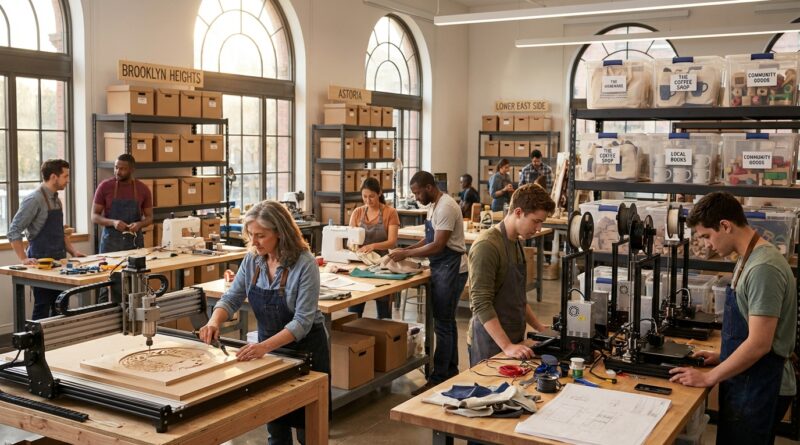
A public makerspace can also be a tiny factory floor. Not a giant one. Not a noisy industrial plant. But a real production space for short runs of useful products made close to home.
Think about what many of these spaces already have. Laser cutters for signs and packaging. Sewing machines for soft goods. Vinyl cutters for labels. Drill presses and hand tools for jigs and assembly. 3D printers for fixtures, prototypes, and custom parts. Computers with design software. Tables for packing and sorting. Sometimes even staff who know how to help people move from idea to repeatable process.
That is enough to make a surprising number of products.
What local makerspace manufacturing actually looks like
This is not about trying to build a car in the public library. It is about picking products that fit the space, the tools, and the staffing.
Good fits for public-space production
Some examples:
- Laser-cut home goods like coasters, organizers, ornaments, and display stands
- Sewn products like aprons, tote bags, pouches, and simple textile goods
- Custom signage for small businesses, events, and neighborhood groups
- Educational kits assembled from cut parts and printed guides
- Small-batch packaging, labels, and branded inserts for local sellers
- 3D-printed accessories, repair parts, jigs, and custom holders
- Short-run merch for schools, nonprofits, and local clubs
The sweet spot is simple, repeatable, low-mess production. You want products that do not need hazardous chemicals, huge storage areas, or highly specialized industrial inspections.
What usually does not fit
Heavy fabrication, large finishing operations, food production, anything with toxic fumes, and products that need strict industrial certification are harder to do in public spaces. That does not mean impossible forever. It just means they are not the best place to start.
Why this matters right now
People are looking for ways to make and sell closer to home. Shipping is unpredictable. Commercial rent is expensive. Buying your own tools before you know if a product will sell is risky.
Public makerspaces lower that risk.
You can prototype without buying a machine. You can test demand with 20 units instead of 2,000. You can improve the design after each batch. You can also keep more of the work local, which means money goes to nearby suppliers, local helpers, and neighborhood stores instead of disappearing into a distant supply chain.
This shift is already happening in small ways. If you liked the broader trend, From Grandma Hobbies to Neighborhood Micro‑Factories: Why Young Makers Are Quietly Rewiring Local Economies makes the point well. Many communities already have the seeds of local production. They just have not named them that way yet.
How to find the makerspaces hiding in plain sight
Most people search for “makerspace” and stop there. That misses half the map.
Check these places first
- Public libraries, especially main branches and newer branches
- Community colleges and adult education centers
- Public high schools with career and technical education labs
- Parks and recreation facilities
- Community centers and nonprofit incubators
- Arts centers with digital fabrication tools
- Workforce development programs
Some spaces are public in practice even if they are not marketed that way. A school lab may open after hours. A library may call it an innovation lab, media lab, or fabrication studio. A community college may offer access through continuing education instead of a public membership.
Questions to ask before you get excited
- What machines are available, and which ones can regular users access?
- What training or certification is required?
- Are there limits on commercial use?
- Can materials be stored on site?
- What are the open hours?
- Is staff available during production time?
- How far ahead do you need to book machines?
- What file formats and materials do they accept?
- Can a small group reserve time together?
Those answers matter more than the glossy website photos.
How to turn “open shop” into a micro-production run
This is where the idea becomes real. A lot of people use public shops one item at a time. That is fine for learning. It is not enough for building a small manufacturing flow.
To make local makerspace manufacturing work, think in stages.
1. Pick one product, not five
Start with the thing you can explain in one sentence. Example: “A laser-cut countertop sign for neighborhood cafes.” Or, “A waxed canvas tool pouch for bike commuters.”
If your idea needs a five-minute explanation, narrow it down.
2. Design for the room you actually have
Do not design for some future dream shop. Design for the tools available this month.
If the library has a laser cutter and a vinyl cutter but no paint booth, make a product that looks good without sprayed finishes. If the school lab has industrial sewing machines but limited cutting space, use templates and pre-cut material kits.
3. Build a repeatable process
Write down every step. Seriously. Make a simple checklist.
- File setup
- Material prep
- Machine settings
- Assembly order
- Quality check
- Packing and labeling
This turns a one-off project into a process another person can follow.
4. Separate machine time from assembly time
The expensive part is usually access to the machine, not the hand assembly. Cut all your parts in one block. Then move to a table for sanding, folding, stitching, labeling, or packing.
That keeps machine bookings short and makes shared-space staff much happier.
5. Test a tiny batch first
Make 10 to 25 units. Sell them. Give a few away for feedback. See what breaks, what confuses people, and what takes too long to produce.
Then change the design before you make more.
The fastest path from idea to sellable item
If your budget is tight, speed matters. You need proof that someone will pay for the product before you spend much money.
A practical four-week plan
Week 1: Find three spaces. Tour them. Ask about training, scheduling, and commercial-use rules. Pick one starter product.
Week 2: Make your prototype. Time every step. Get feedback from five people who might actually buy it.
Week 3: Make a small run of 10 to 25 units. Create a simple label, price, and packaging plan.
Week 4: Sell through one channel. That could be a local shop, school event, weekend market, Instagram preorder, or neighborhood newsletter.
At the end of that month, you know something important. Not whether you have built the next giant brand. Just whether the product works, whether buyers care, and whether the production setup is realistic.
How to work with librarians, teachers, and public staff without driving them crazy
This part is huge. Public makerspaces live or die on trust. Staff are trying to serve lots of people, not just one business idea.
If you want support, make your project easy to say yes to.
What staff want to hear
- Your process is safe and documented
- You understand the training rules
- You are not asking to monopolize the whole room
- Your project could help the space show community impact
- You are open to teaching others what you learn
That last one matters a lot. Public facilities often need a clear story when they ask for funding. If your production run creates jobs, teaches skills, supports local sellers, or helps student interns gain experience, you are giving them a story they can bring to city officials and school boards.
A better way to make the ask
Instead of saying, “Can I use your space for my business?” try this:
“I have a small product idea that fits your tools and safety rules. I want to test a short run, document the workflow, and see if it could become a repeatable local production project that also shows the value of this space.”
That sounds more like a partnership and less like a takeover. Because it is.
The hidden power of group production nights
One person using a public shop is nice. A coordinated team is better.
Picture a weekly production night. One person runs the laser cutter. Another handles sanding and assembly. Someone else applies labels and checks orders. A student helps with inventory. A local librarian tracks machine usage data. A teacher sees a work-based learning opportunity. Suddenly, what looked like a hobby meetup starts acting like a small manufacturing cell.
That is how casual access turns into infrastructure.
What a good micro-production session needs
- A clear product and version number
- Pre-approved materials
- One shared quality standard
- Simple job roles
- A production log
- Cleanup built into the schedule
You do not need perfection. You need enough order that the next session is smoother than the last one.
Common mistakes that slow everything down
Trying to copy factory logic too soon
You are not competing with a giant overseas plant on day one. You are proving that short, local runs have their own advantages. Speed, customization, low minimums, and direct community ties are your edge.
Picking a product with too many steps
If one item needs six machines, three glue types, and a curing shelf, it is probably the wrong first product.
Ignoring the policy side
Some spaces allow commercial work. Some do not. Some allow it only in limited ways. Ask early.
Forgetting storage and transport
Even tiny production runs create piles of stuff. Raw material. Finished goods. Scrap. Packaging. Figure out where it all goes before batch one.
Skipping the boring paperwork
Track costs. Track machine time. Track defects. The notes you hate taking are the ones that show whether this can grow.
What local officials should notice here
If you are a city staffer, librarian, school administrator, or economic development person reading this, here is the important part. You may already own the buildings, tools, and public trust needed for a lightweight manufacturing network. You do not always need a flashy new innovation center. Sometimes you need better scheduling, small materials budgets, clearer rules on commercial use, and a way for local makers to find one another.
That is a much cheaper starting point.
A half-empty makerspace is not just an underused room. It may be a missing piece of the local economy.
At a Glance: Comparison
| Feature/Aspect | Details | Verdict |
|---|---|---|
| Startup cost | Public makerspaces let you use shared tools, training, and work tables instead of buying equipment upfront. | Best for testing products on a tight budget. |
| Production scale | Works well for prototypes, custom jobs, and small batches. Less ideal for large, nonstop output. | Great for 10 to 200 units, depending on the product. |
| Community impact | Supports local jobs, skill building, school partnerships, and neighborhood spending close to home. | Strong long-term value if the space is organized and used consistently. |
Conclusion
There is a simple idea at the center of all this. The buildings your community already owns can do more than host classes and occasional workshops. They can help people make real goods, test real demand, and build real local income. Interest in makerspaces is rising again because people want affordable ways to manufacture close to home. The missed opportunity is that many towns still treat these places as side attractions instead of permanent production infrastructure. If you map the spaces around you, match one product to the tools on hand, and organize small, repeatable production sessions, you can get from idea to sellable item in weeks, not years. That is the practical promise of local makerspace manufacturing. It helps money stay on the block, gives public spaces a stronger reason to exist, and shows that neighborhood-scale manufacturing does not always need a new building. Sometimes it just needs a library card, a sign-up sheet, and a plan.