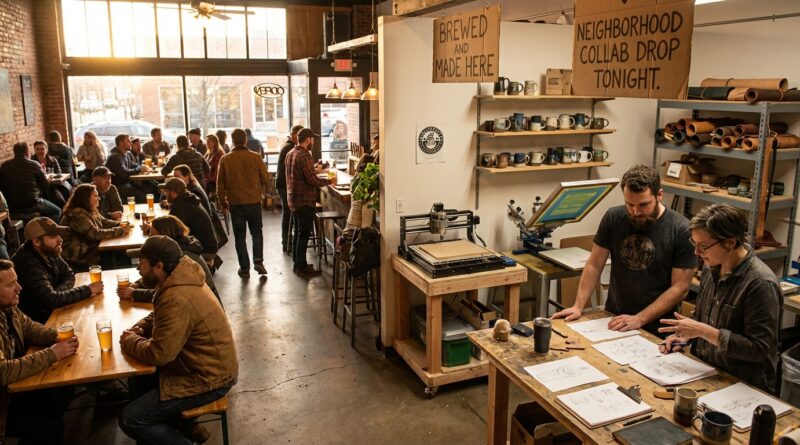
From Taproom To Toolroom: How Local Breweries Are Quietly Becoming Micro‑Manufacturing Labs
Plenty of neighborhood breweries and coffee roasters are tired of hearing the same advice. Post more. Film more reels. Tell a better story. That gets old fast, especially when you are already working long hours just to keep the doors open. The harder truth is that attention is expensive now. What many local shops need is not another marketing trick. They need something useful, visible, and hard to copy.
That is where a local brewery collaboration with makers and hyper local manufacturing starts to get interesting. The back room, side lot, or event space can become more than storage or overflow seating. It can become a tiny production hub. Think limited-run ceramic mugs made on site, screen-printed tote bags during a weekend release, custom leather coasters stamped while customers wait, or spice blends and snacks packed with a nearby food maker. These are not gimmicks. They are real products, made close to home, sold with a story people can actually see.
⚡ In a Hurry? Key Takeaways
- A brewery or café can stand out by turning part of its space into a small local production hub with nearby makers.
- Start with one simple collaboration, like custom mugs, printed merch, or packaged foods tied to a release or event.
- Keep it practical. Check permits, food safety rules, insurance, and workflow so the fun idea does not create a messy back-room problem.
Why “just do more marketing” is failing local shops
Most small businesses are not losing because they forgot to post on Instagram. They are losing because everyone is fighting for the same attention in the same apps, with less reach and higher costs.
A local brewery cannot outspend a national beverage brand. A neighborhood roaster cannot beat a huge online retailer on price, shipping, and ad targeting. But they can do something bigger brands struggle to fake. They can make the block feel alive.
That is the real opening here. If the brewery becomes a place where products are not only sold but also made with local partners, it stops being just another stop for drinks. It becomes part taproom, part showroom, part toolroom.
What hyper-local manufacturing actually looks like
Do not picture a giant factory. Picture a smart use of spare space, slow hours, and nearby talent.
Simple examples that fit real neighborhoods
A brewery teams up with a ceramicist to make handmade steins for a seasonal release. A coffee roaster works with a local woodworker to produce small batch pour-over stands. A print shop brings in portable gear for live shirt printing during launch nights. A leatherworker stamps notebook covers or coasters with the shop logo and the street name.
Now the business is selling a drink, yes. But it is also selling a local object with a reason to exist. Something people can pick up, gift, or collect.
Why this works better than generic merch
Generic merch is often ordered from far away, in bulk, and disconnected from the neighborhood. It can still sell, but it rarely builds deep loyalty.
By contrast, a local brewery collaboration with makers and hyper local manufacturing gives customers a stronger reason to care. They can meet the person who made the item. They can watch part of the process. They know their money is staying close to home. That changes the emotional value of the purchase.
The business case is stronger than it looks
This is not just about making the place feel cool. It can create several practical wins at once.
New revenue without adding another full product line alone
If you partner with a ceramicist, food maker, or printer, you do not have to become an expert in ceramics, snacks, or apparel overnight. You share the effort. Each side brings what it already does well.
The brewery brings foot traffic, a trusted local brand, and a venue. The maker brings production skills, tools, and products. Both can share revenue while keeping startup costs lower than building something from scratch alone.
Built-in reasons for repeat visits
People return for limited runs. They return for live demos. They return because the second Saturday of every month now means “maker night” at the brewery. That is much stickier than hoping they remember your latest social post.
A stronger moat against copycats
Anyone can copy a beer style or a coffee drink. It is much harder to copy a neighborhood network. If your taproom has real ties with the local print shop, potter, baker, illustrator, and bike mechanic, that is not easy for a chain to clone.
How to start without turning your back room into chaos
This is where good ideas often wobble. The goal is not to cram five side businesses into one crowded corner and hope for the best. Start small.
Step 1: Pick one maker and one product
Choose a collaboration that makes sense with your brand and your physical space. A brewery with lots of event traffic might start with live screen-printing. A roaster with a design-forward crowd might start with handmade cups. A spot known for gift traffic might try packaged treats or candles.
One partner. One product. One event window. That is enough to test demand.
Step 2: Use dead space and dead times
Look for underused corners, storage areas that can be reorganized, patios, or slow weekday hours. You do not need a permanent production wing on day one. Pop-up manufacturing is often a better fit.
Step 3: Make the process visible
The point is not just the product. It is the fact that neighbors can see where it comes from. A live stamp press, a small pottery demo, hand-labeling, packing, or custom printing creates a real-world moment that online stores cannot match.
Step 4: Set clear rules before money gets weird
Decide who pays for materials, who owns unsold inventory, how revenue is split, who handles refunds, and what happens if demand is higher than expected. Friendly partnerships still need clear paperwork.
What kinds of makers are best partners?
Look for businesses that already make small batches, can work flexibly, and fit the vibe of your customers.
- Ceramicists for mugs, steins, pour-over sets, or serving pieces
- Leatherworkers for coasters, keychains, menu covers, or bottle carriers
- Print shops for live poster runs, shirts, tote bags, and labels
- Small-batch food producers for sauces, spice rubs, pickles, chocolate, or snacks
- Woodworkers for tap handles, trays, gift boxes, or display pieces
- Illustrators and letterpress studios for prints, cards, and limited packaging
The best partner is usually not the fanciest one. It is the one who can show up, make a good thing, and work well with customers and staff.
What to watch out for before you start
This idea is exciting, but it still has to survive real-world details.
Permits and safety
If food is involved, check local health rules. If tools or heat are involved, check fire safety, ventilation, and insurance coverage. If alcohol is being sold nearby, think through customer flow and risk. A fun maker event should not block exits, crowd service areas, or create liability surprises.
Staff overload
Your bartenders or counter staff should not suddenly become event managers, inventory clerks, and production assistants unless that is planned and paid for. Keep roles clear. If needed, have the maker handle their own setup, sales support, and cleanup.
Bad fit products
Not every product belongs in every space. Something fragile, messy, loud, or slow to produce may frustrate customers and staff. Choose items that fit the setting and can handle retail traffic.
The smartest version of this idea is local, not random
This is where many collaborations either click or flop. Slapping a logo on a mug is not enough. The product should connect to the place.
Use neighborhood references. Street names. Local ingredients. A known building silhouette. A seasonal event tied to the block. Maybe the coffee bags are packed with artwork from a nearby illustrator. Maybe the brewery releases a porter and a local chocolatier makes a matching bar that weekend, packed on site.
When people feel that a product could only come from this one corner of town, it gets harder to replace with a cheaper online option.
Why customers respond so strongly to “made within walking distance”
People are tired of buying things that feel anonymous. They want useful products, but they also want proof that their neighborhood still makes things.
There is a big difference between “we sell tote bags” and “the print shop three blocks over prints these during our Friday night release.” One is merchandise. The other is local memory in object form.
That is what gives this model staying power. It turns buying into participation.
How to measure if it is working
Do not judge success by likes alone. Watch the numbers that matter.
- Average spend per customer on collaboration days
- Repeat visits tied to maker events or limited runs
- Sell-through rate on local products
- Email signups or loyalty signups during events
- How many first-time visitors come because of the maker, not the drink menu
- How often collaboration customers return for core products later
If a collab gets people in the door, raises basket size, and brings them back next month, that is not side noise. That is strategy.
At a Glance: Comparison
| Feature/Aspect | Details | Verdict |
|---|---|---|
| Traditional marketing push | More posts, more ads, more content pressure, often with rising costs and weak local differentiation. | Useful support tool, but rarely enough on its own. |
| Local maker collaboration | Shared products, events, and production with nearby ceramicists, printers, leatherworkers, or food makers. | Best starting point for standout identity and community loyalty. |
| Hyper-local manufacturing model | Uses on-site or semi-on-site production to create limited goods, visible process, and neighborhood-driven revenue streams. | Strong long-term play if permits, staffing, and logistics are handled well. |
Conclusion
Local shops do not need to win the internet to stay relevant. They need to matter more to the people already nearby. That is why this idea matters right now. The cost of staying visible keeps rising, while hyper-local loyalty is becoming one of the few advantages that lasts. A brewery or café that works with leatherworkers, print shops, ceramicists, or small-batch food producers can create products and events that no distant warehouse can copy. Done well, a local brewery collaboration with makers and hyper local manufacturing creates new income, gives neighbors a reason to come back, and keeps more money moving around the same few blocks. That is not just smart branding. It is community infrastructure in plain clothes.