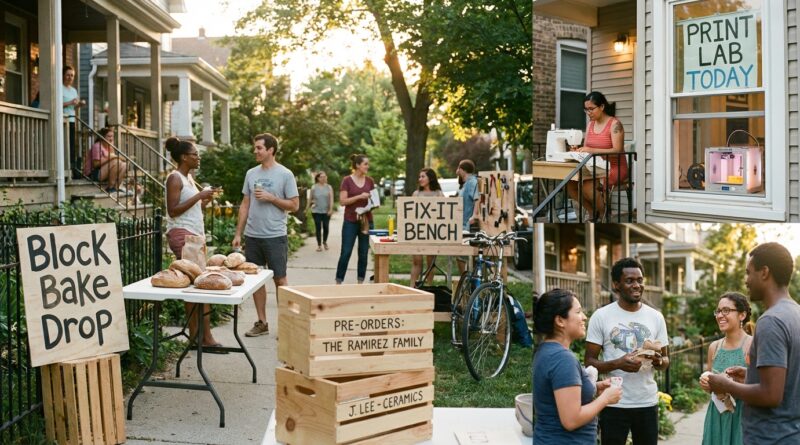
How One Street Can Become Its Own Mini‑Factory: The Rise of Block‑Level Making
If you make candles, bread, prints, soaps, repairs, sewn goods, or small wood items, you already know the problem. Craft fairs are expensive and exhausting. Online marketplaces promise reach, then bury your work under sponsored listings and mystery algorithms. Meanwhile, the people living ten doors down keep saying they want to buy local, but they usually do not know who on the block is actually making anything. That gap is where hyper local block level manufacturing starts to make sense. It is not a giant factory story. It is one street acting like a tiny, organized production zone. One home bakes. Another does mending. Another laser cuts tags. Another handles pickup hours on Fridays. Done right, a block becomes a mini-factory for small batches, everyday essentials, and thoughtful gifts, without huge rent, heavy staffing, or the stress of chasing strangers online.
⚡ In a Hurry? Key Takeaways
- Hyper local block level manufacturing means neighbors making and selling small batches within walking distance, using simple coordination instead of big overhead.
- Start with one block, three makers, one order form, and one weekly pickup window. Keep it boring and repeatable.
- Check local zoning, food, safety, and home-business rules first. The goal is low friction, not cutting corners.
What “block-level making” actually means
Think smaller than a storefront and more organized than a hobby table.
A block-level mini-factory is a loose network of nearby makers who each do one thing well and sell to nearby buyers on a regular schedule. It could be as simple as:
- one neighbor making granola or bread
- one doing clothing repairs and hemming
- one printing cards, labels, or gift tags
- one assembling gift bundles for birthdays or holidays
- one hosting a porch pickup shelf every Saturday
That is the heart of hyper local block level manufacturing. Not mass production. Small, useful, steady production close to the people who need it.
Why this model is showing up now
Because the old options are wearing people out.
Makers need lower overhead
Many local sellers do not need a full retail lease. They need a reliable way to move 10, 20, or 50 units a week without paying festival fees, shipping costs, or ad budgets.
Neighbors want convenience, not just good intentions
People like the idea of shopping local. But most will not hunt through five Instagram pages, three group chats, and a once-a-month market calendar just to buy soap or a birthday gift.
They want one simple habit. Order on Wednesday. Pick up on Friday. Done.
Streets already have the pieces
One person has tools. Another has time in the mornings. Another has a garage workspace. Another is great at organizing orders. What has been missing is not talent. It is coordination.
That is part of the shift described in From Grandma Hobbies to Neighborhood Micro-Factories: Why Young Makers Are Quietly Rewiring Local Economies. The big change is not that people suddenly started making things. It is that they are starting to treat small making like a local system instead of a personal side hustle.
How one street becomes its own mini-factory
You do not need fancy software or a business incubator. You need a repeatable loop.
Step 1: Pick a narrow product mix
Do not launch with 40 products. Start with a small list people can understand at a glance.
Good early categories include:
- bread, cookies, preserves, or meal add-ons where allowed
- candles, soaps, bath salts, or cleaning refills
- hemming, patching, sharpening, or simple repair services
- cards, gift wrap, seasonal decor, and small housewares
The rule is simple. Easy to explain. Easy to fulfill. Easy to repeat.
Step 2: Set one order day and one pickup day
This is where many local selling efforts fall apart. They stay too casual. A block-level system works better when it acts like a tiny utility.
Example:
- Orders close every Wednesday at 8 p.m.
- Makers produce Thursday
- Pickup happens Friday from 5 to 7 p.m. at one porch or driveway table
People remember routines. They forget random pop-ups.
Step 3: Give everyone one place to browse
Not seven separate links. One simple page, form, or neighborhood bulletin with:
- what is available this week
- who made it
- price
- pickup time
- how to pay
This can be a basic order form, a neighborhood email, or a tiny shared storefront page. It does not need to be fancy. It needs to be clear.
Step 4: Divide roles quietly
One person does not have to do everything.
- Makers make
- One organizer collects orders
- One host manages pickup
- One person handles signs or weekly reminders
That small split is what turns scattered side projects into hyper local block level manufacturing.
Why this works better than a craft fair for many people
Craft fairs have their place. They can be fun, social, and great for exposure. But they are also noisy, weather-dependent, and often expensive.
Less waiting, more predictability
At a fair, you hope the right buyers walk by. On a block-level model, buyers already live nearby and know when ordering opens.
Less display theater
You do not need an elaborate booth, banner set, folding walls, and a six-hour smile. A clean order list and reliable pickup can do more for repeat business.
More repeat customers
A passerby might buy once. A neighbor who likes your bread, candles, or repair work might buy every month.
What neighbors get out of it
This is not only good for makers.
Neighbors get something most “shop local” campaigns fail to provide. Actual access.
Reliable local sources
When the same street regularly offers soap refills, fresh bread, mending, gifts, or simple repairs, local buying stops being a feel-good extra and starts becoming a normal habit.
Shorter supply lines
If a gift, household item, or service can come from two houses down, that is a very different supply chain than ordering from a warehouse three states away.
More trust
People are often more comfortable buying food, gifts, or repair help from someone they can meet at pickup and talk to face to face.
What makers should watch out for
This model is simple. It is not magic.
Do not oversell your capacity
If you can make 12 loaves, list 12 loaves. If you can do 8 repair jobs a week, stop at 8. Nothing kills neighborhood trust faster than “Sorry, running behind” every single week.
Check local rules first
This matters. Food, cosmetics, candles, electrical goods, and home-based businesses can all have local requirements. Look up:
- cottage food laws
- home occupation permits
- fire and ventilation rules
- noise limits
- labeling requirements
- product safety and liability issues
Quiet, legal, small-batch is the sweet spot.
Be honest about quality
Not every hobby is ready for weekly sales. If the product is inconsistent, fix that first. A block-level system works because people begin to count on it.
A simple starter plan for one street
If your neighborhood wants to test this, here is a low-drama version.
Week 1: Find three makers
Pick people making very different things so there is no direct competition. For example, baked goods, repairs, and gifts.
Week 2: Choose one shared pickup point
A porch, driveway table, apartment lobby shelf, or small community room can work, depending on the building and local rules.
Week 3: Run a four-week pilot
Keep the offer tiny. Maybe:
- 2 bread choices
- 3 candle scents
- 5 repair slots
- 1 gift bundle option
Then measure what actually sells.
Week 4: Ask boring questions
Boring is good here.
- What sold out first?
- What confused buyers?
- Was pickup smooth?
- Did any maker get overloaded?
- Should ordering happen every week or every other week?
That is how a block becomes reliable instead of trendy for a month.
At a Glance: Comparison
| Feature/Aspect | Details | Verdict |
|---|---|---|
| Startup cost | Usually far lower than fairs or storefronts. Often just materials, simple ordering, and one pickup setup. | Best for small-batch testing |
| Customer discovery | Neighbors can find makers through one shared schedule instead of hunting across social apps and marketplaces. | Stronger than scattered local selling |
| Scalability and risk | Easy to grow slowly, but only if quality, local rules, and production limits are respected. | Very promising if kept disciplined |
Conclusion
People are tired of cheering for “local” in theory while still buying everything through systems that feel far away and hard to trust. A block-level mini-factory offers something much more useful. It gives makers a practical way to sell small batches with almost no overhead. It gives neighbors a dependable way to buy from people they can actually meet. And it gives one street a quiet lesson in how a real hyper-local supply chain works in daily life. That is the real promise of hyper local block level manufacturing. Not a big slogan. Just a simple, repeatable way to make your own street more useful, more connected, and a little more resilient every week.