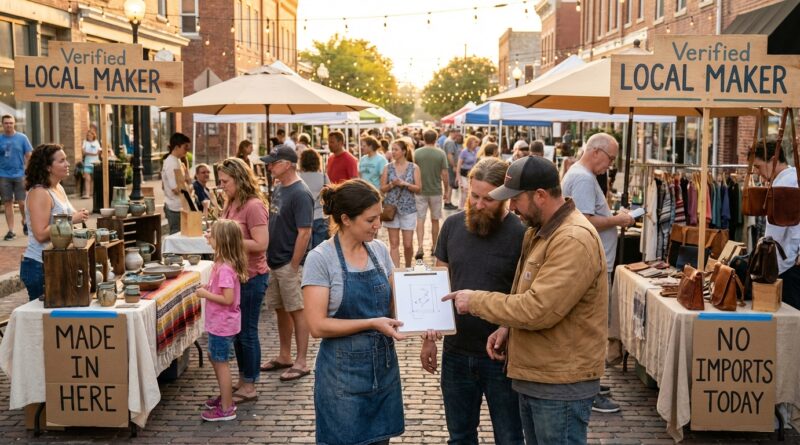
How to Turn Your Local Craft Market Into a True Hyper‑Local Manufacturing Hub
You know the feeling. You walk into a craft market hoping to meet the person who made the candle, mug, bag, or print you are about to buy. Then you start spotting the same jewelry at three booths, or products that look suspiciously like bulk imports with a handwritten “local” sign. Shoppers feel tricked. Real makers get buried. And the people actually designing, sewing, printing, carving, or pouring by hand end up competing with stuff that was never made anywhere near town.
If you want to know how to make local craft markets support real local makers, the answer is not just “ban resellers” and hope for the best. Markets need simple rules, better proof, and a way to connect makers to year-round buyers. When that happens, a weekend fair stops being a cute event and starts acting more like a small local production network. That means better trust for shoppers, steadier income for craftspeople, and more money staying in the neighborhood instead of leaking out to anonymous wholesalers.
⚡ In a Hurry? Key Takeaways
- Local craft markets support real makers best when booths are verified, reseller rules are clear, and shoppers can easily see who actually made the product.
- Start with a simple maker application, studio process check, and public directory so buyers can find vendors after the event.
- Trust is the whole game. Once shoppers believe the market is truly local, real craftspeople can charge fair prices and grow beyond one weekend table.
The real problem is not just resellers
Resellers are part of it, sure. But the bigger issue is that many markets still run like temporary events instead of local business infrastructure.
That sounds fancy, but it is actually simple.
If a market only helps someone sell for six hours on a Saturday, it is useful. If it helps a local ceramicist get wholesale orders from a cafe, a soap maker land a hotel client, or a printmaker connect with a neighborhood gift shop, it becomes something much bigger.
That is when a craft market starts turning into a hyper-local manufacturing hub.
What a hyper-local manufacturing hub actually looks like
Forget the buzzwords. Think of it as a local system where small makers do not just sell to random foot traffic. They also supply nearby homes, shops, cafes, offices, event planners, and community groups.
A candle maker becomes the person a local restaurant calls for holiday gifts. A woodworker starts producing display stands for nearby retailers. A textile artist partners with a small cut-and-sew studio to handle bigger runs without losing quality.
That is the shift. The market becomes the front door, not the whole house.
If you want a practical example of that bigger picture, How to Turn Your Neighborhood Makers Into a Hyper-Local Supply Chain (In 30 Days or Less) lays out how neighborhoods can connect local demand with local production fast.
Start with verified local booth standards
If shoppers cannot tell who is a real maker, trust falls apart. Once that happens, everyone loses.
Use clear vendor categories
Not every seller is the same, and pretending otherwise creates confusion. Markets should label booths with simple categories such as:
- Made by the seller
- Designed locally, produced with small batch partners
- Curated vintage
- Imported or resale goods
This is not about shaming anyone. It is about honesty.
If a shopper wants truly handmade local work, they can find it. If they are fine buying curated goods, that is their choice too. The important part is that the market tells the truth.
Ask for lightweight proof, not a mountain of paperwork
You do not need a full audit team. Most markets can verify makers with a short application that asks for:
- Photos of the workspace
- Photos of work in progress
- A short description of materials and process
- Whether any production steps are outsourced
- The city or neighborhood where the work is made
That one step filters out a lot of fake “local” claims.
Do spot checks instead of acting like the craft police
Organizers do not need to interrogate every vendor. A few random follow-ups each season work well. Ask for updated process photos. Visit a studio open house. Review consistency between the booth and the application.
The goal is not to catch people in a trap. It is to protect the market’s credibility.
Help shoppers see the maker, not just the product
People pay more when they understand what they are buying. They also come back when they remember the person behind the table.
Use booth signage that answers three basic questions
Every booth should make it easy to see:
- Who made this?
- Where was it made?
- How was it made?
A small sign saying “Hand-thrown in East River by Ana. Fired in small batches twice a month” does more work than a generic brand card ever will.
Add QR codes to maker profiles
This is one of those low-tech, high-payoff fixes. Give each verified booth a QR code linking to a simple online profile with photos, product categories, contact details, and upcoming dates.
That way, the relationship does not end when the folding tables come down.
Shoppers can reorder later. Local stores can reach out. Event planners can save favorite vendors. Suddenly the market is feeding business all year.
Build a simple local maker directory
This may be the most overlooked move of all.
A market that ends at 4 p.m. is just an event. A market with a searchable maker directory becomes local infrastructure.
What to include
Keep it basic and useful:
- Maker name
- Neighborhood or city
- Product type
- Custom order options
- Wholesale availability
- Business contact info
- Links to website or social accounts
Now a local cafe can find a ceramicist. A realtor can source closing gifts. A school can order awards or teacher presents. A hotel can buy bath products from someone down the street instead of a generic catalog.
Make room for small-batch production partnerships
This is where things get interesting.
Some makers hit a wall. They can produce enough for markets, but not enough for bigger local orders. Others have design talent but need help with packaging, finishing, sewing, laser cutting, printing, or assembly.
That is where small urban manufacturers come in.
Think partnerships, not factory scale
We are not talking about giant industrial contracts. We are talking about local print shops, shared commercial kitchens, small sewing rooms, wood shops, metal shops, and packaging businesses that can help a maker grow without sending production overseas.
A soap maker might use a local label printer. A bag designer might use a nearby cut-and-sew partner for consistent stitching. A ceramicist might work with a local fulfillment partner during the holidays.
That keeps the business local while making it easier to take on larger orders.
Host a maker-to-manufacturer meet-up
One practical idea. Have market organizers host a short mixer once a quarter where makers meet local service providers and small producers.
Invite:
- Print shops
- Packaging suppliers
- Small batch food producers
- Sewing studios
- Wood and metal shops
- Local business lenders
- Bookkeepers and insurance agents
That is how a market starts turning into an ecosystem instead of a one-day sales opportunity.
Give real makers better ways to stand out
Many genuine craftspeople are not losing because their work is weak. They are losing because knockoffs are simpler to understand and often cheaper at first glance.
Create a “Verified Local Maker” mark
A simple badge on booth signs, maps, and online listings helps shoppers quickly spot businesses that meet your rules for local production.
Keep the standard clear. If someone designs locally but produces elsewhere at scale, say so. If someone hand makes in town, say that too. The point is to make differences visible.
Feature process, not just finished goods
People love seeing how things are made. It builds trust fast.
Offer live demos where possible. Pottery trimming. Block printing. Leather finishing. Screen printing. Candle pouring. Even short “meet the maker” cards with process photos help.
Once shoppers see the labor and skill involved, price starts making more sense.
Help makers earn money beyond the market day
A healthy local craft market should help vendors make sales after the fair, not just during it.
Set up business buyer hours
Consider a first-hour preview for local businesses, interior designers, event planners, and independent retailers. Let them browse before the crowd and talk to makers about custom or repeat orders.
This can be a game changer for vendors who want bigger, steadier income.
Bundle local makers for group sales
Not every buyer wants to source from ten separate people. Make it easier.
Put together themed local bundles like:
- Welcome-to-the-neighborhood gift boxes
- Corporate holiday gifts
- Cafe tabletop packages
- Wedding favor collections
- Hotel room amenity sets
This is one of the easiest ways to answer the question of how to make local craft markets support real local makers. Stop asking every maker to sell alone. Let the market package local talent into offers that larger buyers can actually use.
Make pricing less awkward for real craftspeople
One reason genuine makers struggle is that they are compared side by side with cheap imports dressed up as handmade goods.
That is brutal.
Teach shoppers what they are paying for
Markets can use signs and social posts to explain fair pricing in plain English. Materials. Time. Skill. Rent. Equipment. Small batch production. Local wages.
You do not need a lecture. Just a few honest reminders.
When buyers understand that a hand-printed tea towel is not competing with a factory pack of ten, they make better decisions.
Offer vendor workshops on wholesale and margins
Some makers underprice badly because they are thinking like hobbyists, not business owners. A short workshop on pricing, repeat orders, packaging, and minimums can make a huge difference.
Better pricing means better survival odds. Better survival odds mean more real local production stays alive.
Keep the rules simple and public
If market standards live only in private emails, confusion is guaranteed.
Post the rules where shoppers can see them
Put them on the website. Put them at the entrance. Put them in vendor materials.
Spell out:
- What counts as handmade
- What counts as locally made
- What must be disclosed about outsourcing
- Whether resellers are allowed, and if so, how they are labeled
Transparency calms everyone down. It also makes enforcement feel fair instead of arbitrary.
What residents can do, even if they do not run the market
You do not have to be an organizer to improve things.
Ask friendly questions
Try questions like:
- Did you make this yourself?
- Where is it produced?
- Do you take custom or local wholesale orders?
Real makers usually love answering. Fake local sellers tend to get vague fast.
Support the people who show their process
If someone is transparent about materials, method, and place, reward that. Buy from them. Follow them. Recommend them. Leave reviews. That kind of support matters more than people think.
Push for a better market, not just a bigger one
Attendance numbers are nice. Trust is better.
If your local market is filling with generic stuff, tell organizers you want verified local categories, maker profiles, and year-round directories. Those changes are realistic. They do not require a giant budget.
At a Glance: Comparison
| Feature/Aspect | Details | Verdict |
|---|---|---|
| Verified local booths | Uses simple proof like process photos, workspace info, and clear vendor categories. | Best first step for rebuilding shopper trust. |
| Public maker directory | Lets shoppers and local businesses find makers after the event for repeat, custom, and wholesale orders. | Turns a one-day market into a year-round sales channel. |
| Partnerships with small urban manufacturers | Helps makers handle bigger orders through local printing, sewing, packaging, or fabrication partners. | Strongest path from side hustle to stable local business. |
Conclusion
Local craft markets can do a lot more than host nice weekends. When they verify who is truly making the goods, help shoppers find those makers later, and connect craftspeople with small local production partners, they start building a real neighborhood economy. That matters right now. Interest in local and sustainable products is rising, but trust disappears fast when markets are packed with mass-produced knockoffs. The fix is not complicated. Organize for verified local booths, create simple maker directories, and support practical partnerships that help makers grow. Do that, and more money stays close to home, genuine craftspeople get protected, and seasonal markets can grow into reliable income engines and job creators.