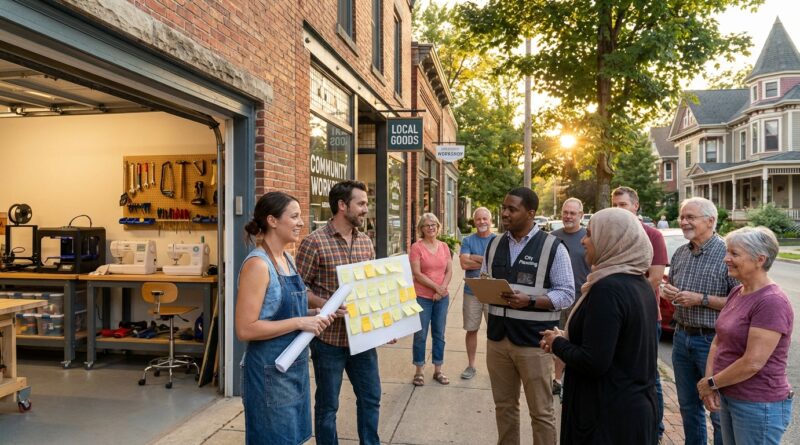
When Zoning Laws Meet Home Workshops: How Neighborhood Rules Are Quietly Deciding The Future Of Hyper‑Local Making
You can do everything right, buy the right tools, keep the noise down, and still get stopped by a rule buried in a city code PDF from 1987. That is the maddening part for people building small workshops at home or in tiny neighborhood spaces. One person is repairing bikes in a garage. Another is making soaps in a spare room. Someone else is running a laser cutter in a back unit. These are not giant factories. But many zoning rules still treat making things as if it automatically means smokestacks, truck traffic, and industrial nuisance. While big tech campuses and data centers soak up land and attention, local councils are quietly deciding whether small makers will have room to exist at all. If you want to protect space for hyper-local production, the good news is you do not need to become a planning lawyer first. You just need to know where to look, what to ask, and how to show up.
⚡ In a Hurry? Key Takeaways
- Zoning rules for home based manufacturing and local makers often decide whether a garage workshop, studio, or micro-factory is legal long before business demand does.
- Start by checking your city’s zoning map, home occupation rules, noise limits, parking rules, and permit language for words like “customary,” “incidental,” “retail,” and “light industrial.”
- The safest path is to ask for small, specific allowances like limited equipment, capped deliveries, and clear hours, instead of a broad “anything goes” change that scares neighbors and gets rejected.
Why this fight is suddenly everywhere
For years, small-scale making survived in the gaps. A garage woodshop here. A backyard ceramics kiln there. A corner storefront doing repairs, printing, sewing, or food prep. Cities often ignored it until a complaint came in.
Now the gaps are shrinking. Industrial land is expensive. Commercial rents are rough. And when cities update zoning, they often focus on large employers, housing targets, warehouse logistics, and headline-grabbing projects. Small makers can get left out simply because nobody wrote them into the rules clearly.
That means the future of neighborhood production is often being decided in dry planning documents, not in public speeches. If that sounds boring, fair enough. It is also where the real decisions happen.
This is one reason pieces like How One Street Can Become Its Own Mini‑Factory: The Rise of Block‑Level Making matter. The idea is simple. A street full of tiny producers can act like a local manufacturing network. But it only works if the rules allow those businesses to exist close to where people live.
What zoning is really doing to home workshops
Zoning does not just answer, “Can I run a business here?” It quietly answers a bunch of smaller questions that matter just as much.
Use category
Your workshop may be legal or illegal based on the label the city gives it. Is it a home occupation? Artisan manufacturing? Light industrial? Repair service? Retail with accessory production? Pick the wrong box and the answer changes fast.
Scale limits
Many cities allow home businesses only if the activity is “incidental” to the home. That sounds harmless until you learn it may limit floor area, employees, equipment, signage, storage, or customer visits.
Impact rules
Noise, vibration, odor, dust, parking, deliveries, outdoor storage, and fire risk often matter more than the product itself. A quiet 3D printer setup may pass. A woodshop with a dust collector and regular van pickups may trigger a different standard.
Building and safety rules
Even if zoning says yes, building code, fire code, health rules, and electrical permit requirements may still say not yet. A lot of makers miss this and assume zoning approval covers everything. It does not.
The big misunderstanding that gets makers in trouble
People hear “home business allowed” and assume that means making products is allowed too. Sometimes it does. Often it means office work, tutoring, consulting, or online sales with minimal onsite activity.
In many places, the line is not between legal and illegal business. It is between low-impact administrative work and physical production. If your city code uses terms like “no visible evidence,” “no mechanical equipment except that customary for domestic use,” or “no change in residential character,” that is where trouble usually starts.
A sewing machine may be fine. A CNC router, curing oven, kiln, commercial mixer, compressor, or welding setup may not be. Not because the city hates makers, necessarily. Usually because the rulebook never got updated for modern small-scale production.
Your plain-English playbook for reading the rules
You do not need to read the entire zoning code. You need a short checklist and a pencil.
1. Find your zoning district
Look up your address on the city’s zoning map. Write down the exact district name. R-1, mixed use, neighborhood commercial, whatever it is. Do not skip this. The same activity can be allowed on one side of the street and banned on the other.
2. Search the code for the right terms
Search for:
home occupation, home business, artisan manufacturing, maker space, light manufacturing, repair, fabrication, studio, cottage industry, live-work, accessory use, performance standards.
If your city does not use maker-friendly language, try old-school terms too. “Handcraft,” “custom manufacturing,” and “small-scale production” can turn up useful sections.
3. Read the definitions first
This is the sneaky part. Definitions control everything. A city may define manufacturing so broadly that candle pouring, jewelry making, and woodworking all count as industrial activity. Another city may carve out artisan production as a lower-impact use. That single definition can make or break a workshop.
4. Highlight the limits, not just the permission
If you see that a use is allowed, keep going. Look for caps on square footage, nonresident employees, customer visits, deliveries, hours, retail sales, and equipment. Those details are the real rule.
5. Check related codes
Zoning is only one layer. Also look for business licensing, fire rules, health department requirements if you make food, and homeowner association rules if they apply. HOAs can be stricter than the city.
What a low-friction opportunity looks like
If you want to start or expand without years of hearings, look for the paths that create the least fear.
Best bets for home-based setups
Quiet, low-odor, low-traffic production tends to have the best chance. Think sewing, printmaking, small electronics repair, jewelry work, light assembly, bike repair, design-to-production workflows, or desktop fabrication with good ventilation and safety controls.
Best bets for tiny storefronts
Neighborhood commercial zones often have more room for mixed retail and production than residential zones do. A small front-of-house showroom with limited back-room making can fit more easily than a fully hidden home workshop.
Best bets for policy change
Ask for narrow categories the city can define clearly. “Artisan manufacturing under X square feet, with no outdoor storage, limited deliveries, and posted operating hours” is much easier for councils to approve than a vague request to legalize manufacturing in neighborhoods.
How to talk to city staff without getting brushed off
Be specific. Planning staff are used to broad, nervous questions like, “Can I run a business from home?” That is too fuzzy to answer well.
Try this instead:
“I make custom lamps in a 200-square-foot garage workshop. No retail visits. One employee, me. One van pickup twice a week. Daytime hours only. Are there home occupation or artisan production rules that fit this?”
That does two useful things. It shows you understand impacts, and it gives staff something concrete to compare against the code.
Bring the facts they care about
Have a one-page summary ready:
- What you make
- Where the work happens
- Tools and power needs
- Noise and odor controls
- Delivery frequency
- Customer visits, if any
- Hours of operation
- Waste handling and safety measures
That simple sheet can save you weeks of back-and-forth.
What to ask for if the current rules do not fit
This is where people often go wrong. They ask for total freedom. Councils hear “future nuisance problem” and shut down. A better move is to ask for practical, bounded changes.
Good, realistic asks
- Create an “artisan manufacturing” category for low-impact production
- Allow home-based making up to a set floor area
- Allow limited accessory retail tied to goods made onsite
- Permit a small number of pickups or deliveries per week
- Allow modern tools if noise and dust standards are met
- Approve neighborhood maker spaces in underused commercial units
- Add live-work options for people who both make and sell
Even better, offer operating conditions
If you show up with guardrails already in mind, you make it easier for officials to say yes.
- No outdoor storage
- No heavy truck traffic
- Set daytime hours
- Indoor activity only
- Noise and ventilation standards
- Maximum equipment size or horsepower, where relevant
That approach tells neighbors, “We are trying to fit into the block, not take it over.”
Why this matters more now than five years ago
Because land policy is moving fast. Cities are rezoning around housing, logistics, and large infrastructure. Big projects make headlines. Quiet code edits do not. But one rewrite of industrial land protections, mixed-use allowances, or home occupation language can reshape what is possible for years.
If industrial land gets reserved only for giant users, and residential areas ban even modest production, local makers get squeezed from both sides. They cannot afford traditional industrial space, and they cannot legally work near home either.
That is how a town slowly loses repair shops, print rooms, bakers, metalworkers, furniture makers, and all the tiny production businesses that keep money circulating locally.
How communities can show up effectively this week
You do not need a giant campaign. Start small and concrete.
1. Read the agenda
Check the planning commission and city council agendas for zoning updates, land use code rewrites, and industrial land studies. The key issue may not say “makers” in the title.
2. Bring examples, not slogans
Show three or four real local businesses that need room. Repairs. Small batch goods. Fabrication. Food production where relevant. Officials respond better to visible, local examples than abstract talk.
3. Use impact language
Say what kind of production you support. Low-noise. Low-traffic. Indoor. Limited scale. That lowers resistance.
4. Ask for a pilot or overlay
If the city is hesitant, suggest a pilot area, temporary permit path, or special small-maker overlay in selected commercial corridors.
5. Put it in writing
Send a short comment letter after the meeting. A spoken comment can disappear. A written request goes into the record.
Common red flags to watch for in proposed rules
These are the phrases that should make you slow down and read carefully.
- “No mechanical equipment other than normal household appliances”
- “No onsite sales or customer visits under any circumstance”
- “No employees or contractors”
- “No deliveries except postal service”
- “No manufacturing of any kind”
- “Use must be invisible from outside,” if your workflow requires pickup, storage, or ventilation equipment
Some of these limits may be reasonable. Some are relics. The point is to catch them before they quietly shut out modern workshop use.
At a Glance: Comparison
| Feature/Aspect | Details | Verdict |
|---|---|---|
| Home occupation rules | Often the easiest legal path, but commonly limited by floor area, equipment, traffic, and visible impact. | Good for quiet micro-making, weak fit for heavier workshop activity. |
| Artisan or light manufacturing category | Can create a clear lane for small production in mixed-use or neighborhood commercial areas with conditions. | Usually the best long-term fix if your city is open to code updates. |
| Variance or special permit | Possible when rules do not fit, but slower, more uncertain, and often tied to one site or one applicant. | Useful as a backup, not ideal as the main solution for local makers. |
Conclusion
The frustrating truth is that zoning rules for home based manufacturing and local makers are shaping the future of small production long before most people notice. And right now, while big tech projects and hyperscale data centers grab the spotlight and consume industrial land, local councils are rewriting the background rules that will either make room for neighborhood workshops or push them out. The good news is that this is still a fight regular people can affect. Read the map. Check the definitions. Look for low-friction openings. Then show up with specific, realistic asks that make sense to staff and neighbors. That is how communities protect room for home-grown workshops instead of watching that room get zoned away. Not someday. This week.