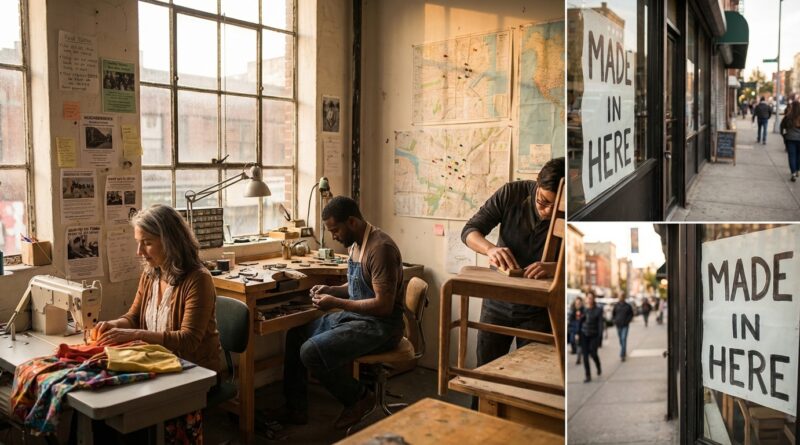
Why Big Brands Are Racing To Look Local And How Real Makers Can Take Back The Story
It is maddening to watch a giant brand slap the word “local” on a label when you are the one actually making things down the street. You know your suppliers by name. Your customers can meet you, email you, or walk into your shop. Then a polished campaign rolls in with pretty photos, a few area landmarks, and a budget bigger than your whole year. Suddenly, the people doing the real work can feel invisible.
Here is the good news. Big brands can borrow the look of local, but they usually cannot copy the proof. If you are wondering how real local makers can compete with fake local marketing, the answer is not to out-shout them. It is to out-show them. Show your hands, your space, your people, your process, and your ties to the neighborhood in ways that are simple, steady, and easy to verify. Real local businesses still have the strongest card in the deck. They are actually here.
⚡ In a Hurry? Key Takeaways
- Big brands can market “local,” but real makers win by proving real roots, real faces, and real accountability.
- Start with plain evidence: who made it, where it was made, where materials came from, and how buyers can reach you.
- That honesty helps customers keep money, skills, and decision-making in the community instead of sending it off to distant systems.
Why big brands suddenly want to look local
Because local sells.
People are tired of faceless products, long supply chains, and companies that only show up in a town when they want attention. Buyers want connection. They want to feel that their money does something close to home.
Big brands know this. So they use local language, local imagery, and local partnerships to look smaller, warmer, and more rooted than they really are.
Sometimes that marketing is partly true. Maybe they source one ingredient from nearby. Maybe they run a pop-up in your city. Maybe they feature a hometown story in an ad. But that is not the same as being a real neighborhood maker whose work, payroll, risk, and reputation live in the same place as the customer.
The problem with fake local marketing
The issue is not just that it feels unfair. It also makes it harder for shoppers to tell the difference between branding and reality.
When every package says “crafted,” “small batch,” “local,” or “community inspired,” those words start losing meaning. That hurts the people who earned them.
A true local maker usually offers things a campaign cannot fake for long:
- Direct accountability
- Real relationships with buyers
- Visible production
- Money that stays nearby
- Local skills and jobs that do not vanish when the ad budget moves on
How real local makers can compete with fake local marketing
1. Replace slogans with proof
Do not just say “local.” Explain it.
Put the facts where people can see them on your packaging, website, market table, and social posts. Keep it short and specific.
- Made in: your town or neighborhood
- Made by: your name, your team, or your family
- Sourced from: named farms, mills, shops, or suppliers when possible
- Available at: your workshop, local market, or nearby stores
“Made three blocks from here” lands harder than “community crafted.” It is concrete. People trust concrete.
2. Show the process, even if it is not polished
You do not need a glossy video team. A simple phone video is often better because it feels real.
Show what you are making. Show your tools. Show the mess. Show the fix when something goes wrong. Show the stack of boxes ready for pickup. Let people see the actual work.
Big companies are good at image. Small makers are good at evidence. Use that.
3. Make your story easy to repeat
Many shoppers want to support local businesses. They just need a simple way to explain why yours matters.
Create a one-sentence story that customers can remember and share.
Examples:
- “We make all our candles in the old bakery building on Maple Street.”
- “Every table is built here in town using wood milled within 40 miles.”
- “We roast in-house twice a week, and you can smell it from the sidewalk.”
If your story is easy to say, your customers become your marketing team.
4. Turn proximity into a real benefit
Being nearby is not just a nice feeling. It is useful.
Tell people what they get because you are close:
- Faster pickup
- Easier returns or repairs
- Custom orders
- Face-to-face service
- Seasonal items that do not sit in warehouses for months
This moves the conversation from vague values to practical benefits.
What customers actually want from “local”
Most people are not asking for a perfect purity test. They are asking, “Can I trust this?”
That means they want clear answers to basic questions:
- Who made it?
- Where was it made?
- Who benefits when I buy it?
- If there is a problem, can I reach a real person?
Real makers usually have much better answers than bigger brands. The mistake is assuming customers will somehow figure that out on their own. You have to spell it out.
Simple ways to stand out without a giant budget
Use signs that explain, not just decorate
At markets, in stores, and online, use plain language. Instead of a fancy tagline, try a small sign that says:
“Designed, made, and packed in this town. Ask us how.”
That invites a conversation. Conversations build trust.
Put your face next to the product
People trust people more than logos. Add a photo of the maker, not just the item. A quick “Hi, I’m Sam, I make these in my garage workshop in Southside” can do more than a dozen polished ads.
Invite people in
If possible, offer studio visits, open workshop hours, tasting days, demo nights, or pickup windows where buyers can see the work in person. The shortest supply chain is one your customer can literally walk through.
Use customer language, not industry language
Skip buzzwords. Say what you mean.
Not “heritage-inspired fabrication.” Say “we sew these bags here, one at a time.”
Not “regionally informed ingredients.” Say “the honey comes from two beekeepers outside town.”
Do not fight on every front
You do not need to copy the big brand playbook. That is a losing game. You probably cannot outspend them on ads, packaging, or influencer deals.
So pick the places where being small is a strength:
- Trust
- Visibility
- Speed
- Customization
- Community ties
That is where the real edge is.
How to answer the “But they’re cheaper” problem
This comes up all the time, and it is a fair question.
When a mass brand uses local-style marketing and lower prices, some buyers will choose the cheaper option. Not everyone is your customer. That is okay.
Your job is to help the right customers understand what your price includes:
- Fair pay close to home
- Smaller runs with more care
- Real access to the maker
- Less distance between production and purchase
- Money recirculating in the local economy
You are not just selling an object. You are selling an honest chain of responsibility.
Build local proof together, not alone
One of the smartest moves small makers can make is teaming up.
Create neighborhood maps, shared market days, open studio trails, and cross-promotions with other real producers. If customers can visit three or four genuine makers in one afternoon, the difference between true local work and ad-driven local styling becomes obvious fast.
A single small shop can be ignored. A visible local network is much harder to overlook.
At a Glance: Comparison
| Feature/Aspect | Details | Verdict |
|---|---|---|
| “Local” claim | Big brands often use broad wording. Real makers can give names, places, and faces. | Specific proof wins trust. |
| Customer connection | Large companies rely on campaigns. Local makers can offer direct contact, visits, and real conversations. | Human access is a major advantage. |
| Community impact | A true local business keeps more money, skills, and decisions rooted in the area. | This is where real local work clearly stands apart. |
Conclusion
Real local makers do not need to invent authenticity. They need to make it visible. If you are frustrated by faux-local marketing, that frustration makes sense. But the answer is not trying to sound bigger. It is sounding clearer, showing more proof, and reminding neighbors that the most honest, accountable supply chain they have is the one they can walk to. That matters right now. It keeps real money, real skills, and real decision-making anchored in the places people actually live, instead of sending them off to distant ad servers and logistics centers. Keep showing the work. The truth is still your strongest selling point.