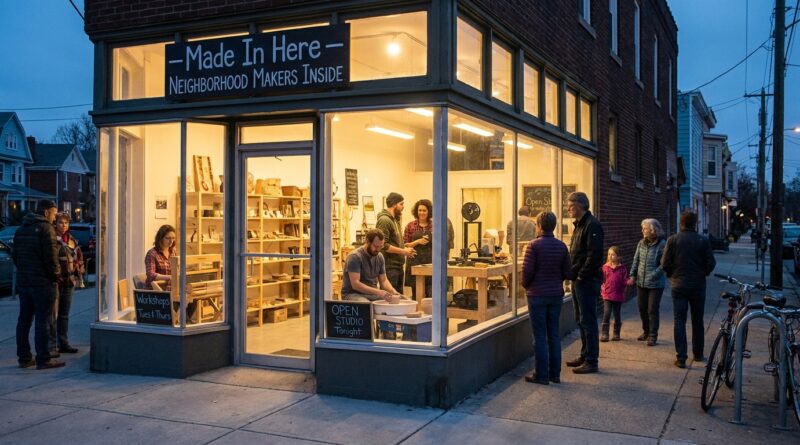
The Hyper‑Local Corner Store Comeback: How ‘Ghost’ Retail Spaces Are Quietly Turning Into Mini Maker Hubs
It is hard to walk past another dark storefront and not feel a little defeated. The windows are dusty. The sign is half peeled off. And the street that used to feel alive now looks like it is waiting for something to happen. At the same time, plenty of local makers are doing real work from spare bedrooms, garages, and kitchen tables, but they cannot justify a full retail lease or pricey weekend market circuit. That mismatch is where the hyper local corner store maker hub idea starts to make sense. Instead of waiting for one big tenant to rescue a block, some communities are quietly filling small empty shops with candle makers, print artists, repair services, bakers, soap makers, and other neighborhood businesses. The result is part shop, part tiny workshop, and part community magnet. It is a practical comeback story, not a glossy one, and that is exactly why it is worth paying attention to.
⚡ In a Hurry? Key Takeaways
- A hyper local corner store maker hub turns empty storefronts into small-scale retail and production spaces for neighborhood makers.
- Start with short leases, shared utilities, simple fixtures, and clear zoning rules so owners and makers can test demand without huge risk.
- These hubs work best when the product is safe, low-noise, low-odor, and easy to make on site without bothering nearby residents or shops.
Why these empty shops are getting a second life
Not every vacant storefront is truly unwanted. A lot of them are just wrong for the old model. The rent may be too high for a traditional boutique, the foot traffic may be too uneven for a chain, or the space may be too small for a full restaurant. But for a local maker, that same shop can be just right.
Think about what many independent businesses need. A front area to sell. A back table to assemble or package goods. A sink. Decent lighting. Wi-Fi. Maybe a storage closet. That is not a huge list.
That is why the hyper local corner store maker hub is catching on quietly. It takes a modest storefront and gives it a more realistic job. Not as a single big-bet retailer, but as a flexible place where making and selling can happen side by side.
What a hyper local corner store maker hub actually looks like
This is not a giant factory tucked into a shopping district. It is smaller and more neighbor-friendly than that. Picture a former corner shop split into zones.
Front of house
The front is the customer area. Shelves, small displays, maybe a counter, maybe a tasting table if local rules allow. People can browse finished products and talk to the person who made them.
Back of house
The rear becomes the mini production area. That might mean screen printing, candle pouring, jewelry assembly, sewing, gift boxing, floral work, or small-batch food prep if health codes allow.
Shared setup
Some spaces go one step further and host multiple makers under one roof. Each gets a shelf wall, workbench, or timed use of equipment. This lowers the cost for everyone and keeps the storefront active more days of the week.
If that sounds familiar, it overlaps with the trend described in The Hyper-Local Mini Main Street: How Micro-Retail Maker Lanes Are Quietly Turning Dead Squares Into Neighborhood Manufacturing Hubs, where smaller retail clusters begin acting more like neighborhood production networks than old-school shopping strips.
Why this model works better than waiting for a perfect tenant
Property owners often wait for a single stable renter who can sign a long lease and build out the space at their own cost. That sounds safe. In a soft market, it can leave a storefront empty for months or years.
A maker hub changes the math.
Lower entry costs
Many makers cannot commit to five years of rent, but they can handle a pop-up term, seasonal lease, or shared-space agreement. That means the landlord gets movement instead of silence.
More reasons to visit
People are more likely to stop in when something is being made in front of them. A quiet block becomes interesting again. Curiosity is powerful foot traffic.
Local money stays local
When production and sales happen in the same neighborhood, more of the spending tends to recirculate nearby. Owners hire local helpers. They buy supplies from nearby vendors when possible. Customers feel more connected to what they are buying.
Holiday season fit
Fall and winter are especially strong for this model because shoppers are already looking for gifts, events, and more personal retail experiences. A once-empty corner can become a place to buy ornaments, candles, baked goods, cards, knitwear, and custom pieces without waiting for a once-a-month market.
The practical stuff people forget
This is where good ideas can get stuck. A storefront may look perfect, but the details matter.
Zoning and permits
Not every shop can legally be used for light production. Cities need to be clear about what counts as acceptable on-site making. Soap and candles may be fine. Food may trigger health inspections. Wood cutting may be too noisy. Nobody wants to learn that after signing papers.
Insurance
If the space is part workshop, liability changes. Owners and tenants need insurance that matches the actual use of the space, not the old use listed on an outdated lease.
Utilities
Makers often need more outlets, better lighting, sinks, ventilation, or internet than a simple display shop. These are not glamorous upgrades, but they are often the difference between a working hub and a pretty failure.
Storage
Finished goods, raw materials, packaging, and seasonal inventory take up room fast. The best mini hubs plan for this from day one.
What residents can do if they want this in their neighborhood
You do not need to own commercial property to help this happen.
Ask better questions
When you see an empty shop, do not just ask, “Why does nothing survive there?” Ask, “Could this hold three smaller businesses instead of one?” That shift matters.
Support test runs
Weekend pilots, holiday pop-ups, and maker residencies can prove demand without forcing anyone into a huge commitment. If a neighborhood shows up for the trial, owners notice.
Buy local on ordinary days
These spaces do not survive on grand opening buzz alone. A Tuesday afternoon sale counts. A refill order counts. A birthday gift bought two blocks from home counts.
What property owners can do without spending a fortune
Many owners assume a revival plan means a full renovation. Often it does not.
Start with a clean, safe shell
Working lights, paint, secure locks, functioning bathroom, basic signage rights, and decent flooring can go a long way. Makers can often do the rest if the base is solid.
Offer shorter terms
A 3-month seasonal lease, 6-month trial, or step-up rent agreement can attract tenants who would never sign a standard long lease. Flexibility fills more spaces than wishful thinking.
Bundle shared basics
Wi-Fi, utilities, waste pickup, and common shelving can be included in a simple package. That makes the space feel more plug-and-play and less intimidating.
Market the space honestly
Instead of advertising “ideal retail opportunity” for the hundredth time, describe it as a micro retail and light maker space. That tells the right people they are welcome.
What makers should look for before saying yes
Not every cheap storefront is a good deal.
Check the block, not just the unit
Visit at different times of day. Is the street dead at lunch but lively after school pickup? Is there nearby parking? Are there other small businesses that bring in compatible traffic?
Know your production limits
If your process creates smoke, strong odors, or heavy noise, a tiny neighborhood storefront may not be the right fit. But if you package, assemble, decorate, personalize, print, sew, or craft in a tidy way, it may be ideal.
Plan for visible making
Customers love seeing work in progress. Set up your layout so the process feels inviting, not messy or blocked off. A little theater helps.
Why this matters beyond shopping
An active storefront does more than sell things. It signals that a place still has local confidence. It gives new business owners a smaller first step. It makes a block feel watched, used, and cared for. And it helps neighborhoods avoid the all-or-nothing cycle where only chains can afford to return.
That is the real appeal of the hyper local corner store maker hub. It is not nostalgia for old retail. It is a better fit for how many small businesses actually work now.
At a Glance: Comparison
| Feature/Aspect | Details | Verdict |
|---|---|---|
| Cost to start | Shared or short-term maker hubs usually need less cash upfront than a full standalone boutique or market circuit. | Strong option for testing demand. |
| Neighborhood impact | Active windows, live production, and regular local shopping can make an empty block feel useful again. | Better than leaving space dark. |
| Operational risk | Success depends on zoning, insurance, utilities, and choosing low-impact maker uses that fit the area. | Worth doing, but only with the basics sorted first. |
Conclusion
Many cities are dealing with a strange split right now. Some blocks have too many empty storefronts, while demand for local goods and real-world shopping experiences keeps climbing. Seeing those ghost stores as plug-and-play maker spaces is one of the more practical fixes on the table. It helps residents find something worth walking to, gives property owners a smarter use for awkward vacancies, and gives small brands a place to make and sell without betting the farm. If communities can start small and stay realistic, the hyper local corner store maker hub could help revive commercial corridors, shorten supply chains, and keep more money circulating close to home just when fall and holiday shopping begin to matter most.