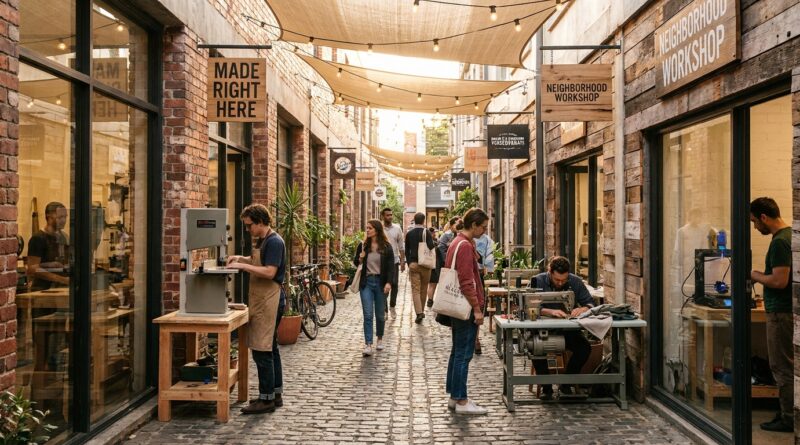
The Hyper-Local Mini Main Street: How Micro-Retail Maker Lanes Are Quietly Turning Dead Squares Into Neighborhood Manufacturing Hubs
You know that sad little strip in town. Half-empty windows. A vape shop, a tax prep office, maybe one chain holding on, and a parking lot that feels more alive than the storefronts. It is frustrating because everybody can see the wasted potential. Meanwhile, local woodworkers, candle makers, bike repair folks, seamstresses and food crafters are bouncing between weekend markets, Etsy listings and borrowed studio space, trying to build something real without a real home. That is why hyper local micro retail manufacturing hubs matter. They take those dead, forgettable blocks and turn them into small, busy, walkable maker lanes where people can shop, watch things being made, get repairs done and meet the person behind the product. It is not a fantasy plan. Cities are already trying it, and for neighborhoods tired of blank windows and generic retail, it offers a practical way to bring life, jobs and local pride back to the block.
⚡ In a Hurry? Key Takeaways
- Hyper local micro retail manufacturing hubs turn empty storefront strips into walkable clusters of makers, repair shops and small-batch producers.
- If your town has a dead plaza, push for short leases, low-rent small bays and zoning that allows light production next to retail.
- The big value is visibility. Neighbors can see jobs being created, dollars stay closer to home, and local businesses get a better shot than they do in isolated industrial parks.
What a maker lane actually looks like
Think of a small main street, but updated for how local business works now.
Instead of filling every unit with standard retail, the corridor mixes tiny production spaces with customer-facing shops. One storefront might roast coffee in the back. Another might sell handmade leather goods and do repairs on site. Next door, a ceramic artist runs a compact studio with a retail counter up front. A bike mechanic shares a wall with a knife sharpener, a printmaker or a custom baker.
The point is density. These businesses work better together when they are close enough for foot traffic, shared customers and shared services.
That is what makes hyper local micro retail manufacturing hubs different from the old model. In the old model, small producers got pushed into industrial zones where nobody could find them. Here, making and selling happen in the same visible place.
Why this idea is catching on
There are a few simple reasons cities are paying attention.
Vacant retail needs a better plan
A lot of older shopping strips were built for a kind of retail that is not coming back. Waiting for the perfect national tenant often means waiting forever. A cluster of local makers can fill smaller spaces faster and create more reasons for people to visit regularly.
Makers need lower-risk space
Most local producers do not need a giant warehouse on day one. They need 300 to 1,000 square feet, decent power, basic ventilation, a front door and rent they can survive. A maker lane gives them a first rung on the ladder.
People want to buy from someone they can meet
Shoppers are tired of generic sameness. A place where products are made in plain sight feels different. You are not just buying soap, bread, planters or repaired boots. You are buying from your neighbor.
Why this works better than scattering makers all over town
Isolation is expensive. If a local maker rents a random unit alone, they have to create all the foot traffic themselves. That is hard.
Put eight or ten makers in one compact strip, and each business helps the others. Someone stopping in for a bike tune-up might also grab locally roasted beans, get a zipper repaired, and pick up a gift. That kind of overlap matters.
It is the same basic logic behind food halls, just more useful to everyday life. These corridors can become places where people shop, fix, order, learn and linger.
This is also where neighborhood-scale production connects nicely with other local manufacturing ideas. For example, small fabrication and custom part work can complement retail-facing maker lanes. If you want a glimpse of that side of the picture, The Hyper-Local Micro Factory Next Door: How Neighborhood 3D-Print Hubs Quietly Turn Ideas Into Real Products shows how compact production spaces can handle practical, local demand.
What cities are testing right now
The details vary, but the playbook is starting to look familiar.
Small-format storefronts
Instead of one large tenant taking 5,000 square feet, a city or landlord splits the strip into small bays. That makes it easier for first-time businesses to move in.
Flexible zoning for light production
This is a big one. If rules only allow pure retail, local producers get blocked. Cities testing these corridors are making room for low-impact making, packaging, assembly and repair in customer-facing spaces.
Shorter leases and lower build-out costs
A two- or three-year starter lease can be the difference between a dream and a business. Some programs also help with shared sinks, ventilation, signage or code upgrades so each tenant does not have to start from scratch.
Shared back-end support
Sometimes the smartest part is invisible. Shared loading areas, common storage, group marketing, bookkeeping help or cooperative purchasing can lower costs for everyone.
What your town would need to make this real
If you want one of these corridors where you live, focus on the boring stuff first. That is where projects live or die.
1. The right kind of space
Look for an underused strip, plaza edge or short main-street block with decent sidewalks, easy parking and units that can be divided. Fancy is not required. Functional matters more.
2. Zoning that allows making, not just selling
A maker lane fails fast if every business has to pretend it is only a boutique. Light production has to be legal and clearly defined. Think baking, sewing, assembly, repair, printing, roasting, small-batch fabrication and similar low-impact work.
3. Affordable rents
This is the heart of it. If rents are priced for chains, the local maker story ends before it starts. The whole model depends on low-risk occupancy.
4. Basic infrastructure
Good lighting. Reliable power. Sinks where needed. Ventilation where needed. Safe public spaces. Clear signage. These are not glamorous fixes, but they are what make tiny businesses possible.
5. A cluster, not a one-off
One maker in one lonely storefront is nice. Six to twelve in a row is a destination.
Who benefits most
This model works especially well for businesses that make, fix or finish products in small batches.
- Repair shops for bikes, clothing, shoes, electronics or small appliances
- Food makers doing baking, preserves, roasting or specialty packaged goods
- Wood, leather, textile and ceramics studios with a retail front
- Printers, engravers and custom gift makers
- Micro-fabricators using tools like laser cutters or 3D printers for local orders
It also helps customers who are tired of throwing things away. A neighborhood with repair and custom making nearby is simply more useful than a row of copy-paste chain stores.
The obstacles no one should ignore
This is a good idea, but it is not magic.
Code and permitting can get messy
Health rules, fire separation, accessibility, noise and ventilation all matter. Towns need clear, plain-English rules for what kind of light manufacturing belongs in mixed retail settings.
Cheap rent can drift upward
A maker lane can revive an area so well that it prices out the very businesses that made it interesting. Cities and landlords should think about rent caps, graduated lease terms or protected affordable units if they want the model to last.
Not every maker wants foot traffic
Some producers need quiet, shipping access or more specialized space. That is fine. A neighborhood hub will not fit every business. It works best for businesses that benefit from being seen.
How residents can push for one
You do not need to wait for a giant redevelopment plan.
Start with a specific block
Pick the dead strip everybody already complains about. Photos help. Vacancy counts help more.
Find the local makers first
Before asking the city for anything, see who would actually move in. Market vendors, repair specialists, home-based producers and artists are a good place to start.
Ask for pilot rules, not permanent perfection
Temporary permits, pop-up leases and trial zoning overlays are often easier to approve than a full rewrite. Once a pilot works, the city has proof.
Make the case in everyday terms
Do not just talk about culture or creativity. Talk about filled storefronts, visible jobs, safer sidewalks, local tax base, useful services and less money leaking out to chains and distant platforms.
At a Glance: Comparison
| Feature/Aspect | Details | Verdict |
|---|---|---|
| Traditional chain retail strip | Relies on larger tenants, standard leases and generic storefront use. Often leaves long vacancies when chains pull out. | Less flexible, weaker local identity |
| Scattered local makers in isolated spaces | Can work for individual businesses, but each shop must generate its own foot traffic and often lacks visibility. | Good for some, but hard to scale |
| Hyper local micro retail manufacturing hubs | Clusters small makers, repair services and retail fronts in one walkable corridor with lower rents and shared customer flow. | Best mix of visibility, local impact and practical reuse |
Conclusion
Dead storefront strips do not have to stay dead, and local makers do not have to stay hidden. Right now, cities from Raleigh to Milwaukee are testing micro-retail corridors that cluster hyper-local artisans, small-batch manufacturers and repair specialists into dense, walkable strips instead of isolating them in industrial parks. For Made In Here readers, this is a real playbook moment. It shows how to push your own town to convert underused corners into low-rent, maker-first main streets that keep dollars close, create visible jobs for neighbors and replace generic chain retail with spaces where every purchase comes with a face and a story. That is not just smarter retail. It is a better kind of neighborhood.