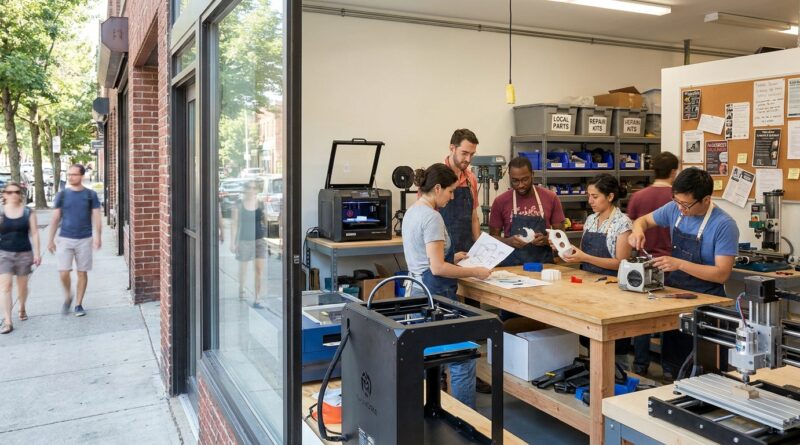
The Hyper-Local Micro Factory Next Door: How Neighborhood 3D-Print Hubs Quietly Turn Ideas Into Real Products
You know the feeling. A hinge snaps on a stroller, a dishwasher knob cracks, or you finally sketch the little product idea that has been bouncing around your head for months. Then reality hits. Getting one replacement part made is weirdly hard, ordering from far away takes forever, and setting up “real manufacturing” for a small run feels out of reach. So the idea sits in a notebook, or the broken item ends up in the trash. That is exactly why the rise of the hyper local micro factory 3d printing neighborhood makers model matters. Quietly, local print farms, makerspaces, garage fabricators and small machine shops are starting to fill the gap between DIY tinkering and big factory production. They can help neighbors repair, prototype and make short runs without huge minimum orders. Better yet, they keep money, know-how and jobs close to home, where people can actually see the results.
⚡ In a Hurry? Key Takeaways
- A neighborhood-scale micro factory can turn local repair needs and product ideas into real parts and small-batch products fast.
- Start by finding nearby print farms, makerspaces and machine shops, then bring a simple drawing, broken sample or prototype goal.
- Use local shops for prototypes, repairs and short runs first, but always confirm material strength, safety and real-world testing before selling anything important.
What a neighborhood micro factory really is
It is not usually one giant building with smokestacks. It is often a mix of small places and people. A 3D print farm in a retail strip. A makerspace with CNC tools. A machinist who takes local jobs. A sewing shop, laser cutter, woodworker or electronics hobbyist who can handle one step in the process.
Together, they act like a small manufacturing network. One shop prints the first prototype. Another cleans it up. Someone else handles packaging, labels or assembly. That is the practical version of a hyper-local micro factory.
If this idea sounds familiar, it overlaps with what I covered in The Hyper-Local Print Farm Next Door: How Neighborhood 3D Shops Are Quietly Becoming Micro-Factories. The short version is simple. The neighborhood shop that prints a replacement bracket today may be the same place helping local residents launch tiny product lines tomorrow.
Why this matters now
For years, small manufacturing sounded like something only startups with funding could touch. That has changed. Desktop and prosumer machines are better. Local shops know more. Design files move instantly. And people are tired of waiting weeks for a simple part.
There is also a money issue. When every custom piece, repair part or trial product order gets sent across the country or overseas, your neighborhood loses twice. It loses the spending, and it loses the chance to build local skill.
That is why this shift matters beyond gadget fans. It is about resilience. When supply chains wobble, local capacity becomes a very practical thing.
What these hubs can actually make
Repair parts
This is the easiest entry point. Think clips, brackets, covers, knobs, spacers, mounts and adapters. These are the kinds of parts that break all the time and are annoying to source.
Product prototypes
Have an idea for a kitchen tool, bike accessory, desk organizer or pet product? A local hub can make a rough version quickly so you can test fit, feel and function before spending bigger money.
Short production runs
You do not need 10,000 units to get started. Many neighborhood makers can handle 10, 50 or 200 units, depending on the item. That is enough for a farmer’s market, Etsy shop, local retailer or pilot launch.
Custom tools and jigs
Small businesses often need one-off fixtures, templates or holders to make their own work easier. A local micro factory can save them time with simple custom solutions.
Who benefits most
Honestly, more people than you might think.
- Parents trying to fix everyday household items
- Side-hustle sellers testing a product idea
- Local repair shops that need odd parts fast
- Schools and clubs building project kits
- Artists and crafters making custom components
- Small businesses needing packaging inserts, holders or branded accessories
The point is not that every neighborhood needs a full factory tomorrow. The point is that many neighborhoods already have the pieces. They just are not connected yet.
A simple playbook for working with nearby makers
1. Start with the problem, not the machine
Do not walk in saying, “I need this done on a resin printer with carbon fiber nylon.” If you are not sure, that is fine. Start with what you need the part to do.
Say something like this: “This latch broke on my cooler. It needs to hold tension outdoors.” Or, “I want to test a phone stand I can sell at local markets.” That gives the shop enough context to suggest the right process.
2. Bring a sample, sketch or measurements
The easier you make the first conversation, the faster things move. Bring the broken part if you have it. If not, bring clear photos with a ruler in the shot. Even a rough hand sketch helps.
3. Ask about materials in plain English
You do not need a crash course in polymers. Ask practical questions.
- Will this survive heat in a car?
- Is it flexible or brittle?
- Can it be used outdoors?
- Is it food-safe, or just okay for dry contact?
- Will it handle weight or repeated stress?
Good local fabricators are usually happy to explain this without jargon.
4. Expect version one to be a test
This is where a lot of first-time customers get frustrated. Prototype work is not magic. The first version teaches you what to change. Maybe the handle is too thin. Maybe the clip is too tight. Maybe the whole thing needs a different material.
That is normal. In fact, it is the whole advantage of local production. You can fix problems in days instead of waiting weeks.
5. Talk about quantity early
Making one part and making 100 parts are very different jobs. A local shop may print a one-off prototype, then suggest a different process for a small run if you plan to sell it.
Ask these questions early:
- What does one unit cost?
- What does 25 cost?
- What changes would make it cheaper to produce?
- Can assembly or finishing be done locally too?
How neighborhoods can organize around this
This is where things get exciting. A micro factory does not have to be one business doing everything. A neighborhood can build a loose network that works almost as well.
Create a local maker directory
List who can do what. 3D printing. Laser cutting. CNC routing. Sewing. Light assembly. CAD design. Packaging. Electronics repair. Post it online and keep it updated.
Run monthly repair and prototype nights
Libraries, schools and community centers are great for this. Residents bring broken items or product ideas. Local makers help assess what is possible. Even if only a few projects get solved each event, the network grows.
Pair designers with fabricators
Some people have ideas but cannot model a part. Others can model and print but do not know how to market a product. Match them up. That is how tiny local businesses start.
Use local institutions as anchor customers
Schools, cafes, bike shops, clinics and nonprofits all need custom little things. Tool holders. Signs. Mounts. Replacement bits. If they commit to using neighborhood makers when possible, the local manufacturing base gets real traction.
Common mistakes to avoid
Assuming 3D printing solves everything
It solves a lot, but not everything. Some parts need metal. Some need molded rubber. Some are better cut from wood or acrylic. Think “best local process,” not just “print it.”
Skipping durability testing
A prototype that looks good on the table may fail in heat, sunlight, moisture or repeated use. Test before you sell, install or rely on it.
Ignoring design-for-cost
Fancy shapes can be cool, but simple often wins. Fewer parts, easier assembly and less print time usually mean better margins and faster turnaround.
Forgetting permissions and compliance
If you are making something for children, food use, electrical systems or safety gear, the bar is much higher. Local shops can help make parts, but product responsibility still matters.
What to ask before you place an order
- What file types do you accept?
- Can you help with design if I only have an idea or broken sample?
- What material do you recommend, and why?
- How long will one prototype take?
- How much does a small batch cost?
- Can you do finishing, assembly or packaging?
- What kind of testing should I do before real use?
At a Glance: Comparison
| Feature/Aspect | Details | Verdict |
|---|---|---|
| Speed | Local print farms and makerspaces can often turn around prototypes and repair parts in days instead of weeks. | Big win for urgent fixes and product testing. |
| Cost for small runs | Per-unit cost may be higher than mass production, but there are usually no huge minimum orders or expensive tooling upfront. | Best for prototypes, niche products and local demand. |
| Community value | Jobs, skills and spending stay closer to home, while residents gain easier access to repair and manufacturing help. | Strong long-term benefit for resilient neighborhoods. |
Conclusion
The big idea here is refreshingly down to earth. Your neighborhood does not need to wait for some giant economic plan to get better at making things. A few capable local shops, a makerspace, some practical partnerships and a habit of solving problems nearby can go a long way. That is the real promise of the hyper local micro factory 3d printing neighborhood makers movement. It helps people fix useful things instead of tossing them. It gives product ideas a low-risk path out of the sketchbook. And it keeps more work, skill and spending in the community. As distributed, small-batch manufacturing gets more practical, the neighborhoods that organize around it will have a real edge. Faster turnarounds, stronger local businesses and more chances for everyday people to build something real without leaving their block.