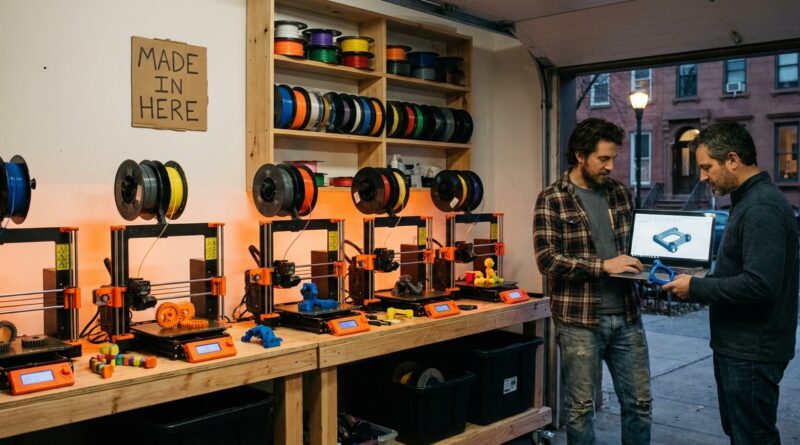
The Hyper-Local Print Farm Next Door: How Neighborhood 3D Shops Are Quietly Becoming Micro-Factories
Waiting two weeks for a plastic bracket the size of a cracker is enough to make anyone crazy. The same goes for a missing appliance clip, a custom classroom tool, or a quick gift you could have picked up locally if someone nearby had the right machine. That is the gap a hyper local 3d printing micro factory can fill. And the funny part is, many neighborhoods already have one. It might be a maker with three printers in a garage, a couple running jobs from a spare bedroom, or a shared workshop handling small batches for local shops.
These tiny print farms are not trying to replace giant factories. They are solving smaller, more annoying problems faster. They make replacement parts, signs, jigs, fixtures, adapters, organizers, educational tools, and custom one-off items that do not make sense to import from across the world. For customers, that means shorter wait times and easier communication. For printer owners, it means those humming machines can do more than gather dust between Etsy orders. Quietly, block by block, they are becoming neighborhood micro-factories.
⚡ In a Hurry? Key Takeaways
- Small neighborhood print farms can make simple parts, tools, gifts, and fixtures faster than waiting on distant suppliers.
- If you need something made, bring measurements, photos, and the item it must fit. That saves time and money.
- Not every part should be 3D printed. Load-bearing, heat-exposed, or safety-critical items need the right material and honest limits.
What a neighborhood print farm actually looks like
Forget the image of a giant warehouse full of robots. Most hyper-local print operations are much smaller and much more practical.
Think two to ten desktop 3D printers. A stack of filament spools. Some basic finishing tools. Maybe a laser cutter or small CNC on the side. Orders come in through text, email, Instagram, a simple website, or word of mouth.
The sweet spot is not mass production. It is short runs and useful odd jobs. Five shelf spacers for a local boutique. A replacement knob for a stove that is no longer supported. Twenty custom name tags for a school event. A bracket for a food truck. A jig for a carpenter. A tactile learning aid for a teacher.
That is why the phrase hyper local 3d printing micro factory matters. The value is not just the printer. It is the distance. Across town beats across an ocean when the part is simple and the need is immediate.
Why this is starting to matter now
People have had enough of fragile supply chains for basic stuff. If one cheap part breaks, the whole item can become useless. You wait, search marketplaces, compare mystery sellers, and maybe still end up with the wrong fit.
At the same time, a lot of makers already own capable machines. They are printing prototypes, hobby models, and occasional customer jobs. In between, those machines sit idle. That idle time is an opening.
When local residents know a nearby shop or home-based operator can help, money stays in the neighborhood. Repairs happen sooner. Designers get repeat work. A side hustle starts looking a lot more like a real business.
If you have been following the broader shift toward neighborhood manufacturing, this fits neatly with The Hyper-Local Last-Mile Workshop: How Neighborhood Makers Are Quietly Turning Delivery Hubs Into Micro-Factories. The big idea is simple. Some of the things we wait to be shipped could be made much closer to home.
What these micro-factories are good at
Fast replacement parts
This is the gateway use case. A broken vacuum latch. A missing dishwasher wheel. A mount for a sensor. A clip for a cabinet. If the original part is gone, cracked, or overpriced, a local print farm may be able to model and remake it quickly.
Custom fixtures and organizers
Small businesses love this. Cafes need holders. Retail shops need display risers. Mechanics need socket organizers. Teachers need bins, labels, and manipulatives. These jobs are not glamorous, but they are steady.
Small-batch products
Some local designers use print farms to test and sell original products without ordering a thousand units upfront. That lowers risk. It also lets them improve the design after hearing from real customers.
Community-specific tools
A local sports club may need medal racks. A neighborhood garden may need hose guides and plant markers. A museum gift shop may want custom souvenirs. These are niche needs, and niche needs are where small shops shine.
How customers should work with a local 3D printer
This part matters. A good result starts with a good handoff.
Bring the broken piece if you can
Nothing beats the actual part. Even a cracked or partial piece helps with measuring, shape matching, and figuring out how it failed.
Take clear photos
Show the part by itself and where it fits. Put a ruler or coin next to it for scale. A blurry close-up taken in the dark is not doing anyone favors.
Explain what the part has to survive
Is it near heat? In sunlight all day? Under tension? Exposed to water? Snapped on and off often? Material choice matters. PLA might be fine for a desk organizer. It is not always the right pick for a car interior in summer.
Ask for one test piece first
If you need ten or fifty, start with one. Fit it. Use it. Then approve the batch. That small pause can prevent a pile of almost-right parts.
How makers can turn idle printers into local income
If you run a few printers at home or in a shared space, there is a real opportunity here. Not a fantasy. A practical one.
Start with boring jobs
Boring is good. Boring pays. Spacers, brackets, labels, clips, holders, hooks, feet, stands. These solve real problems and often lead to repeat business.
Pick a service radius
Do not try to serve the whole country. Start with a few square miles. Offer pickup, local drop-off, or scheduled delivery windows. Hyper-local works because it is convenient.
Show examples people understand
Most customers do not know what your printer can do. They do know what a broken curtain bracket feels like. Post before-and-after repairs, organizer systems, classroom tools, and retail fixtures. Make the use case obvious.
Build a simple intake form
Ask for dimensions, photos, quantity, material needs, deadline, and whether the file already exists. This cuts down on endless back-and-forth.
Be honest about limits
Trust grows when you say no to the wrong job. If a part is safety-critical, food-contact sensitive, or likely to fail under heat or force, say so. That honesty is part of being a real local manufacturer, not just a hobby seller.
Where the real-world examples are showing up
Some of the most interesting operators are not aiming for scale first. They serve a school district, a few apartment buildings, several contractors, a bike shop cluster, or a handful of local Etsy sellers who need fast turnaround.
One neighborhood print farm might focus on repair parts and home fixtures. Another may become the unofficial prototyping partner for local inventors. Another may mostly print event items, branded accessories, and classroom tools.
The point is not that every garage printer becomes a factory. The point is that some already function like one on a small, useful scale. They just are not usually described that way.
What to watch out for
This is promising, but it is not magic.
Material limits are real
Different plastics behave differently. Some are stiff but brittle. Some handle heat better. Some flex. Some warp. A good local operator should walk you through that in plain English.
Design time costs money
The plastic is often the cheap part. Measuring, modeling, testing, and revising take time. Customers are usually happier when they understand they are paying for problem-solving, not just melted filament.
Not every job belongs on a desktop printer
Some items need injection molding, metal machining, or certified industrial processes. A smart micro-factory knows when to print, when to outsource, and when to recommend a different fix entirely.
Why communities should care
Because this is local resilience in a very practical form.
When a neighborhood can make some of its own replacement parts, fixtures, learning tools, and small custom items, it becomes less dependent on long supply chains for everyday needs. That does not replace global manufacturing. It fills the gaps global manufacturing is bad at.
It also creates a path for local talent. Designers get to test products without huge upfront costs. Makers turn spare capacity into income. Small shops gain a nearby fabrication partner. Residents get things fixed instead of thrown away.
At a Glance: Comparison
| Feature/Aspect | Details | Verdict |
|---|---|---|
| Speed | Local print farms can often quote, test, and deliver simple parts in days, sometimes same week. | Best for urgent small jobs |
| Customization | Easy to tweak size, shape, labeling, and fit for one-off needs or tiny batches. | Excellent fit for local businesses and repairs |
| Durability and safety | Depends heavily on material choice, print quality, and whether the part is used in heat, stress, or safety-critical settings. | Great for many uses, but not every use |
Conclusion
The most useful tech trends are often the quiet ones. Right now, small 3D print farms are popping up in spare bedrooms, garages, and shared makerspaces, quietly serving hyper-local orders while most of the attention stays on giant global factories. If more residents learn how to find and work with these neighborhood operators, idle machines can turn into income, repair dollars can stay local, and designers can build a steady business instead of just a hobby. For communities dealing with higher costs and shaky supply chains, sourcing brackets, fixtures, learning tools, and custom parts from someone around the corner is not a novelty. It is a smart resiliency move. This is not sci-fi. In plenty of places, the hyper local 3d printing micro factory is already here. You may just not have noticed the one next door yet.