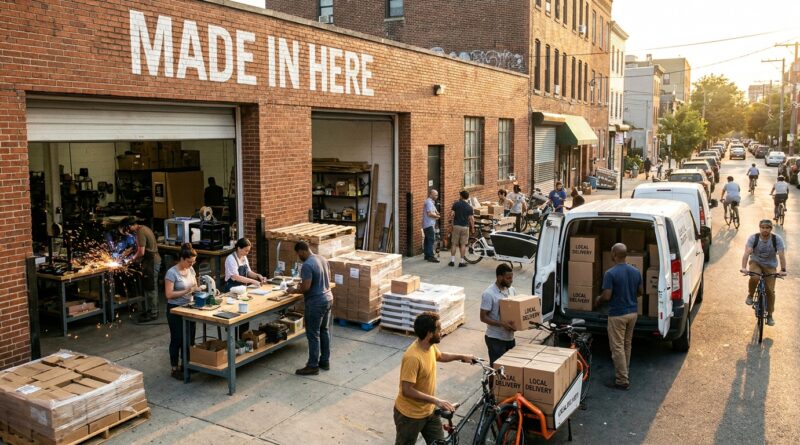
The Hyper-Local Last-Mile Workshop: How Neighborhood Makers Are Quietly Turning Delivery Hubs Into Micro-Factories
You know the feeling. You order something simple, maybe a replacement bracket, a shelf spacer, a custom house number, or one oddly sized part, and then the site says it will arrive in nine days from three states away. That is frustrating enough for shoppers. For brands and retailers, it is worse. They are spending fortunes trying to shave hours off delivery while ignoring the machine shop, print lab, sewing studio, or wood shop sitting five minutes from the customer. That blind spot matters. A hyper local micro factory last mile manufacturing model flips the script. Instead of shipping every item from a distant warehouse, companies can make certain products near the buyer, then drop them into the same local delivery routes already moving groceries, parcels, and pharmacy orders. The result is less waste, fewer stockouts, faster custom work, and more money staying in the neighborhood instead of disappearing into long-haul freight bills.
⚡ In a Hurry? Key Takeaways
- A hyper local micro factory last mile manufacturing setup lets nearby makers produce select goods close to the customer, then use local delivery networks for the final trip.
- Start with items that are small, customizable, urgent, or often out of stock, such as spare parts, fixtures, signage, and simple home goods.
- This only works well if quality checks, material standards, and delivery timing are clearly defined from the start.
Why this idea is suddenly getting real
For years, retail treated manufacturing and delivery as separate worlds. One side made products in bulk, often far away. The other side raced to move boxes faster. That worked when supply chains were predictable.
They are not predictable now.
Shipping costs jump around. Ports clog. Popular items go out of stock for silly reasons. Customers also want more choice. Not endless choice, just specific choice. The right size. The right finish. The right mounting hole. The right fabric color. Mass production is good at volume. It is not always good at “I need this one thing by Thursday.”
That is where neighborhood makers come in. A city already has small workshops with useful tools and practical know-how. CNC routers, laser cutters, embroidery machines, welding rigs, kiln rooms, textile tables, resin printers, and desktop 3D printers are sitting in light industrial strips, garages, co-ops, and maker spaces. Many are underused between jobs.
The smart move is to connect them to local demand instead of pretending every product must begin its life in a giant distant factory.
What a hyper-local last-mile workshop actually looks like
Think of it less like one giant mini-factory and more like a neighborhood network.
The basic model
A retailer, marketplace, or city-backed platform receives an order. Software checks whether the item can be made locally. If yes, the job is routed to a vetted nearby maker with the right machine, materials, and schedule. The item gets produced, checked, packed, and handed off to a local courier or delivery hub already operating in that area.
In plain English, the delivery hub stops being just a box-sorting center. It becomes the handoff point for locally made goods.
What kinds of products fit best
Not everything belongs in this model. You are not going to locally manufacture a refrigerator overnight. But plenty of products do fit:
- Replacement hardware and spare parts
- Custom shelving brackets and mounts
- Signage and display pieces
- Simple stitched textile goods
- Personalized home decor
- Small furniture components
- Packaging inserts and prototypes
- Short-run seasonal merchandise
These are exactly the kinds of items that suffer when global supply chains wobble. They are also the kinds of jobs local shops can often do faster than a large factory once setup and shipping time are counted honestly.
This is the same basic shift explored in The Hyper-Local Supply Rescue: How Neighborhood Makers Are Quietly Becoming the Backup Plan When Global Manufacturing Stalls. The big idea is simple. The backup plan is already nearby. Most systems just are not set up to see it.
Why brands are paying attention now
This is not just a nice community story. It solves real business headaches.
1. It cuts long-haul shipping on the right products
If a product can be made a mile from the customer, there is no reason to truck it 800 miles first. That lowers emissions, sure, but it also cuts packaging, damage risk, and waiting time.
2. It helps with stockouts
Some products do not need to be stored by the thousand. They can be made when needed, especially if demand is lumpy or highly local. Instead of “backordered,” the message can become “made this afternoon.”
3. It handles customization better
Big factories hate tiny variations unless the order volume is huge. Local shops are often better at one-off and short-run jobs. They are built for adaptation.
4. It keeps local value local
This matters more than people think. Money paid for a nearby job tends to circulate nearby. That supports skilled trades, apprenticeships, and small business growth instead of sending every dollar outward.
The hidden advantage: delivery routes are already there
This is the part many people miss.
Cities already have last-mile routes crisscrossing neighborhoods all day. Parcel vans, bike couriers, same-day drivers, pharmacy runners, and retail fulfillment services are already making the trip. So the missing piece is often not transportation. It is coordination.
If local production jobs can be slotted into those existing routes, the economics start to make sense quickly. A delivery network with empty space in the van is wasted capacity. A nearby workshop with idle machine time is also wasted capacity. Put them together, and you have a small local production engine hiding in plain sight.
What cities and retailers need to build first
Here is where the romantic version meets reality. This does not work just because a city has creative people. It works when the messy details are handled.
Clear product categories
Start with a short list of things that are easy to standardize and easy to route. Spare parts, brackets, signage, custom organizers, and textile repairs are good early candidates.
Vetted maker network
Not every maker is a fit for commercial work. Brands need verified capabilities, turnaround times, material lists, file compatibility, and sample quality checks.
Shared standards
If one shop uses different tolerances, packaging, or labeling than another, problems pile up fast. The platform needs standard specs so buyers get consistency even when different shops make the item.
Simple order routing software
The software does not have to be magic. It just needs to answer practical questions. Who is closest? Who has the right tool? Who has the needed material in stock? Who can meet the deadline?
Pickup windows that match delivery cycles
A local courier cannot wait around while a part finishes printing. Production slots and handoff times have to line up with real route schedules.
What could go wrong, and how to avoid it
There are a few obvious traps here.
Quality can become inconsistent
If five shops make the same item five slightly different ways, customers notice. The fix is boring but effective. Standard files. Standard materials. Standard inspection photos. Standard packaging.
Some goods are a terrible fit
Heavy, highly regulated, or ultra-low-cost mass items often do not belong in a hyper local model. If the product is cheaper to import in bulk than to make nearby, forcing it local helps nobody.
Makers can get buried in admin work
Small shops often lose time on quoting, file cleanup, customer messaging, and delivery coordination. A good platform removes that burden instead of adding more of it.
Retailers may treat local makers like disposable overflow labor
That is a mistake. If neighborhood producers are expected to save the day, they need fair pay, predictable terms, and visibility into future demand.
A practical playbook for getting started
If you are a retailer, local economic development group, or marketplace builder, do not start with a giant citywide vision board. Start smaller.
Step 1: Map local capabilities
Find the existing workshops first. Machine shops, sign makers, textile studios, fabrication labs, woodworkers, ceramics studios, and 3D print shops. Ask what they already make well.
Step 2: Match them to repeat pain points
Look for products customers constantly wait on, return, or request in custom versions. Those are your best candidates.
Step 3: Pilot one neighborhood and one category
Do not try to route 400 product types across an entire metro area on day one. Test one corridor. One depot. One product family.
Step 4: Build trust with simple metrics
Track turnaround time, defect rate, delivery success, cost per order, and customer satisfaction. If the numbers work, expand.
Step 5: Tell customers what is happening
People like knowing an item was made nearby, especially if it arrives fast and cuts waste. “Produced in your city” is not just branding. It helps explain why this model matters.
Why this matters beyond retail
This idea is bigger than shopping convenience.
A neighborhood production network can support repair culture, local resilience, job training, and emergency response. Schools and workforce programs can connect students to real trades. Cities can reduce dependency on fragile faraway supply lines. Hospitals, housing agencies, and maintenance teams can source odd replacement parts faster. Small businesses can order short runs without huge minimums.
That is the quiet power of a hyper local micro factory last mile manufacturing system. It is not trying to replace global manufacturing. It is filling the gap between mass production and immediate local need.
At a Glance: Comparison
| Feature/Aspect | Details | Verdict |
|---|---|---|
| Speed for custom or urgent items | Local makers can often produce and hand off to couriers the same day or next day, especially for simple parts and short runs. | Strong fit |
| Cost versus mass-produced bulk goods | Neighborhood production is usually not the cheapest option for commodity items made in huge volumes. | Use selectively |
| Supply chain resilience | Distributed local capacity helps brands avoid stockouts, reduce shipping dependence, and respond to local demand shifts faster. | High value |
Conclusion
Faster shipping has grabbed all the headlines, but the smarter story may be much closer to home. When cities and retailers connect neighborhood metal shops, textile studios, woodworkers, and 3D print labs to local delivery routes, they get a practical way to cut shipping emissions, avoid stockouts, and respond to very specific customer needs without waiting on a shaky global chain. That keeps jobs and spending nearby, trims wasteful long-haul freight, and turns “out of stock” into “made around the corner.” The best part is that the raw pieces already exist in many communities. What is missing is the decision to use them on purpose.