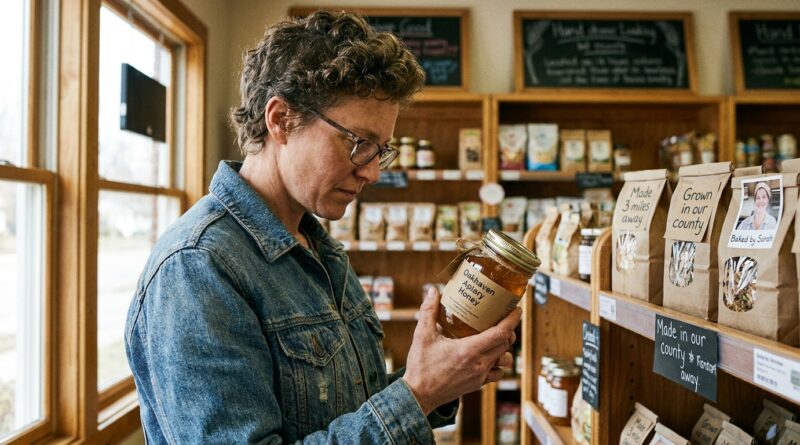
The Hyper-Local Label Check: How Neighborhood Makers Are Quietly Turning ‘Made Here’ Into a Daily Shopping Habit
You know the moment. You are standing in the aisle, holding two jars of jam or a bar of soap or a bag of coffee, and both are dressed up with words like “artisan,” “small batch,” and “crafted with care.” One may actually be made ten minutes away. The other may be designed locally but produced three states over, or overseas. That guessing game wears people out fast. So they grab the familiar big brand and move on. Fair enough. Most of us do not have time to play detective during a Tuesday grocery run. The good news is that learning how to tell if a product is truly made locally does not require a deep dive into trade law or a phone call to the company. You just need a simple label check you can do in under a minute, and once it becomes a habit, it changes how you shop without making shopping harder.
⚡ In a Hurry? Key Takeaways
- The fastest way to tell if a product is truly made locally is to check for a real street-level maker, a nearby production location, and clear wording like “made in” instead of vague branding terms.
- Start with a 3-step aisle test: read the back label, look up the company address, and watch for soft phrases like “inspired by,” “crafted for,” or “distributed by.”
- Buying truly local is not just a feel-good move. It keeps more spending, job skills, and small-scale production capacity in your own community.
Why “Local” Gets Fuzzy So Fast
Stores know people want a closer connection to what they buy. So the packaging has adapted. That is why you see words like “heritage,” “handcrafted,” “farm style,” and “local favorite” even when the actual production story is pretty thin.
Some labels are not lying exactly. They are just not answering the question you care about. A company can be locally owned but produce somewhere else. A brand can have a hometown founder story but use a distant co-packer. A shop can stock a “regional” item that is still made hundreds of miles away.
That is why the better question is not “Does this feel local?” It is “Where was this actually made, packed, brewed, baked, poured, assembled, or finished?”
How to Tell if a Product Is Truly Made Locally
1. Look for “made in” language, not mood words
Start with the plainest wording on the package. “Made in [your town or county]” is useful. “Produced in [nearby city]” is useful. “Roasted in-house” is useful.
Words like “crafted,” “artisan,” “small batch,” and “locally inspired” are not proof of anything by themselves. They describe a vibe, not a location.
2. Check the address, not just the logo
A lot of truly local makers put a real address on the package. Not just a website. Not just a social handle. A street address or a named production site is one of the best signs you are dealing with an actual neighborhood business.
If the label only says “distributed by” or “marketed by,” slow down. That often means the company selling it is not the company making it.
3. Watch the wording around “distributed by”
This is one of the biggest label tells. “Made by” points to the maker. “Distributed by” points to the seller or middleman. Those are not the same thing.
If you want the local economic impact, “made by” matters more.
4. Use the ZIP code test
If the package lists a town you recognize, great. Now check the ZIP code or city name. Is it actually your area, or just the nearest metro brand hub? Plenty of products borrow the identity of a city while being made far outside it.
You do not need perfection here. The goal is to get closer to the source with less guesswork.
5. Look for details only a real maker would include
Small neighborhood producers often include specifics because they are proud of them. Things like batch numbers, harvest dates, roast dates, workshop names, maker signatures, seasonal runs, or exact production neighborhoods.
Big companies can copy the look of that, sure. But when those details are paired with a clear local address and direct “made here” wording, the odds improve a lot.
The 30-Second Hyper-Local Label Check
If you want a dead-simple habit, use this in the aisle:
Step 1: Flip it over
Ignore the front label first. The front is marketing. The back is where the truth usually lives.
Step 2: Find one of three phrases
Look for “made by,” “manufactured in,” or “produced in.” If you cannot find those, that is already a clue.
Step 3: Confirm the location
Check whether the place listed is truly nearby. If it is within your town, county, or normal local shopping orbit, that counts for most people.
If all you find is “distributed by” plus a distant website, it is probably not the local buy you hoped for.
What Counts as “Truly Local” Depends on the Product
There is no perfect universal rule, and that is okay. Fresh bread, candles, beer, honey, furniture, and hardware goods all work differently.
For some items, local means made inside your neighborhood. For others, local may mean produced within your county or metro area. For a heavy item like a table or planter, made within fifty miles may be realistic. For pantry items, you may be able to find options made much closer.
The point is to pick a practical radius and stick with it. That gives you a filter you can use quickly.
Red Flags That a Product Is Trading on Local Vibes
Here are the common signs that something is wearing a local costume:
- Lots of hometown imagery, but no clear production location.
- “Designed in” your city, but actually manufactured far away.
- “Craft” language with a parent company that owns dozens of brands.
- A local-sounding brand name with only a fulfillment center listed.
- “Distributed by” a local office, with no maker named anywhere.
This comes up a lot in food and drink. If you have noticed some “craft” labels feeling a little too polished and corporate, you are not imagining it. The same label-reading instinct shows up in beer too, which is part of why pieces like The Hyper-Local Taproom Shift: How Neighborhood Breweries Are Quietly Replacing Big Craft With Truly Backyard Beer are striking a nerve with people.
Where This Habit Helps Most
Grocery stores
Jam, honey, salsa, coffee, pasta sauce, baked goods, spice mixes, pickles, and snacks are all good places to start. These categories are packed with “small batch” wording, so the label check really pays off.
Gift shops and markets
Soap, candles, ceramics, stationery, and wood goods often look local because the branding is warm and personal. Sometimes they are. Sometimes they are ordered wholesale and relabeled. A quick address check can save you from paying handmade prices for something mass-produced.
Hardware and home goods
This is where people often forget to look. Plant stakes, shelves, repair kits, cleaners, brushes, baskets, and seasonal decor may have local alternatives hiding in plain sight.
When the Label Is Still Not Clear
If you are still unsure, use the least annoying backup method. Search the business name on your phone and look for photos of the workspace, not just the branding. A real maker often shows their shop, kitchen, roasting space, studio, or production floor.
You can also ask one plain question at checkout or at the market stall: “Is this actually made nearby, or is it just the brand based here?” That is direct, friendly, and much better than trying to decode clever packaging alone.
Do Not Let Perfect Be the Enemy of Better
You do not need to investigate every purchase like a journalist. The goal is not purity. The goal is improvement.
If you switch even a few repeat buys to products that are clearly made close to home, that adds up. One coffee. One loaf. One six-pack. One gift. One cleaning product. Those choices become a pattern.
And patterns are what shift local economies.
At a Glance: Comparison
| Feature/Aspect | Details | Verdict |
|---|---|---|
| Front label wording | Terms like “artisan,” “crafted,” or “small batch” sound nice but usually do not confirm local production. | Weak proof |
| Back label details | A clear “made in” statement, production site, or local maker address gives you something real to verify. | Best signal |
| “Distributed by” language | This often points to a seller, office, or brand manager rather than the actual maker of the product. | Use caution |
Conclusion
You do not need more shopping guilt. You need a cleaner shortcut. A simple hyper-local label check gives you one. When you know how to tell if a product is truly made locally, you stop relying on packaging theater and start making faster, smarter choices in the moment. That matters right now. People want alternatives to giant retail systems, but most need a filter they can actually use between the cereal aisle and the checkout line. This is that filter. Done often enough, it turns grocery runs, gift errands, and hardware stops into small, steady acts of economic self-defense. More of your money stays nearby. More skills stay in use. More local making stays possible. And all you really changed was what you looked for on the label.