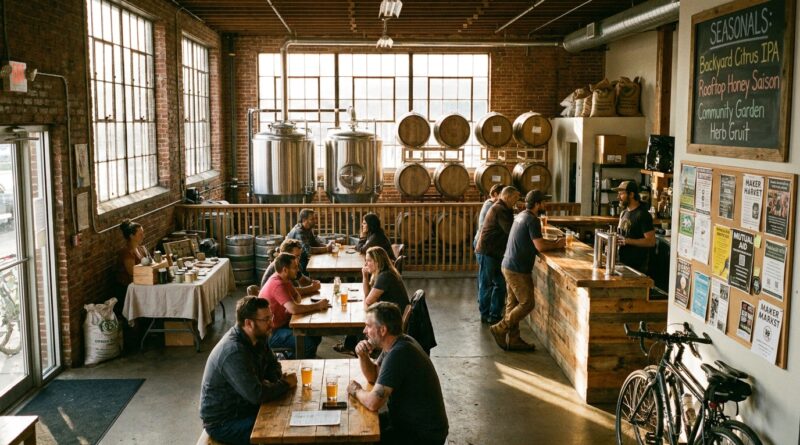
The Hyper-Local Taproom Shift: How Neighborhood Breweries Are Quietly Replacing Big Craft With Truly Backyard Beer
You are not imagining it. A lot of “craft” beer has started to feel weirdly un-crafty. The cans look sharp, the price keeps climbing, and somehow the beer still feels like it came from nowhere in particular. If you are tired of paying premium prices for a brand that acts local but ships from three states away, you are in good company. That frustration is a big reason the hyper local neighborhood brewery trend is gaining real traction. People want a taproom they can walk to, a brewer they might actually meet, and a pint tied to nearby grain, fruit, honey, or herbs. They want the neighborhood spot back. Quietly, that is exactly what is happening. While bigger regional craft brands are flattening out, the smallest breweries with the deepest local roots are becoming the places people return to, not just for beer, but for a real sense of place.
⚡ In a Hurry? Key Takeaways
- The hyper local neighborhood brewery trend is real. Small taprooms tied closely to their block, town, and local growers are winning loyalty while bigger “craft” brands lose some shine.
- If you want to support the right places, look for breweries that name nearby farms, host neighborhood events, collaborate with local makers, and sell mostly on-site instead of chasing wide distribution.
- Your beer money matters. Spending it at a truly local taproom can help keep dollars on Main Street, support nearby suppliers, and create a gathering place that feels useful beyond happy hour.
Why drinkers are turning away from big craft
For years, “craft” meant small, distinctive, and close to home. Then a lot of brands grew up fast. Some got bought. Some spread into every grocery store cooler in sight. Some kept the indie look while operating more like mini national chains.
None of that is automatically bad. Growth can mean stable jobs and good beer. But for regular drinkers, the tradeoff has become obvious. The beer costs more, feels less personal, and often travels a long way before it lands in your fridge.
That is where the hyper local neighborhood brewery trend comes in. It is less about hype and more about distance, relationships, and trust. The pitch is simple. Make beer for the people nearby. Use what is around you when it makes sense. Build a taproom people treat like a second living room.
What makes a brewery truly hyper local
Not every small brewery is part of this shift. Size alone does not make a place neighborhood-first. A truly hyper local brewery usually has a few clear traits.
It is built around the taproom, not the shelf set
These breweries often make most of their money on-site. That changes everything. The beer does not need to survive a long supply chain or appeal to everyone at once. It just needs to be fresh, interesting, and good enough to make locals come back next week.
It tells you where things come from
You will see a saison brewed with honey from a nearby beekeeper. A fruited sour made with berries from a farm 15 miles away. A dark lager made for a local bakery pop-up. The menu starts to read like a neighborhood map.
It works with other local businesses
Think coffee roasters, pizza makers, cheesemakers, farmers, artists, bakers, and musicians. The best neighborhood breweries are not trying to be islands. They act more like connectors.
It feels like a place, not just a brand
This part matters more than people think. A hyper local taproom often reflects the block it sits on. The staff knows regulars. The event board includes fundraisers, run clubs, craft markets, and dog rescue nights. That sense of familiarity is hard to fake.
Why the smallest breweries are suddenly in a better position
For a while, bigger looked safer. More tanks. More stores. More cans in more zip codes. But beer is a tough business, and expansion can get expensive fast. Packaging, shipping, distributor pressure, shelf competition, and ingredient costs add up.
The smallest neighborhood breweries can dodge some of those problems. They often do not need to win a statewide can war. They need a full taproom on Thursday, a solid trivia night on Tuesday, and enough local support to keep the tanks busy.
That lighter footprint can make them more flexible. They can test a one-off with local peaches. They can host a backyard maker market with six vendors on a weekend. They can change quickly because they are listening to the people in the room.
How to spot a neighborhood brewery that is the real thing
If you want to support this shift, it helps to know what to look for. A lot of places use the language of community. Fewer back it up in visible ways.
Check the menu language
Does it name specific local partners, or does it just say “locally inspired”? Real names are a good sign. So are details about farms, beekeepers, orchards, or neighborhood collaborators.
Look at the event calendar
Is it full of generic promotions, or does it include local fundraisers, school events, artist nights, run clubs, and small maker pop-ups? A real neighborhood taproom usually shares its space.
Ask one friendly question
You do not need to interrogate anyone. Just ask, “What here is most tied to the area?” If the answer comes quickly and specifically, you are probably in the right place.
Notice who is in the room
Are there regulars, families, nearby workers, dog walkers, and people greeting each other by name? That is usually a better signal than any branding on the wall.
Why this matters beyond beer
This is not just about finding a better pilsner. A strong neighborhood brewery can do the work an old-school third place used to do. It gives people a reason to gather without much planning. It offers local makers a place to test products. It gives farms and suppliers a nearby buyer. It keeps at least some spending circulating close to home.
That same local-first energy is showing up in other drink categories too. If this idea clicks for you, you will probably also like The Hyper-Local Kombucha Boom: How Neighborhood Fermenters Are Quietly Turning Tea Into a Community Anchor. It is the same basic story in a different glass. People want products with a real connection to where they live.
How to support the hyper local neighborhood brewery trend without spending a fortune
You do not need to become a beer superfan. Small habits help.
Start with one nearby taproom
Pick the place you can walk to, bike to, or reach in a quick drive. Convenience matters. The easiest local habit is the one you actually keep.
Buy pints, not just packaged beer
On-site sales usually help breweries more than grabbing a can somewhere else. If you have the choice, having one pint in the taproom can do more than a random four-pack run.
Show up for the side events
Craft fair. Food truck night. Charity raffle. Local band. These are not extras. They are often part of what makes the business work as a community anchor.
Bring someone new
The best kind of word-of-mouth is simple. “There is a place a few blocks away. Want to check it out?” That is how neighborhood spots become neighborhood institutions.
What brewery owners are getting right
The smartest local breweries are not trying to out-market giant brands. They are doing something better suited to this moment. They are being specific.
Specific about ingredients. Specific about place. Specific about whose products get featured in the taproom. Specific about the stories behind the beer.
That may sound small, but it is powerful. In a market full of polished sameness, clear local identity stands out. It gives people a reason to care.
What to be careful about
“Local” can be stretched pretty far by marketers. A taproom can be locally located without being locally rooted. So trust your eyes more than the slogan.
If a place talks endlessly about community but has no visible partnerships, no neighborhood events, and no sense of connection to nearby makers, it may just be using the right words.
Also, not every hyper local brewery will be cheap. Small-batch brewing with local ingredients can cost more. But there is a difference between paying for freshness, relationships, and local sourcing, and paying for a heavily branded illusion of craft.
At a Glance: Comparison
| Feature/Aspect | Details | Verdict |
|---|---|---|
| Beer sourcing and identity | Big craft often relies on broad branding and wide distribution. Hyper local breweries highlight nearby farms, local collaborators, and small-batch freshness. | Hyper local wins if you care about place and story. |
| Taproom experience | Larger brands can feel polished but generic. Neighborhood breweries often act like community living rooms with regulars, pop-ups, and local events. | Neighborhood taprooms offer stronger community value. |
| Impact of your spending | Money spent at a truly local brewery is more likely to support nearby jobs, growers, makers, and Main Street activity. | Best choice if you want your beer run to do more close to home. |
Conclusion
A very specific shift is happening right now. National and regional craft brands are flattening, while the smallest, most embedded neighborhood breweries are finding their footing by going radically local on ingredients, collaboration, and story. That is good news for drinkers who are tired of expensive beer with no real sense of place. It is also good news for neighborhoods that need durable gathering spots and stronger local supply chains. When you learn to spot and support the taprooms that are truly tied to nearby farms, backyard makers, and local events, an ordinary beer run turns into something more useful. You are not just buying a pint. You are helping build a tougher, friendlier, more connected local economy, one that feels a lot more human than another faceless four-pack in the cooler.