The Hyper-Local Kombucha Boom: How Neighborhood Fermenters Are Quietly Turning Tea Into a Community Anchor
People are worn out on drinks with nice labels and no real connection to the place they live. You grab a bottle from a cooler, flip it over, and it was brewed hundreds or thousands of miles away. For would-be makers, the frustration runs the other direction. They can brew a great batch at home, but moving from hobby to business feels expensive, confusing, and full of rules that seem built for giant beverage companies. That is exactly why the local kombucha brewery community is getting so interesting right now. Small fermenters, mixed-fermentation taprooms, and beverage co-ops are finding a middle path. They are staying small on purpose, selling close to home, and using workshops, refill programs, and neighborhood partnerships to turn a simple tea ferment into something bigger than a drink. In many places, kombucha is becoming a tiny manufacturing business, a social hub, and a practical way to keep local dollars moving around the block instead of out of town.
⚡ In a Hurry? Key Takeaways
- A local kombucha brewery community works best when it stays neighborhood-sized, sells fresh, and gives people reasons to return beyond just buying a drink.
- Start with a small fermenter, a refill model, and partnerships with nearby farms, cafes, or markets before chasing grocery store distribution.
- Food safety, licensing, and consistent fermentation matter a lot, so a small operator should get local rules clear early and build simple repeatable systems.
Why hyper-local kombucha is having a moment
Kombucha sits in a sweet spot. It feels healthier than soda, more social than a supplement, and more welcoming than a bar for people who do not drink alcohol. That makes it unusually flexible.
A neighborhood brewer can sell it on tap, bottle small runs, host tasting nights, teach fermentation classes, and build a refill program without needing a giant factory. The product also rewards freshness. A batch brewed nearby simply tells a better story than one shipped across the country in a truck.
That is a big part of the appeal of a local kombucha brewery community. People are not just buying flavor. They are buying trust, routine, and place.
What makes this a real business, not just a hobby
A lot of food trends look fun from the outside but are tough to turn into steady income. Kombucha has a better shot than most because it can stack several small revenue streams together.
1. Direct sales are still the cleanest starting point
Selling pints, growler fills, or canned small batches directly to neighbors keeps margins healthier than wholesale. It also gives brewers immediate feedback. If people love ginger pear and ignore lavender mint, you know by the weekend, not six months later.
2. Refill programs create repeat visits
Refills are simple and sticky. Customers bring back a clean bottle or growler, pay a little less, and return more often. That regular traffic can matter more than a one-time retail splash.
3. Workshops turn education into income
Fermentation classes, flavoring sessions, SCOBY care basics, and beginner brewing nights all do double duty. They bring in ticket revenue and turn curious visitors into loyal customers.
4. Flights widen the audience
Kombucha plus craft-soda flights are smart because they welcome kids, non-drinkers, people cutting back on alcohol, and anyone who just wants to try a few flavors without committing to a full pour.
Start smaller than you think
One of the biggest mistakes small beverage makers make is acting like their goal should be supermarket shelves right away. That sounds impressive, but it often crushes the business before it has time to grow roots.
The better model is usually local first. A small taproom. A booth at a neighborhood market. A shared production kitchen. A weekly pickup window. A few reliable cafe partners.
That same “smaller, closer, more focused” survival strategy is showing up in beer too. If you want a useful parallel, The Hyper-Local Brewery Crossroads: How Neighborhood Beer Makers Are Surviving The Cost Crunch By Getting Smaller, Not Bigger lays out why neighborhood beverage businesses are often stronger when they stop trying to scale like national brands.
How neighborhood fermenters can build a loyal following
You do not need a huge marketing budget. You need a reason for locals to care.
Make the ingredients feel local
Use fruit seconds from a nearby farm. Work with a local tea shop. Use herbs from a community garden or urban grower. Even spent ingredients can circle back into the neighborhood if you compost with a local partner or feed scraps into another small food project where allowed.
That kind of short supply chain does two things. It lowers waste, and it gives people a story they can taste.
Design the space as a third place
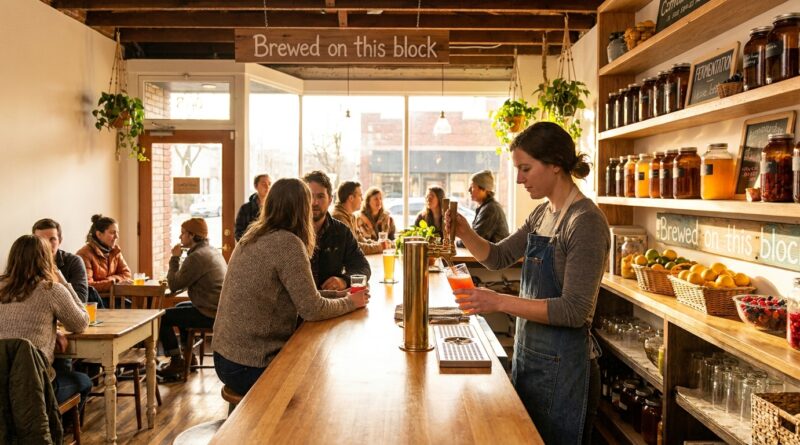
Some of the most promising kombucha spots are not trying to feel like sterile production rooms. They feel like a cross between a tasting bar, workshop studio, and community clubhouse.
A few stools. A refill station. Shelves with jars and brewing kits. Community board by the door. Maybe a weekday class and a weekend market pop-up. That is enough to make a tiny storefront feel useful all week, not just during rush hour.
Sell routine, not just novelty
Limited flavors are fun, but routine pays bills. A weekly refill club, a membership mug, a flavor-of-the-month subscription, or a standing pickup for office kegs gives customers a habit. Habits are better than hype.
The practical setup that lowers risk
Anyone thinking about joining a local kombucha brewery community should keep the first version as simple as possible.
Start with a tight menu
Three to five dependable flavors are easier to manage than a dozen experiments. You want consistency first. Once your tea base, sugar levels, carbonation, and turnaround are steady, then you can play more.
Pick one main sales channel
If you try to do events, wholesale, subscriptions, farmers markets, and a taproom all at once, things get messy fast. One main channel and one secondary channel is usually enough to start.
Build around reusable packaging
Refillable glass bottles, swing-tops, kegs, or tap service cut packaging costs over time and reinforce the local angle. Customers remember a refill ritual more than another disposable can.
Use oddball spaces wisely
Kombucha does not always need a huge footprint. Small former cafes, narrow downtown shops, underused market stalls, and shared production spaces can work well if they meet health and zoning rules.
What can trip people up
This is still food production. That means romance needs to share the room with discipline.
Licensing and regulation
Rules vary by city and state. Some places treat kombucha very differently depending on alcohol content, packaging, and where it is sold. Before spending on branding or furniture, get clarity from your health department and local regulators.
Consistency
Fermentation can drift. Temperature changes, tea strength, sugar levels, and timing all affect the final product. If customers cannot trust that the same flavor tastes roughly the same every week, they will not stick with you.
Overexpansion
The jump from “our neighbors love this” to “let’s distribute everywhere” can happen too fast. More tanks, more packaging, and more shelf space usually mean more cash tied up before demand is truly proven.
Why city partners should pay attention
For downtown groups, small-business offices, and property owners, these beverage spaces solve more than one problem at once.
They can activate storefronts that are too small or awkward for standard retail. They create a low-barrier form of light manufacturing. They bring foot traffic without depending only on late-night alcohol sales. And they tend to connect naturally with markets, wellness events, food halls, and neighborhood programming.
In plain English, they help a block feel alive.
At a Glance: Comparison
| Feature/Aspect | Details | Verdict |
|---|---|---|
| Best growth model | Neighborhood taproom, market sales, and refill memberships before large retail expansion | Safer and more sustainable for most small brewers |
| Customer draw | Fresh flavors, local ingredients, classes, and a welcoming non-alcohol-centered social space | Strong fit for repeat neighborhood traffic |
| Main challenge | Licensing, fermentation consistency, and the temptation to scale too fast | Manageable if systems and local compliance come first |
Conclusion
The local kombucha brewery community is not just a quirky food trend. It is a practical small-business model hiding in plain sight. Right now local kombucha breweries, mixed-fermentation taprooms and neighborhood beverage co-ops are popping up as a low-barrier entry point into manufacturing, because they sit at the intersection of food, wellness and social life. The smartest operators are keeping it simple. One fermenter. One short supply chain. A few loyal neighbors. Then they build from there with zero-waste ingredient loops, kombucha and craft-soda flights for non-drinkers, and workshops or refill programs that give people a reason to come back every week. For city partners and downtown districts, this is also a smart way to reuse small or unusual storefronts as fermentation-forward third places that keep money, skills, and ingredients circulating inside the neighborhood. Small can work. In this case, small might be the whole point.