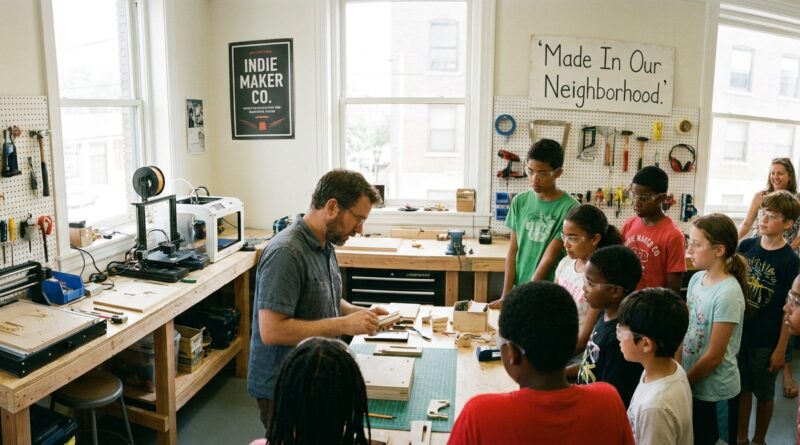
The Hyper-Local Career Pipeline: How Neighborhood Maker Camps Are Quietly Turning Middle Schoolers Into Tomorrow’s Manufacturers
Ask almost any small manufacturer, machine shop, fabrication studio or working maker what keeps them up at night, and you hear the same worry. Orders are there. Interest is there. Local demand is growing. But the next generation of people who can actually make the work happen feels fuzzy and far away. That is frustrating, especially when modern manufacturing is not the greasy, repetitive job many parents still picture. In a lot of neighborhoods, it is CAD files, CNC routers, laser cutters, fixture design, short production runs and fast problem-solving. The surprise is that a fix may already be taking shape in plain sight. Middle school maker camps, youth build programs and summer hands-on workshops are quietly becoming the first step in a real hyper local manufacturing workforce pipeline. When local shops show up early, with simple projects and a steady presence, kids stop seeing manufacturing as some distant industry and start seeing it as something people do right down the block.
⚡ In a Hurry? Key Takeaways
- Neighborhood maker camps can become a real hyper local manufacturing workforce pipeline when local shops participate consistently, not just once.
- Start with one age-appropriate project, one staff volunteer and one recurring visit each season to build trust with families and program leaders.
- Keep projects safe, simple and real. Kids do not need industrial machines to understand how local design, tooling and production careers work.
Why this matters more than people think
There is a strange mismatch happening right now. Small-batch production is growing. People want local goods. Businesses want shorter supply chains. But the talent story has not caught up.
Many younger students still do not know what modern manufacturing looks like. Their parents often do not either. If the only picture they have is an outdated shop class stereotype, they will miss the fact that local production can be creative, stable and well-paid.
That is why maker camps matter. They are not just summer babysitting with glue guns. At their best, they are low-pressure places where kids can discover that making things is fun, technical and useful.
For small manufacturers, this is not charity. It is long-term workforce work. It just starts earlier than many owners expect.
What these neighborhood camps are really doing
A good maker camp introduces kids to the building blocks of manufacturing without making it feel like a lecture. They might design a simple part, measure materials, assemble a product, test a prototype or solve a production problem as a team.
That matters because middle school is often when kids start deciding what kind of person they think they are. “I like making stuff.” “I am good with tools.” “I like design.” “I like figuring out how parts fit together.” Those small identity shifts stick.
And when those experiences are tied to real local businesses, the lesson gets stronger. The idea is no longer abstract. It becomes, “Oh, that bike rack, sign bracket or custom wood fixture was made by a shop near my house.”
Small exposure can have a big effect
Kids do not need a full apprentice program at age 12. They need a door cracked open. One shop tour. One simple production challenge. One chance to talk to someone who programs a CNC machine or builds jigs all day.
That is often enough to make manufacturing feel visible and possible.
Why parents are paying attention now
Parents are hunting for hands-on programs because so much of childhood has drifted onto screens. They are not wrong to want balance. A camp where kids design, cut, assemble and troubleshoot feels useful in a very concrete way.
It also answers a deeper worry. Families want to know there are real careers nearby, not just abstract dreams that require leaving town. When local makers step into youth programs, they give parents a believable path they can actually picture.
That path does not have to be narrow. A child can start with cardboard prototyping and end up in product design, machining, welding, industrial maintenance, fabrication, CAD drafting or a small business of their own.
What local makers and manufacturers should actually do
This is where some good ideas fall apart. Owners think they need a huge formal partnership, a polished curriculum and a stack of expensive equipment. They usually do not.
Start smaller.
1. Bring one real project
Pick a task that reflects the kind of work your shop really does, but simplify it for younger hands. That could mean:
- Designing a simple phone stand and talking through prototyping
- Building a small fixture from pre-cut parts
- Comparing strong and weak joints
- Explaining how a sketch becomes a production run
- Letting kids inspect sample parts and spot defects
Authenticity matters more than flash. Kids can tell when something is real.
2. Show the full chain, not just the “fun tool” part
Modern manufacturing is not only pressing buttons on cool machines. It is measurement, planning, material choice, quality checks, packaging and communication.
If students only see sparks and laser beams, they get a distorted picture. If they see the whole process, they start to understand the range of jobs inside one small shop.
3. Come back regularly
One guest appearance is nice. A repeating presence changes culture.
If a local business visits every summer, hosts a fall open house and provides scrap material for projects, people begin to connect that shop with opportunity. Trust grows. So does recognition.
4. Make it easy for camp leaders
Program directors are often stretched thin. If you want to be invited back, show up prepared. Bring materials. Keep instructions simple. Respect time limits. Build around safety rules.
The easier you make it for them, the more likely the partnership lasts.
What a real hyper local manufacturing workforce pipeline looks like
The phrase can sound bigger than it needs to be. In practice, a hyper local manufacturing workforce pipeline often looks like a staircase, not a giant program.
Step 1: Exposure in middle school
Camps, library build days, school maker clubs and neighborhood workshops let kids try making without a lot of pressure.
Step 2: Deeper projects in high school
Students who stay interested can move into fabrication classes, internship days, shadowing, capstone projects or paid summer work.
Step 3: First local job or training path
After that, the path can branch into community college programs, apprenticeships, direct shop work or micro-business ownership.
The important thing is that the path feels connected. Each step should point to the next one.
This is also where neighborhood infrastructure matters. If you want a wider view of how shared spaces support this trend, The Hyper-Local Makerspace Boom: How Neighborhood Tool Libraries Are Quietly Building the Next Wave of Backyard Manufacturers is worth a look. Tool libraries and makerspaces often become the bridge between casual interest and serious skill-building.
Why this helps local businesses right now, not just later
It is easy to hear “youth pipeline” and think only in 10-year timelines. But there are near-term benefits too.
Families become more loyal to local production
When parents see local businesses investing in kids, they understand those businesses differently. The shop is no longer an invisible industrial unit tucked behind a warehouse row. It becomes part of the neighborhood.
That makes “buy local” more concrete. People support what they can see.
Shops get better known in their own backyard
Many small manufacturers are oddly invisible to the people who live closest to them. Camps and youth programs change that. They create word of mouth without feeling like marketing.
Technical skill stays in the community
This may be the biggest point. If young people never see local technical careers, they assume opportunity lives elsewhere. Usually that means bigger brands, larger cities and jobs that pull talent away.
But if they see skilled work happening nearby, and see adults who built decent lives doing it, more of that know-how stays local.
Common mistakes to avoid
Talking over kids’ heads
You do not need to explain five-axis machining in full detail to a seventh grader. Focus on what problem the tool solves. Keep the language plain.
Turning it into a sales pitch
Students and parents respond better to curiosity than advertising. Teach first. Invite questions. Let the value speak for itself.
Using fake projects that have nothing to do with your work
If your shop makes brackets, fixtures or custom packaging tools, find a kid-friendly way to reflect that. Real work is more interesting than a generic craft project.
Making safety an afterthought
This one is simple. Age-appropriate tools only. Clear supervision. No shortcuts. A good program should leave kids excited, not scared.
What schools, camps and community groups should ask for
If you run a youth program, you do not need a giant corporate sponsor. Ask local makers for specific help:
- A two-hour build session
- Sample materials and offcuts
- A simple design challenge
- A shop tour for older students
- A parent night about local career paths
Specific asks get better responses than vague partnership talk.
Also, do not limit your list to “traditional manufacturers.” Cabinet shops, sign makers, welders, bike builders, metal fabricators, 3D print studios, repair businesses and small product brands all have something useful to show.
At a Glance: Comparison
| Feature/Aspect | Details | Verdict |
|---|---|---|
| One-off shop visit | Good for awareness, but easy to forget if there is no follow-up or local context. | Helpful start, not enough on its own |
| Recurring maker camp partnership | Builds trust, repeat exposure and a visible path from curiosity to real local skills. | Best option for a lasting pipeline |
| Generic STEM program with no local industry tie | Can be fun and useful, but often fails to connect kids to actual neighborhood careers. | Good supplement, weak workforce bridge |
Conclusion
Hyper-local manufacturing is growing, but the concern behind it is real. Small shops and studios need people who can run equipment, solve design problems and keep production rooted close to home. The encouraging part is that the start of that answer may be much closer than most business owners think. Maker camps and youth build programs are filling up because families want hands-on learning tied to real life. When neighborhood makers step into those spaces with practical, honest projects, they do more than entertain kids for an afternoon. They help build a hyper local manufacturing workforce pipeline, they give families a reason to believe in local production over anonymous imports, and they keep skill, confidence and opportunity circulating inside the community. It does not take a giant budget or a formal academy to start. One project. One camp. One consistent relationship. That is often enough to help a whole neighborhood imagine making things here, and keeping that future here too.