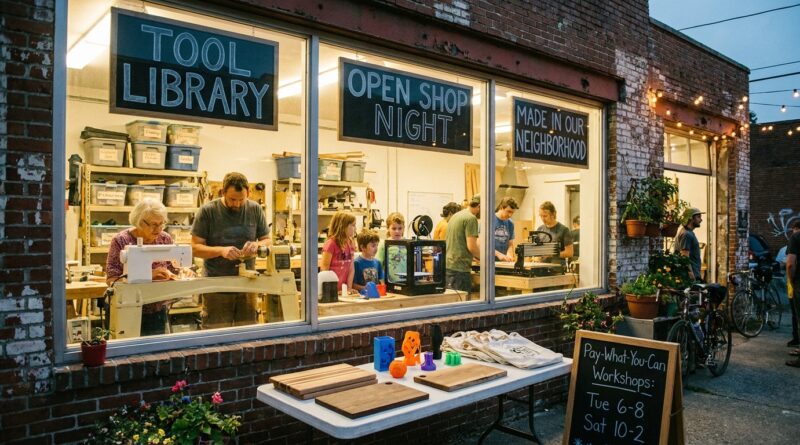
The Hyper-Local Makerspace Boom: How Neighborhood Tool Libraries Are Quietly Building the Next Wave of Backyard Manufacturers
You can feel the gap, even if you do not have a name for it. Maybe you have a repair idea scribbled on a notepad, a product sketch sitting next to the toaster, or a side hustle that never gets past the “someday” stage because you do not own a laser cutter, CNC router, or even a decent soldering station. That is frustrating. A lot of people want to make things locally, but they assume the real tools and training live somewhere far away, tucked inside a startup hub, a college lab, or a factory park they will never enter. The quiet shift happening now is that a hyper local makerspace tool library is giving regular people a place to learn, borrow, build, and test ideas close to home. These neighborhood spaces are not just hobby rooms. They are becoming on-ramps to small-scale manufacturing, repair businesses, farm fabrication, and local product making that can actually stay rooted in the community.
⚡ In a Hurry? Key Takeaways
- Neighborhood makerspaces and tool libraries are making pro-grade tools and basic manufacturing training easier to access close to home.
- Start by checking your library, school district, community college, farm co-op, or downtown nonprofit for open shop hours, safety classes, and tool borrowing programs.
- These spaces work best when people use them safely, take the required training, and support local makers by buying small-batch goods made in their own area.
Why this matters now
For years, “advanced manufacturing” sounded like something that happened elsewhere. Big buildings. Big contracts. Big machines. Not your block.
But that picture is changing. Community workshops, school fab labs, rural innovation barns, and neighborhood tool libraries are opening in places that used to have no clear path for hands-on learning. Empty storefronts are becoming laser and wood shops. Public libraries are adding 3D printers and sewing equipment. Career centers are opening evening access for adults. Some farm towns are even building shared fabrication spaces for repairs, prototyping, and low-volume production.
That matters because talent often does not leave a town from lack of ideas. It leaves from lack of access. If people can learn the tools where they live, more of them can stay, build, and sell where they live too.
What a hyper local makerspace tool library actually looks like
The phrase can sound more complicated than it is. Think of it as a shared place where people can use tools they could not afford, store, or justify buying on their own.
Makerspace
A makerspace usually gives you access to equipment and workstations. That might include 3D printers, laser cutters, vinyl cutters, woodworking tools, metalworking gear, sewing machines, electronics benches, or software for design and fabrication.
Tool library
A tool library works more like a book library. You borrow tools for home or job-site use. Some focus on drills, saws, ladders, garden tools, and repair basics. Others include specialty items like tile saws, torque wrenches, soldering kits, or small shop equipment.
The new mix
The most interesting spaces now combine both. You can take a safety class, use the shop for one project, then borrow smaller tools to finish the work at home. That mix lowers the barrier in a big way.
What people can realistically make in these spaces
This is where the story gets practical. These spaces are not just for novelty keychains and science fair projects.
Depending on the equipment, local makers are producing:
- Custom signs, displays, and retail fixtures
- Small-batch home goods and kitchen products
- Replacement parts and repair components
- Farm and garden tools, brackets, and jigs
- Furniture, shelving, and built-ins
- Wearables, bags, and sewn goods
- Electronics enclosures and prototypes
- Educational kits and classroom materials
That does not mean every neighborhood shop is ready to crank out full factory runs. Most are better suited to prototyping, short-run production, repair work, and skill-building. But that is the point. A lot of businesses start small. One fixture. Ten units. Fifty market-ready products. Local manufacturing often begins at that scale.
Where to find these spaces in your own ZIP code
If you have never looked before, you might be surprised by what is already there.
Start with the obvious places
- Public libraries
- School district career centers
- Community colleges
- Downtown arts nonprofits
- Workforce development centers
- Extension offices and farm groups
- Habitat ReStore-style building reuse groups
Use the right search words
Do not just search “makerspace near me.” Try:
- hyper local makerspace tool library
- tool library + your city
- fab lab + your county
- community workshop + your town
- public library makerspace
- borrow tools + your area
Ask three simple questions
When you find one, ask:
- What tools can the public use?
- Do I need training or membership first?
- Can I make products to sell, or only personal projects?
Those answers tell you quickly whether the space is a casual craft room, a serious fabrication lab, or something in between.
Why these spaces are quietly creating backyard manufacturers
Most people do not wake up and decide to become a manufacturer. They start by fixing a problem.
A gardener needs a better seed tray. A mechanic needs a custom bracket. A parent wants safer classroom storage. A local shop owner needs a small run of display stands but cannot meet a huge vendor minimum.
Shared tools let ordinary people test those ideas without taking on the full cost of a shop lease, industrial equipment, and formal schooling. That lowers the risk enough for more people to try.
And once a few neighbors start making useful things, a small local supply chain can form around them. One person knows CAD. Another does finishing work. Another handles packaging. Someone else runs a weekend market stall. That is how local production ecosystems grow. Quietly at first.
What good training looks like
Not every space is equal. The best ones do more than unlock a room full of expensive machines.
They teach process, not just buttons
You want to learn how to measure, design, choose materials, use the machine safely, and finish a product well. Hitting “print” is the easy part.
They offer beginner-friendly pathways
Look for spaces with intro classes, certifications by machine type, office hours, and project-based learning. A good shop should make beginners feel welcome without pretending the equipment is simple or risk-free.
They connect learning to local needs
The strongest spaces teach skills that match the area. In one town that might be woodworking and furniture repair. In another it might be farm welding, textiles, prototyping, or sign making.
That local fit matters more than trendiness.
How families and schools fit into the picture
This boom is not just for adults trying to launch side businesses. It also matters for kids and teens who need a real path into making things.
When young people can sell simple products, learn pricing, and see how ideas become objects, they build confidence fast. That is one reason stories like The Hyper-Local Kids’ Table: How Youth Maker Markets Quietly Build the Next Wave of Neighborhood Manufacturers feel so connected to this moment. Youth markets and neighborhood shops can feed each other. One builds early confidence. The other builds real-world technical skills.
That pipeline is a lot more useful than telling kids to “learn STEM” in the abstract.
What local buyers can do right now
People love saying they want to buy local. This is where that idea can get more concrete.
Buy the first version
Many local products start rough. Packaging may be plain. Colors may be limited. The first run may not be perfect. That is normal. Early buyers help fund better tools, better materials, and better process.
Hire local for small custom jobs
Need a sign, shelf, repair part, planter box, market display, or school fixture? Ask whether a neighborhood maker can do it before ordering from a giant catalog.
Support the spaces, not just the products
Memberships, donations, class fees, volunteer hours, and tool drives keep these places running. If the shop closes, the local pipeline closes with it.
Common concerns people have
“I am not technical enough for this.”
You do not need an engineering degree to start. You need curiosity, patience, and a willingness to take safety rules seriously. Many successful makers begin with one machine and one problem they care about.
“Is this just for hobbyists?”
Some spaces are hobby-focused. Others are clearly business-friendly. Ask whether members can produce goods for sale, whether there is storage, and whether the machines are reliable enough for repeat work.
“Can this really help local economies?”
Yes, though not in a magic overnight way. These spaces are best at seeding lots of small activity. Repair services. Market goods. Fixtures for local shops. Tiny production runs. Skill-building that leads to jobs. Over time, that adds up.
At a Glance: Comparison
| Feature/Aspect | Details | Verdict |
|---|---|---|
| Access to tools | Shared shops and tool libraries let residents use or borrow equipment they likely could not buy themselves. | Best low-cost entry point for beginners and side hustlers. |
| Training and skill-building | Good spaces offer safety classes, machine certifications, and project-based learning tied to local needs. | Worth joining if education is built in, not treated as an afterthought. |
| Business potential | Most spaces support prototyping, custom jobs, repairs, and small-batch products rather than mass production. | Strong launchpad for hyper-local manufacturing, but not a full factory replacement. |
Conclusion
The big shift here is simple. You no longer have to wait for some distant innovation district to bring manufacturing back. Across the country, community makerspaces, school-based fabrication labs, and neighborhood tool libraries are opening or expanding with one clear goal: teach locals how to use pro-grade manufacturing tools and keep that talent rooted in the community. That means “advanced manufacturing” is no longer locked inside far-off industrial parks. It is showing up on farms, main streets, and in shared spaces much closer to home. If you have been sitting on an idea, this is your sign to go look around your own ZIP code. You may find the tools, the teachers, and the future customers are already nearby. And if you are a buyer, your support can turn local pride into something more solid: a real, growing base of small, skilled, hyper-local producers.