The Hyper-Local Reshore Wave: How Neighborhood Factories Are Quietly Bringing ‘Made Nearby’ Back Home
You can feel the strain in everyday life. A basic household item takes three weeks to arrive. A replacement part is suddenly out of stock. Prices jump, quality slips, and the label tells you almost nothing about who made the thing or where your money went. That frustration is exactly why hyper local reshoring small manufacturers matter right now. Quietly, in old warehouses, back lots, shared kitchens, and light industrial strips, small factories are coming back. They are making socks, sauces, metal parts, furniture, skincare, and packaging closer to the people who buy them. The hard part is that most of us do not know where to look. National headlines talk about “reshoring” like it is a giant policy project. On the ground, it is often one workshop, one block, one hiring sign, and one reopened production line at a time. Once you know how to spot them, “made nearby” stops being a slogan and starts becoming a practical shopping choice.
⚡ In a Hurry? Key Takeaways
- Hyper local reshoring means small manufacturers are bringing production back to your city or neighborhood, not just back to the country.
- Start by checking industrial districts, farmers markets, local business directories, and product labels for real local production clues.
- Supporting nearby makers can mean faster restocks, clearer sourcing, better accountability, and more money staying in your community.
What “hyper-local reshoring” actually means
Reshoring usually gets framed as a national story. A company moves production back from overseas. A governor cuts a ribbon. A CEO gives a speech. That is part of it, sure.
But the more interesting story is smaller. Hyper local reshoring small manufacturers are businesses that bring making, packing, assembling, or finishing back to a neighborhood scale. That can mean a former garment shop reopening in a city corridor, a food maker moving out of a distant co-packer and into a local micro-plant, or a machine shop taking on work that used to be imported.
This does not always look dramatic. Sometimes the shift is just one room with new sewing machines. Sometimes it is a bakery adding a packaging line instead of outsourcing it two states away. Small changes still matter. They shorten supply chains, create jobs nearby, and make products feel rooted in a place again.
Why people are suddenly paying attention
People are tired of fragile systems. That is the plain truth.
When supply chains stretch across oceans, every bump gets passed on to the buyer. Delays. Price swings. Mysterious substitutions. Goods that look identical no matter where you shop. A lot of consumers are not chasing nostalgia. They are chasing reliability.
Small local manufacturing answers that in a simple way. Shorter routes. Fewer middle steps. Easier communication. If a small factory runs into trouble, you can often see it, ask about it, or work around it faster than if your product is stuck in a container halfway around the world.
If this trend feels familiar, it connects well with Beyond The Hype: How Hyper‑Local Makers Are Quietly Replacing Global Supply Chains, which gets at the same real-world frustration many buyers are feeling.
What these neighborhood factories actually look like
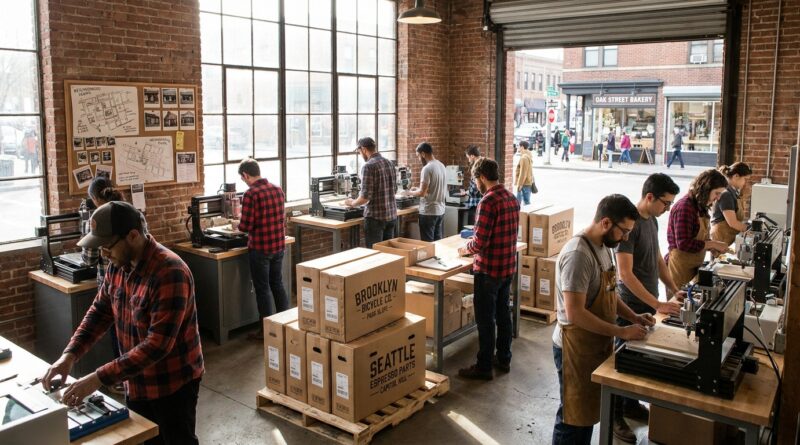
Forget the old image of a giant smokestack plant. A lot of today’s small manufacturing spaces are modest and easy to miss.
Former warehouses with new life
A sock mill, screen printer, soap works, or cut-and-sew studio may be operating in a building you drive past every day. The outside can look plain. Inside, people are making real products with modern equipment and small teams.
Food production hidden in plain sight
That local jam brand or hot sauce company may not just be “based” in your city. It may be cooking, bottling, labeling, and shipping from a compact facility behind a market or on a side street in a commercial strip.
Hybrid workshops
Some businesses mix retail and production. You can buy the candles, bags, ceramics, or pantry goods up front and see some of the making process in back. That visibility builds trust fast.
Shared maker spaces that become real factories
Many small brands start in shared commercial kitchens or industrial co-ops, then expand into dedicated local production. Reshoring at this scale often starts small, then sticks.
How to find small manufacturers in your own city
This is where most people get stuck. They want to buy local, but they do not know who is actually making anything nearby.
Read labels carefully
“Designed in” is not the same as “made in.” Neither is “distributed by.” Look for words like manufactured, sewn, milled, roasted, bottled, assembled, or packed locally. Those are stronger clues.
Search industrial, not just retail, areas
Use map apps to browse light industrial districts, warehouse corridors, and maker hubs near your bus line or main roads. Many small factories are not in trendy shopping districts.
Check farmers markets and craft fairs differently
Do not just ask, “Is this local?” Ask, “Do you make this here?” and “Where is your production space?” The answer tells you whether you are supporting a local maker or just a local reseller.
Use local business directories
City economic development offices, maker guilds, chambers of commerce, and neighborhood business associations often maintain directories. Search terms like “small batch,” “made in [city],” “micro-manufacturing,” and “local production” can help.
Watch hiring posts
If a company is hiring sewing operators, line cooks for packaged foods, machine technicians, cutters, assemblers, or packers, that is often a sign that real production is happening nearby.
Ask stores who supplies them
Independent grocers, gift shops, hardware stores, and boutiques usually know which products are truly made nearby. Store owners love sharing this when they have a good local source.
How to tell if a “local” brand is truly making things locally
Not every neighborhood-friendly brand is a local manufacturer. Some are honest design brands that outsource production elsewhere. That is fine. It is just different.
Here are better signs that a company is truly part of the hyper local reshoring small manufacturers wave:
- They name the neighborhood or facility where production happens.
- They show equipment, workstations, or staff doing the making.
- They can explain where materials come from and what steps happen locally.
- They hire for production roles, not just marketing and sales.
- They talk about lead times, batch sizes, or capacity in plain terms.
A vague “inspired by local makers” message is not the same thing as local manufacturing. You are allowed to ask clear questions.
Why this matters beyond feel-good shopping
Buying from nearby manufacturers is not only about civic pride. It changes how money and trust move.
More resilience
If one supplier fails, a local producer can often adapt more quickly. They may switch materials, adjust runs, or tell customers what is happening in real time.
Better accountability
It is easier to stand behind quality when your buyers can find you. Being local does not guarantee better products, but it does make hiding poor quality harder.
More local jobs
These jobs matter because they are not abstract. They are on your neighbor’s shift, your cousin’s commute, your city’s tax base, and your main street lunch rush.
More distinct products
Local makers often produce things with regional identity, practical design choices, or smaller runs that large global systems tend to flatten out.
What to ask before you buy
You do not need to interrogate anyone. A few friendly questions can tell you a lot.
- Where is this made?
- What part of the process happens here?
- Do you have a workshop or production site nearby?
- Do you make small batches or continuous runs?
- Can customers visit, tour, or see production online?
The point is not to catch someone out. The point is to spend your money with your eyes open.
What local governments and neighborhoods can do
Consumers are not the whole story. Hyper-local manufacturing also depends on whether a city makes room for it.
Affordable light industrial space matters. So do zoning rules, permit timelines, transit access, and utility costs. If every workable building turns into storage, luxury lofts, or chain retail, neighborhood production gets squeezed out.
That is why this trend really is local. National policy can encourage reshoring. Neighborhood decisions decide whether it lands anywhere useful.
How to support the right businesses without overspending
Let’s be honest. Some locally made goods cost more. Small runs and fair wages usually do.
That does not mean you need to replace everything at once. Start with categories where reliability and repeat buying matter. Socks. Pantry staples. Cleaning products. Home goods. Gifts. Repair parts. Workwear. If the item is something you buy often, a stable nearby source can be worth more than a tiny discount from a faraway seller.
You can also support these businesses in ways that cost little or nothing. Leave reviews. Tell local stores to stock them. Share their hiring posts. Visit open houses. Ask your workplace, school, or event planner to source from them.
At a Glance: Comparison
| Feature/Aspect | Details | Verdict |
|---|---|---|
| Supply chain length | Nearby production usually means fewer shipping steps, faster feedback, and less exposure to distant delays. | A strong reason to buy local when reliability matters. |
| Price | Small manufacturers may charge more up front because of labor costs, smaller runs, and local overhead. | Worth comparing against durability, restock speed, and community impact. |
| Community benefit | Purchases are more likely to support local jobs, nearby suppliers, and neighborhood commercial spaces. | One of the biggest long-term advantages. |
Conclusion
The big reshoring story can feel distant and abstract. The useful version is much closer to home. It is the sock mill in a revived warehouse. The food micro-plant behind the grocery store. The small batch workshop hiring people who ride your bus line and spend their paychecks down the street. When you learn how to spot and support hyper local reshoring small manufacturers, a fuzzy national trend turns into something practical. You buy with more confidence. Small factories get a better shot at surviving. More of each dollar keeps moving through your community instead of disappearing offshore. That will not fix every supply chain problem overnight. But it does give you a map, and right now, that is a lot more helpful than another headline.