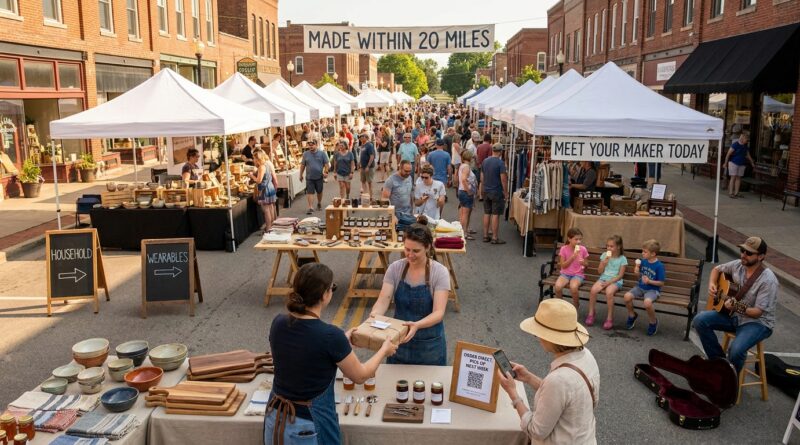
From Parking Lot To Pop-Up Factory: How Weekly Maker Markets Are Quietly Rewiring Local Shopping
You know the feeling. You say you want to shop local, then you walk into a giant store and every shelf looks like every other shelf in every other town. Same candles. Same cutting boards. Same soap with a fake “artisan” label. Meanwhile, the people actually making interesting things in your area are tucked into a Saturday stall between the lettuce and the honey, and by the time you remember that great ceramic mug or hot sauce, the market is over and the maker is hard to track down again. That is the gap the hyper local maker market is starting to fix. What looks like a simple weekend shopping stop is slowly turning a parking lot into a pop-up factory floor, showroom, and neighborhood business incubator. And if shoppers start treating these markets less like a once-in-a-while outing and more like a weekly buying habit, the effect on local income and community resilience is a lot bigger than it first appears.
⚡ In a Hurry? Key Takeaways
- A hyper local maker market turns casual browsing into repeat spending that helps small local businesses survive and grow.
- Pick 2 or 3 items you can buy weekly or monthly from makers, like bread, candles, gifts, skin care, ceramics, or repairs, and build them into your routine.
- Buying direct usually means better quality, clearer sourcing, and more of your money stays in your community instead of going to platform fees and middlemen.
Why these markets matter more than they look
From a distance, a weekly maker market can seem small. A few tents. A coffee truck. Maybe some live music. Nice, but not exactly an economic force.
Look closer, though, and something more interesting is happening. These markets give local producers a real-world place to test products, meet repeat customers, and get paid without giving a giant chunk of the sale to an online marketplace. That matters right now.
Material costs are up. Rent is up. Packaging is up. Shipping is expensive. And many online selling platforms take fees that eat into already thin margins. For a small maker, one good market day can be the difference between ordering more supplies and pausing production for a month.
That is why the hyper local maker market is not just a cute community event. It is becoming a practical piece of local commerce.
From “that looks nice” to “I buy this every week”
The biggest problem for local makers is not always getting discovered. It is getting remembered.
Lots of shoppers happily buy one handmade item at a market. Fewer come back the next week with a plan. That is the shift that changes everything.
Casual browsing does not create stable income
If you buy a handmade candle once every nine months, the maker gets a nice sale. If twenty households buy one every month, the maker can forecast inventory, buy supplies in smarter batches, and keep producing.
Repeat demand is what turns a hobby business into a durable local one.
Weekly habits build real local infrastructure
Think about how people use supermarkets. They do not “discover” milk every week. They simply have a routine. Local markets work best when shoppers do the same thing with a few categories.
Maybe it is bread from the baker, soap from the body care stall, coffee beans from the local roaster, birthday gifts from the printmaker, and seasonal jam from the preserves table. None of that has to replace every big-box purchase. It just has to become normal.
Why a parking lot can function like a pop-up factory
Here is the quiet part most people miss. When makers gather in one place every week, the market starts doing jobs that used to belong to traditional retail.
It becomes a showroom
You can touch the fabric, smell the soap, test the handle on the mug, and ask whether the cutting board needs special oil. That is hard to beat.
It becomes a research lab
Makers learn fast. Which scent sold out first. Which price point got pushback. Whether customers want refill pouches, larger jars, or simpler packaging.
It becomes a mini production network
One maker meets a local illustrator. The illustrator meets a printer. The printer meets a candle maker who needs labels. That is how local supply chains start to form. Not with a giant policy speech. With folding tables and repeat foot traffic.
What shoppers get out of it, besides feeling virtuous
Let’s be honest. People are tired of being told to spend more money “for the greater good” if the product is worse or the process is inconvenient.
The good news is that buying from a hyper local maker market can be a better deal in the ways that count.
Better quality control
You are buying from the person who made it, or from someone standing one step away from production. If something breaks, melts, shrinks, or tastes off, you know who to ask.
More useful product knowledge
A local ceramicist can tell you which mug is dishwasher safe. A skin care maker can explain what is unscented versus fragrance-free. A woodworker can tell you how to maintain a board so it lasts for years.
Stronger trust
There is less mystery. Fewer fake reviews. Fewer generic listings with polished photos and vague descriptions.
This is part of the same shift behind The Hyper‑Local Repair Revolution: How Neighborhood Fix‑Shops Are Quietly Outcompeting Big Retail. People are starting to value direct relationships with the person doing the work, whether that work is repairing a jacket or making a fresh batch of soap.
How to make your local market habit actually useful
You do not need to become a full-time market shopper. You just need a better system.
1. Choose a few repeat-buy categories
Start with things you already buy regularly. Bread. Snacks. Coffee. Skin care. Gifts. Home goods. Pet treats. Cleaning products.
If you try to buy everything local all at once, it gets tiring. If you pick three categories, it becomes manageable.
2. Save maker contact info on the spot
This is where many good intentions die. You love the product, then lose the business card.
Take a photo of the stall sign. Follow the maker on social media while you are standing there. Save their name in your notes app with what you bought.
3. Ask what they bring every week
Some makers rotate inventory. Others take preorders. A simple question like “Are you here every Saturday?” or “Can I order this in advance?” can turn a one-time purchase into a reliable habit.
4. Use markets for gifts before emergencies hit
One reason people fall back on chain stores is last-minute panic. Keep a short list of local makers for birthdays, host gifts, teacher gifts, and holidays. Future you will be grateful.
5. Spend with intention, not guilt
You are not required to buy the most expensive handmade thing on every table. Support works better when it is sustainable for you too.
A loaf of bread every week is more valuable than one giant guilt purchase followed by six months of nothing.
What local makers need from communities right now
They need consistency more than applause.
Most makers do not need to “go viral.” They need enough repeat customers to plan labor, order materials, and justify staying in business. That stability helps them improve their products, expand their line, and sometimes move into a shared storefront or studio.
Markets can also connect nicely with other neighborhood-first habits. The same person who buys handmade kitchen towels may be more likely to repair an old lamp instead of replacing it, or get boots resoled instead of tossed. Again, that is where local repair culture and local maker culture reinforce each other.
What towns and organizers can do better
Shoppers matter, but organizers matter too.
Make recurring schedules obvious
If customers cannot tell when and where a market happens, they cannot build a habit around it. Weekly consistency beats occasional hype.
Help people re-find vendors
Simple vendor directories, QR code boards, and email recaps make a big difference. One of the biggest weaknesses of one-off events is that great makers disappear after you walk away.
Mix makers with practical sellers
A market full of decorative goods is fun. A market with practical staples gets repeat traffic. Bread, produce, pantry items, repair services, textiles, ceramics, soap, and small gifts create a healthier mix.
At a Glance: Comparison
| Feature/Aspect | Details | Verdict |
|---|---|---|
| Convenience | Big-box stores are open more often, but weekly maker markets can become easy if you build a repeat list and save vendor info. | Big-box wins on hours. Local wins if you turn it into a routine. |
| Product quality and transparency | At a maker market, you can ask who made it, what it is made from, and how to use or maintain it. | Strong advantage for local makers. |
| Local economic impact | Direct purchases keep more money with the producer and reduce dependence on high-fee platforms and distant suppliers. | Best choice if you want your spending to strengthen your community. |
Conclusion
The next time you stop by a market, it helps to think beyond the tote bag. Right now, as economic anxiety rises, local makers are getting squeezed between rising material costs and big platforms that take a painful cut of every sale. Helping neighbors turn casual market browsing into intentional weekly purchasing directly stabilizes local income, keeps more money cycling inside the community, and gives small producers the repeat demand they need to keep making. For you, the payoff is immediate. Better quality goods. Real relationships with the person who made them. Clearer sourcing. Less anonymous shopping. And maybe most important, the reassuring feeling that a small weekly habit is doing real work. A hyper local maker market is not just a pleasant Saturday stop. It is one of the simplest ways to help rebuild a resilient, local-first economy from the ground up.