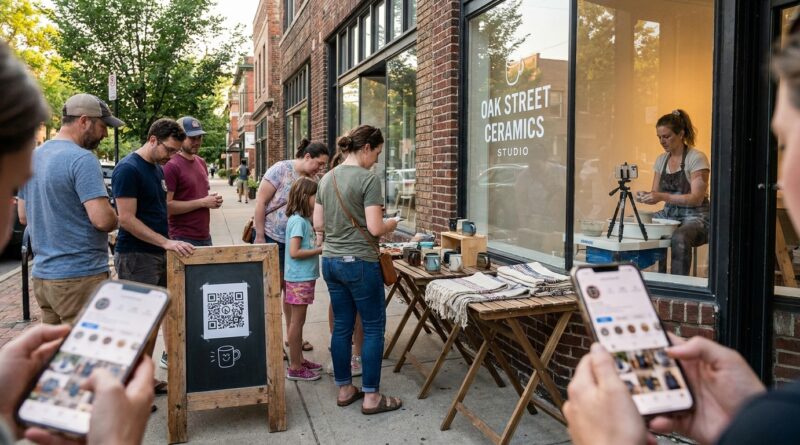
The Hyper‑Local Factory In Your Phone: How Neighborhood Makers Are Quietly Turning Instagram Into A Live Shop Window
You find a ceramic mug you love at a street fair. Or a hand-poured candle, a leather wallet, a baby blanket that does not look like every other one online. Then Monday comes. The booth name is gone from memory, the business card is missing, and Google gives you page after page of ads, marketplace resellers, and suspiciously identical products. It is annoying, and honestly a little sad. The good news is that many neighborhood makers are not missing. They are just hiding in plain sight on Instagram. For a lot of small crafters, Instagram reels, stories, highlights, and direct messages are the whole shop. If you know how to search, what clues to look for, and how to buy safely, your phone becomes a surprisingly good local maker directory. Here is how to find local makers on Instagram without getting buried under big-brand noise.
⚡ In a Hurry? Key Takeaways
- Use Instagram search with your city name, neighborhood, market names, and product words like “ceramics,” “candles,” or “jewelry” to find real local makers fast.
- Check tagged posts, location pages, story highlights, and who local market organizers follow. That is often better than plain Google.
- Before you buy, look for consistent posting, process videos, customer pickups, clear pricing, and secure payment options so you are supporting a real maker, not a copycat account.
Why Instagram became the quiet storefront for local makers
Many small makers do not have time or money for a polished website, paid ads, and a full online store. They are making the thing, packing orders, doing pop-up events, and answering customer messages themselves.
So Instagram becomes the easiest place to show new work. A reel shows the mug being trimmed. A story shows what is left after the Saturday market. A highlight explains custom orders. A pinned post gives pickup times. It is messy, but it is real.
That is why learning how to find local makers on Instagram matters. It is often where the freshest inventory shows up first.
Start with smarter Instagram searches
Use city + product keywords
Do not just search “candles” or “pottery.” That is a fast route to giant accounts and random sellers. Search in combinations like these:
“Brooklyn candles”
“Austin ceramic mug”
“Portland handmade jewelry”
“Chicago leather goods”
“Silver Lake florist”
“Toronto tufting”
Try your city, your neighborhood, and nearby suburbs. A lot of makers avoid broad labels and use the place name their customers know best.
Search market and event names
If you saw a maker in person, the best clue may not be the maker’s name. It may be the event name. Search the weekend market, craft fair, flea market, school fundraiser, or street festival on Instagram.
Then check:
- Posts tagged at that event
- The organizer’s followers and following lists
- Reels from the event
- Story highlights labeled “vendors” or “market day”
This works because event organizers usually tag their sellers, even when sellers do not have strong websites.
Use hashtags, but be picky
Hashtags still help, just not the giant generic ones. Skip broad tags like #handmade or #smallbusiness when possible. They are crowded and easy to spam.
Better tags look like this:
- #seattlemaker
- #denverceramics
- #phillyartistmarket
- #atlantahandmade
- #brooklynjeweler
- #dallasmakersmarket
Also try tags tied to neighborhoods, not just cities. The smaller the community, the better the signal usually gets.
Check the places real makers actually show up
Location tags are often gold
Tap the location on a post, or search for a market venue, community studio, local coffee shop, or boutique that hosts pop-ups. Makers often tag where they sell, even if they forget to use perfect keywords.
Good places to check include:
- Farmers markets
- Art walks
- Shared maker studios
- Craft fairs
- Indie gift shops
- Coffee shops with vendor tables
If you like hunting in person too, The Sidewalk Maker Map: How One Afternoon Walk Can Reveal Dozens of Hidden Craftspeople In Your Neighborhood is a smart companion to your Instagram search. It turns a casual walk into a list of makers to follow later.
Look at who your favorite local shop follows
This is one of the easiest tricks and one of the least used. Open the Instagram page for a trusted local boutique, market organizer, gallery, plant shop, record store, or cafe that hosts pop-ups. Then look at who they follow.
Small businesses tend to follow other small businesses nearby. It is a much better signal than a random search result.
Watch stories and highlights, not just the main grid
The main profile grid can look quiet. That does not mean the maker is inactive. Many one-person shops post most of their useful information in stories.
Check for highlights labeled:
- Shop
- Available
- Markets
- Custom
- Pickup
- FAQ
- Sold
That is often where you will find current stock, ordering steps, turnaround times, and local pickup details.
How to tell a real local maker from a reseller or copycat
Look for process, not just product shots
A real maker usually shows the making. Maybe not every day, but often enough that you can see hands, tools, worktables, test pieces, packaging, kiln shelves, sketches, sewing stations, or market setup.
If every photo looks like a polished catalog image with no signs of life behind it, pause for a second.
Check for local clues
Real local accounts often mention:
- Neighborhood pickup
- Next weekend’s market
- A local coffee shop stockist
- Studio sharing with another maker
- City-specific weather, events, or festival prep
Those details are hard to fake over time.
Read captions and comments
Comments can tell you a lot. Are local customers asking what booth they will be at this weekend? Is the maker answering questions about restocks, custom sizes, or pickup windows? That is a good sign.
On the other hand, if comments are full of generic spam and there is no real customer conversation, be careful.
How to actually buy from makers on Instagram
Do not wait too long
Many local makers make in small batches. If you see something you love in a story, ask about it. Stories disappear. Inventory moves fast. And a lot of makers are making just a handful of each item.
Use direct messages clearly
Keep your message simple:
“Hi, I saw your blue stoneware mugs in today’s story. Are any still available? I am in town and can do local pickup if that helps.”
That saves time for both of you.
Ask the practical questions up front
Before sending payment, ask about:
- Price
- Pickup or delivery area
- Shipping cost if needed
- Turnaround time for custom work
- Payment method
- Return or exchange policy
Most honest sellers will answer plainly, even if the answer is “sorry, no returns on custom pieces.”
Use safer payment methods
If possible, use payment options with buyer protection or established payment apps that clearly show the seller’s identity. If someone pushes you toward an odd payment method, or wants full payment with no details at all, trust your gut.
For local pickup, meet in a normal public spot unless the maker clearly works from a public studio or shop. Many sellers already have standard pickup spots for this reason.
Create your own mini local maker feed
Once you find three or four good local accounts, Instagram gets much more useful. Follow them. Save posts you like. Interact with their content. Follow the markets they attend. Soon your feed starts surfacing related nearby makers.
You can also make a private list in your notes app with:
- Maker name
- Instagram handle
- What they make
- Pickup area
- Upcoming markets
This sounds old-school, but it works. It turns random discoveries into a real buying list for gifts, repairs, custom work, and home goods.
Best search patterns for different kinds of makers
For gifts and home goods
Search city + candles, ceramics, prints, soap, textiles, wreaths, woodwork, stationery.
For clothing and alterations
Search neighborhood + tailor, seamstress, embroidery, slow fashion, handmade clothing.
For furniture and repair
Search city + furniture maker, upholstery, chair repair, woodworking, refinishing.
For food and specialty items
Search city + baker, sourdough, jam, hot sauce, microbatch, meal prep.
The point is to search like a neighbor, not like a national shopper.
Why this matters more than it seems
When you buy from a real local maker, your money does more than get you a product. It helps somebody keep renting a studio corner, pay for market fees, buy materials locally, and keep making things that do not come from the same anonymous supply chain as everything else in your feed.
It also makes buying easier for you over time. Once you know who makes the great mugs, hems the curtains, or prints the cards in your own city, you stop starting from scratch every time.
At a Glance: Comparison
| Feature/Aspect | Details | Verdict |
|---|---|---|
| Instagram keyword search | Best when you combine city or neighborhood names with specific product terms like ceramics, candles, tailoring, or prints. | Good starting point, but works best when kept local and specific. |
| Location tags and market accounts | Shows who is actually selling at local venues, pop-ups, and craft fairs. Often reveals makers that never rank in web search. | Usually the fastest way to find real neighborhood sellers. |
| Buying through DMs | Lets you ask about availability, custom work, pickup, and shipping directly, but you need to check for signs of a real active business. | Convenient and personal if the account shows clear proof of real local work. |
Conclusion
Mass-produced lookalikes are everywhere now, and that makes local craft feel harder to find than it should. But it is not gone. It is often sitting a few taps away in reels, stories, tagged posts, and neighborhood market accounts. Once you know how to find local makers on Instagram, you can skip some of the ad clutter, buy from people in your own city, and keep more of that spending on Main Street instead of sending it off to another faceless seller. Better yet, you get products with a real person behind them. A name. A face. Maybe even a booth you can visit next Saturday.