The Neighborhood Craft Shelf: How Small Shops Are Turning One Aisle Into A Hyper‑Local Maker Launchpad
You know the feeling. You walk into a neighborhood shop hoping to buy something local, then end up staring at the same generic candles, mugs, snacks, or gift items you could find almost anywhere. It is frustrating, especially when a store calls itself community-focused but gives you no easy way to spot what was actually made nearby. That is where the neighborhood craft shelf comes in. The idea is simple. One clearly marked aisle, rack, endcap, or display devoted to goods made by local makers. Not hidden in the back. Not mixed in so badly you need a treasure map. Just one visible, permanent home for nearby talent. For anyone wondering how to sell local handmade products in neighborhood shops, this is one of the most practical answers around. It helps shoppers find local goods fast, gives makers steady exposure, and lets small retailers test fresh products without betting the whole store on them.
⚡ In a Hurry? Key Takeaways
- A dedicated local-maker shelf is one of the easiest ways to help shoppers quickly find nearby handmade goods in everyday stores.
- Makers should start small with a few reliable products, clear labels, and simple wholesale or consignment terms when approaching neighborhood shops.
- This model is low risk because stores can test one small section first, learn what sells, and rotate products without overloading inventory.
Why one aisle can solve a real shopping problem
Most people are not against buying local. They are just busy.
They are picking up coffee before work. They are grabbing screws for a weekend repair. They are stopping by the market for milk, bread, or a last-minute gift. In those moments, they are not going to spend 20 minutes researching which soap, jam, notebook, or candle came from three miles away instead of 3,000.
That is why this idea works. It removes the hunt.
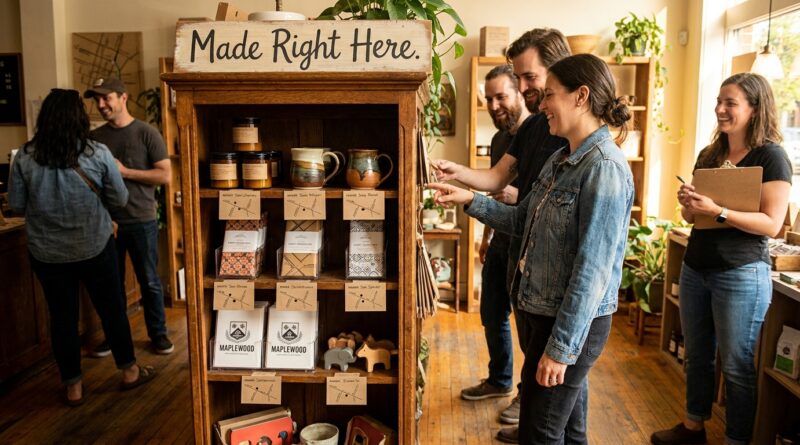
A neighborhood craft shelf makes local products obvious. One sign. One section. One quick turn down the aisle, and shoppers can see what their own community is making.
What a neighborhood craft shelf actually looks like
This is not some fancy retail overhaul. It can be surprisingly small.
In one store, it might be a single bookcase near the register. In another, it might be half an endcap labeled “Made Nearby.” In a coffee shop, it could be a narrow shelf of ceramics, syrups, cards, and packaged treats beside the pastry case.
The magic is not the size. It is the clarity.
What should be on the shelf
The best products are usually simple, giftable, and easy to restock. Think handmade soaps, candles, ceramics, spice blends, hot sauce, knit goods, greeting cards, wood items, prints, tote bags, or small-batch pantry staples.
These are the kinds of goods people can understand at a glance. No long explanation needed.
What signage should say
Good signage does a lot of heavy lifting. Keep it plain and useful:
“Made within 10 miles.”
“Local makers from our neighborhood.”
“Meet the maker. Scan here.”
That last part matters. A QR code can link to the maker’s page, their story, or even a short note about where the product was made.
How to sell local handmade products in neighborhood shops
If you are a maker, this is where the idea gets very practical.
Many local creators assume they need a huge following, perfect branding, or a full craft-fair schedule to get into retail. Often, they do not. A small local shelf changes the pitch.
You are not asking a store to rebuild its identity around your products. You are offering a few well-made items that fit a community display the shop can test with low risk.
Start with your easiest “yes” products
Pick the items that are:
- Easy to explain in one sentence
- Easy to package and price
- Reliable to make again
- Not too fragile or complicated to stock
If you make ten different things, do not lead with all ten. Start with your clearest winners.
Make the shop owner’s life easier
Bring a one-page sheet with product names, prices, wholesale or consignment terms, restock timing, and your contact info. Include clean photos.
Store owners are busy too. If your offer feels organized, you stand out fast.
Suggest a small test, not a giant commitment
Instead of asking for a full product line placement, suggest a 30-day or 60-day trial on the local shelf. That lowers the pressure for everyone.
It also gives you real sales feedback.
Use your phone as part of the display
Local shelves work even better when they connect the in-store moment to your online presence. If you want a smart companion strategy, The Hyper‑Local Factory In Your Phone: How Neighborhood Makers Are Quietly Turning Instagram Into A Live Shop Window shows how many makers are already using simple social posts to turn curiosity into repeat buyers.
That matters because someone might discover you on a shelf today, then follow and buy from you later.
Why small shops should care
For a shop owner, this is not charity. It is smart merchandising.
A local-maker shelf gives the store something chain retailers struggle to copy. Personality. Real local connection. A reason to browse.
It freshens the store without a full reset
One shelf is manageable. You can rotate makers by season, test categories, and see what gets people talking.
If handmade dog treats move quickly, add more. If hand-poured candles stall in July, swap them for picnic goods or local jam.
It gives shoppers a reason to come back
Regular inventory is predictable. That is useful, but not always exciting.
Local goods add a little discovery. People start checking the shelf to see what is new. That can turn a routine stop into a habit.
It keeps more spending in the neighborhood
That phrase gets thrown around a lot, but here it is very concrete. The store earns revenue. The maker earns revenue. The customer gets something with a local story. More of the money stays closer to home.
Why shoppers respond so well to this
People like local products, but they also like convenience.
That is the quiet strength of this setup. It does not ask shoppers to attend a Saturday market, memorize maker names, or scroll social media for an hour. It puts discovery inside routines they already have.
That is a very different kind of support for local business. Less effort. More visibility. Better odds that someone actually buys.
What makes a local shelf succeed or fail
Not every version of this idea works equally well.
What helps
- Clear labeling that says where the item is made
- Consistent restocking so the shelf does not look abandoned
- Products at a range of prices, including small impulse buys
- A simple visual theme so the section feels intentional
- Short maker stories that make people feel connected
What hurts
- Mixing local products randomly across the store with no marker
- Overcrowding the shelf with too many similar items
- Unclear pricing
- Packaging that looks unfinished or confusing
- No process for restocking or rotating slow sellers
A simple playbook for stores that want to try it
Step 1: Pick one small, visible area
Near checkout is great. An endcap is great. A dead corner nobody visits is not.
Step 2: Choose 5 to 12 makers to start
That is enough variety without making the display feel chaotic.
Step 3: Set simple rules
What counts as local. What packaging standards apply. How often restocks happen. Whether the store buys wholesale or uses consignment.
Step 4: Tell the story in plain English
Use short signs. “Made in our neighborhood.” “Crafted within 15 miles.” “Scan to meet the maker.”
Step 5: Watch what actually sells
Do not assume the prettiest item will be the winner. Sometimes the $8 spice blend beats the $38 vase every time.
For makers, exposure matters almost as much as sales
Craft fairs are exhausting. Social media can feel like shouting into the wind. Pop-ups are fun, but temporary.
A shelf in a neighborhood store is different. It is steady.
Even if someone does not buy your item that day, they see your name. They learn your style. They know you exist. That kind of repeated real-world exposure is hard to get on your own.
And because shoppers can discover you while doing ordinary errands, the audience is often broader than the usual maker-market crowd.
At a Glance: Comparison
| Feature/Aspect | Details | Verdict |
|---|---|---|
| Shopper convenience | Local products are grouped in one clearly labeled spot, so people can find them in seconds during normal errands. | Big win for visibility |
| Maker opportunity | Provides recurring shelf presence, neighborhood exposure, and a simpler path than constant fairs or pop-ups. | Strong low-cost entry point |
| Store risk | Retailers can start with a small shelf, test wholesale or consignment, and rotate products based on real demand. | Low risk, easy to test |
Conclusion
The neighborhood craft shelf is such a useful idea because it meets people where they already are. Grabbing coffee. Visiting a neighborhood market. Running into the hardware store for one thing and leaving with three. Instead of asking shoppers to hunt down special events or keep tabs on every maker online, it gives hyper-local goods a permanent, visible home inside daily life. For makers, that can mean steadier income and real-world visibility without the nonstop grind of fairs. For shop owners, it is a simple way to refresh the store, strengthen community ties, and keep more dollars close to home. And for the neighborhood itself, it becomes a living, walkable directory of local talent that anyone can discover in about 30 seconds, just by turning down the right aisle.