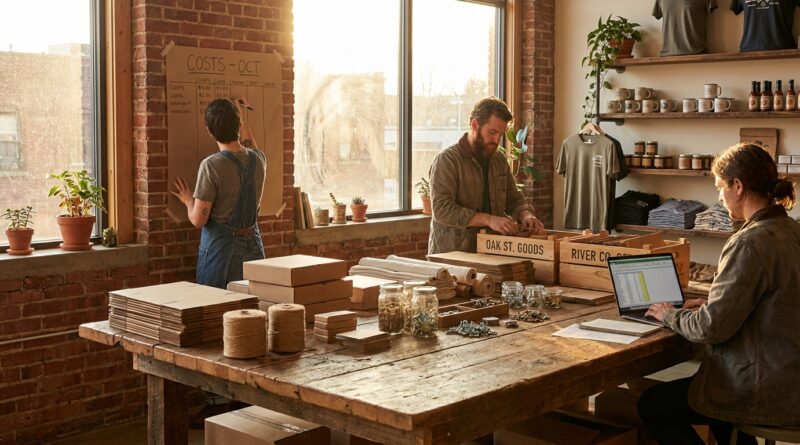
The Hyper-Local Cost Squeeze: How Neighborhood Makers Are Surviving The New Price Shock
When a bag of flour jumps, a box of jars costs more, and the weekend market raises booth fees at the same time, small makers feel it fast. That is the part outsiders often miss. A neighborhood baker, woodworker, potter or soap maker usually does not have giant margins to hide behind. So when three or four basic costs rise at once, the math can go from tight to scary in a month. If that sounds familiar, you are not overreacting. A lot of local makers are asking the same question right now: how local makers can handle rising material costs without cutting quality, burning out, or quietly shutting the door.
The good news is that some of the best fixes are surprisingly small and local. Not glamorous. Not complicated. But real. The strongest move is often not “sell way more.” It is to buy smarter together, share the boring overhead, and turn scattered one-person purchases into a tiny neighborhood buying group. Think of it as a cost circle. Five or six makers pooling orders for packaging, flour, clay, fabric, lumber or labels can often get better pricing, lower delivery costs, and fewer last-minute panic buys. That is how the numbers start making sense again.
⚡ In a Hurry? Key Takeaways
- Local makers can handle rising material costs best by forming small neighborhood buying groups, or “cost circles,” for shared supplies.
- Start with one category, like packaging or flour, track real prices for 30 days, and split one group order before trying anything bigger.
- Keep the system simple and written down, so shared buying saves money instead of creating confusion, late payments, or damaged trust.
Why this price shock is hitting small makers first
Big companies can order by the pallet. They have storage space. They can lock in supplier deals. A local maker usually cannot.
If you run a small workshop or food business, you are often buying in modest amounts, paying higher per-unit costs, and dealing with less room to store extra stock. Add rent increases, utility bills, delivery surcharges, insurance, and market fees, and even a “small” cost bump starts to stack up.
This is why a local candle maker, brewer, seamstress, or baker can look busy on Instagram and still be under real pressure behind the scenes. Sales might be steady. Profit might not be.
The fix that works in real neighborhoods: a tiny cost circle
A cost circle is just a small group of nearby makers who coordinate purchases of shared basics. Nothing fancy. No giant co-op paperwork at the start. Just a practical system to lower costs on things everyone already needs.
What a cost circle can buy together
Start with items that are boring, repeatable, and easy to count:
- Packaging, boxes, tissue, tape, bags, labels
- Flour, sugar, grains, yeast, salt
- Clay, glaze materials, kiln shelf paper
- Lumber, sandpaper, screws, glue
- Fabric, thread, zippers, batting
- Bottles, jars, lids, can carriers
The reason this works is simple. Shared volume often lowers unit cost. One delivery split six ways is often cheaper than six separate deliveries. And makers stop losing money to rushed small orders.
How to start a neighborhood cost circle this week
Do not begin with twenty people and ten product categories. That is how good ideas turn into part-time admin jobs.
Step 1: Find three to six makers with overlapping needs
Keep it local. Walking distance is ideal. Same side of town is good enough.
You are looking for reliable people, not just friendly people. The best group is often a mix like this:
- A baker
- A brewer or coffee roaster
- A ceramic studio
- A sewist or textile maker
- A woodworker
Not everyone needs the exact same materials. They just need enough overlap in purchasing habits to make combined ordering useful.
Step 2: Pick one supply category only
Choose the easiest shared expense first. Packaging is usually the winner because many makers use boxes, bags, labels, tissue, or tape. It is less tricky than food safety items and less messy than raw chemicals.
One category is enough to prove the idea.
Step 3: Track current prices for 30 days
Each maker should note:
- What they buy
- How much they buy
- What they pay per unit
- Shipping or delivery costs
- How often they run out and place emergency orders
This part matters because people often feel squeezed but cannot yet see exactly where the leak is. The numbers make the conversation calmer and clearer.
Step 4: Test one pooled order
Once you have the numbers, combine one month’s worth of one supply category and compare the quote against everyone buying solo.
If the savings are real, great. If they are not, you learned that before building a bigger system.
Step 5: Put one person in charge, then rotate later
At the start, one person should collect quantities, request quotes, place the order, and log payments. After a few rounds, rotate the role if needed.
Do not run it through group-text chaos. Use one shared spreadsheet and one payment deadline.
Where savings usually show up first
People tend to focus on wholesale price alone, but the best savings often come from four places at once:
1. Shipping and delivery
This is the silent killer for small orders. Combining purchases can cut repeated shipping charges fast.
2. Better price breaks
Suppliers often drop the per-unit price at higher quantities. A single maker may never hit that tier alone. Five makers together might.
3. Fewer emergency buys
Running out of labels or flour on a Thursday usually means paying more somewhere else on Friday. Shared planning reduces panic purchases.
4. Less wasted time
Time is a cost too. If every maker spends two hours a week hunting, comparing, and reordering basics, that is real labor. Shared systems give some of that time back.
How to keep the group from turning into a headache
This is the part that determines whether the idea lasts.
Write down simple rules
You do not need legal drama. You do need clarity. Agree on:
- Order dates
- Payment deadlines
- Pickup times
- What happens if someone backs out late
- Who handles damaged goods or missing items
Use prepaid orders when possible
The safest system is simple. No order gets placed until everyone has paid. That protects the organizer from floating the bill.
Do not overshare storage
Bulk buying only helps if somebody can store the order safely and neatly. Food supplies need clean, dry, pest-safe storage. Lumber needs space. Clay is heavy. Keep that in mind before chasing the biggest possible order.
Stay realistic about trust
If someone is always late paying or always changing quantities at the last minute, the system breaks. Small groups work because the expectations are plain and the members are dependable.
Other ways local makers can cut pressure besides shared buying
If you are serious about how local makers can handle rising material costs, shared orders are the first tool, not the only one.
Share booth space or rotate market attendance
If market fees are climbing, two compatible makers can sometimes split a larger booth or alternate weeks rather than paying every single date. This works especially well for goods that do not compete directly.
That ties in nicely with From Parking Lot To Pop-Up Factory: How Weekly Maker Markets Are Quietly Rewiring Local Shopping, which shows how local markets are becoming more than shopping spots. They are becoming real economic infrastructure for makers.
Standardize a few inputs
If you currently use seven box sizes, twelve jar types, or three kinds of tissue paper, there may be room to simplify. Fewer variations can mean easier ordering and less dead inventory sitting on shelves.
Offer preorder windows
Preorders help makers buy closer to actual demand. That means less cash tied up in uncertain stock and fewer leftovers if buyer habits shift.
Raise prices carefully, with context
Some price increases are unavoidable. But customers respond better when the change is clear and specific. “Our flour and butter costs rose 18 percent this year, so loaf prices are changing by 75 cents” lands better than silent shrinkage or a mysterious jump.
What neighbors can do if they want to keep handmade work in town
This is not just a maker problem. It is a neighborhood problem.
When a small bakery or workshop closes, the town loses more than products. It loses know-how. It loses future apprentices. It loses places where young people can learn that making things for a living is still possible.
Practical ways to help
- Ask makers what recurring supplies create the most pressure
- Connect similar businesses that may not know each other well
- Offer clean storage space if you have it
- Support preorder events instead of waiting for discount sales
- Encourage markets to offer shared-booth options or lower-fee trial weeks
The most useful kind of “support local” is not pity buying. It is helping the local economy work better.
Red flags that mean a cost circle needs to pause and reset
Not every group should keep going just because the idea is good on paper.
- No one can store materials safely
- People repeatedly miss payment deadlines
- Quantities change after orders are placed
- The group expands too fast
- The savings are tiny compared to the time spent managing it
If two or three of those are happening, shrink the system. Go back to one supply type and fewer people.
At a Glance: Comparison
| Feature/Aspect | Details | Verdict |
|---|---|---|
| Solo purchasing | Easy to control, but often means higher unit prices, more shipping fees, and more emergency orders. | Simple, but expensive over time. |
| Neighborhood cost circle | Shared buying can cut shipping, unlock better pricing tiers, and reduce wasted time if the rules are clear. | Best option for many small makers. |
| Large formal co-op | Can produce bigger savings, but needs more admin, stronger governance, and much more trust. | Worth considering later, not first. |
Conclusion
Rising input costs are not a small annoyance for neighborhood makers. They are a direct threat to survival. And when small breweries, bakeries, studios, and workshops close, a town loses more than products on a shelf. It loses skills, apprenticeships, and a piece of its identity. The good news is that the fix does not always have to be huge. A tiny local cost circle around packaging, lumber, clay, flour, or fabric is something people can start this week. It keeps more money in makers’ pockets, keeps real production on the street, and turns “support local” into something sturdier than good intentions. It becomes smart collaboration that actually moves the numbers.