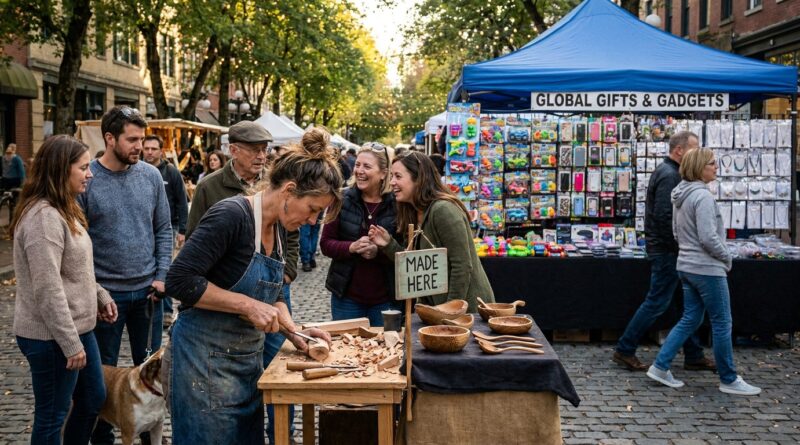
The Anti-Dropship Craft Fair: How To Spot (And Celebrate) The Makers Who Actually Make It Here
You are not imagining it. A lot of “local” craft fairs now have the same weird feeling as scrolling a discount marketplace online. The candles look familiar. The jewelry looks oddly mass-produced. The laser-cut signs all use the same fonts. And somehow every booth claims the products are “handmade” or “designed locally.” That is frustrating, especially when you showed up ready to spend real money on real neighborhood talent. The good news is you do not need to be an art-school critic to tell the difference. If you know a few simple signs, you can get much better at spotting who actually makes their goods nearby and who is reselling imported stock with a crafty backstory. Once you know what to look for, you can shop with more confidence, support the right people, and help push local markets back toward the makers they were meant to feature.
⚡ In a Hurry? Key Takeaways
- Real local makers can usually tell you clearly what they make, how they make it, and where they make it.
- Ask simple questions like “Did you make this yourself?” and “Where is it produced?” then watch for specific, natural answers.
- If something looks identical to dozens of online listings, trust your gut before paying a handmade price.
Why this keeps happening
Craft fairs got popular again. That is the good part.
The bad part is that popularity attracts resellers. Some buy cheap wholesale products from giant online catalogs. Some use dropship suppliers. Some add custom packaging, a logo, or a nice display and slide into events that shoppers assume are curated.
Meanwhile, actual makers are doing slower, messier, harder work. They are cutting wood, pouring soap, sewing bags, glazing ceramics, mixing skin care, printing artwork, or casting metal in a garage, basement, studio, or shared workshop. They often cannot compete on volume, and they definitely cannot compete with factory pricing dressed up as artisan work.
That is why knowing how to spot real local makers at craft fairs matters. It is not about being snobby. It is about making sure your money goes where you think it is going.
Start with the easiest clue. Can the seller talk about the work?
This is often the fastest tell.
A real maker usually has details ready without sounding rehearsed. Ask a basic question and listen for a direct answer.
Questions that work well
Try one of these:
- Did you make these yourself?
- Where do you make them?
- What materials do you use?
- How long does one take?
- What part of the process is hardest?
What a real answer sounds like
It is usually specific. Something like, “I throw the mugs in my home studio, then fire them at a community kiln twice,” or “I sew the outer bag here, but I source the brass hardware from a supplier in Ohio.”
Notice the difference. Real makers tend to know the boring details. They are living them.
What a red-flag answer sounds like
Be cautious if the answer is vague or slippery. Things like “We work with artisans,” “It is locally designed,” or “We source globally” may not mean the person in front of you made anything at all.
That does not automatically make them dishonest. But it does mean you should ask a follow-up.
Look at the booth itself
Displays can be polished. That alone means nothing. Plenty of true makers have beautiful setups.
What you are looking for is evidence of process, not just branding.
Good signs
- Work-in-progress samples
- Photos of the studio or workshop
- Tools, molds, sketches, fabric swatches, glaze tests, or prototype pieces
- Small variations between items
- Signage that explains materials or methods
Potential warning signs
- Huge walls of identical items in every color
- Packaging that looks more like mass retail than a small maker setup
- No story about process, only lifestyle slogans
- Products that jump wildly between categories, like tumblers, pet toys, phone cases, crystal lamps, and baby bibs all at one booth
That last one is a big clue. Most genuine makers have a lane. Not always. But usually.
Check for “too perfect” sameness
Handmade does not mean sloppy. Good makers can produce polished work. But handmade often has tiny differences.
If every necklace, cutting board, knitted hat, or ceramic bowl looks machine-uniform down to the millimeter, pause. If every item also resembles what you have seen all over Amazon, Temu, Etsy, or Alibaba, pause harder.
A simple trick is to scan the whole table. Do you see a maker’s style, or do you see a catalog?
Price can tell you something, but not everything
People often assume cheap means fake and expensive means handmade. If only it were that easy.
Some real makers underprice themselves. Some resellers slap a luxury price on imported goods.
Still, pricing can raise useful questions.
When low prices should make you curious
If a hand-thrown mug is $12, or a detailed leather bag is $25, ask how it is made. Materials and labor cost money. Sometimes a price is low because the seller is new or generous. Sometimes it is low because a factory made 5,000 of them.
When high prices should make you curious
If a simple item has a very high price, ask what justifies it. A real maker will usually explain materials, time, process, or small-batch production without getting defensive.
Use the “three-question test”
If you want a quick system for how to spot real local makers at craft fairs, use this:
- Who made it? Look for a clear person, team, or studio.
- Where was it made? Look for a real place nearby, or an honest explanation if part of the process happens elsewhere.
- What part did you do? Look for a concrete role, not fuzzy marketing language.
You are not interrogating anyone. You are just checking whether the story holds together.
Not every outsourced part is a dealbreaker
This part matters.
“Locally made” does not always mean every raw ingredient came from down the block. A jeweler may source chains and clasps elsewhere. A candle maker may buy fragrance oils from another state. A printmaker may use a pro printer for giclee reproductions of their original art.
That can still be legitimate local craft.
The key is honesty. Real makers usually tell you exactly what they do themselves and what they source. Resellers tend to blur that line.
Do a fast phone check if needed
You do not need to stand in the aisle doing detective work for twenty minutes, but a quick search can help if something feels off.
Try this
- Search the product description plus a distinctive phrase
- Use image search if the item looks very generic
- Check the seller’s social pages for studio shots, process videos, or older work
If the exact same item appears on bulk-import sites in the same photos, same colors, and same packaging, you probably have your answer.
Pay attention to language on signs and labels
Words matter. Some are helpful. Some are carefully slippery.
Usually stronger signs
- Hand-thrown
- Screen printed by me
- Sewn in my home studio
- Original illustration
- Small-batch soap made in town
Usually weaker signs
- Curated
- Designed locally
- Inspired by artisans
- Boutique collection
- Ethically sourced, with no other details
Again, weak language does not always equal bad faith. But it should prompt a question.
Look for the maker’s fingerprints online and offline
Real makers often leave a trail. Not a corporate content strategy. Just normal evidence that they actually do the work.
You might see photos of a messy table, half-finished products, packed kiln shelves, thread spools, test batches, shipping days, market prep, or mistakes they learned from.
This is one reason neighborhood retail matters too. Small shops that truly feature local work often know their makers personally and can tell you exactly who made what. If you want another good example of that idea in action, The Neighborhood Craft Shelf: How Small Shops Are Turning One Aisle Into A Hyper‑Local Maker Launchpad is worth a look.
How to support the real ones without making it awkward
You do not have to call out questionable booths in public. Most people just want to shop smart and back the right vendors.
What helps genuine makers right away
- Buy directly from them when you can
- Ask for their card or Instagram
- Tell friends which booths are the real deal
- Post a photo and tag them
- Ask if they take custom orders
- Return to future markets and look for them again
That last one matters more than people think. Repeat customers keep small makers going.
If you are talking to market organizers
Organizers are under pressure too. Filling booths is hard. Vetting vendors takes time. But if enough shoppers ask better questions, standards tend to improve.
Reasonable things to ask organizers
- Do you allow resellers?
- Are vendors required to disclose what they make themselves?
- How do you define handmade or local?
- Do you review vendor applications and product photos?
You are not being difficult. You are helping protect the event’s reputation.
At a Glance: Comparison
| Feature/Aspect | Details | Verdict |
|---|---|---|
| Seller’s answers | Specific details about materials, process, time, and workspace usually point to a real maker. | Strong positive sign |
| Product consistency | Some variation is normal in handmade work. Perfect sameness can suggest factory production. | Use caution |
| Booth story and evidence | Studio photos, tools, works in progress, and honest sourcing notes help build trust. | Very helpful clue |
Conclusion
The tension is real right now. More people want to shop local, but more imported, white-labeled products are sneaking into “maker” spaces and muddying the water. That chips away at trust just when buyers are trying to do the right thing, and it takes money away from the people actually making things in your community. The upside is that shoppers are not powerless. Once you know how to spot real local makers at craft fairs, you can walk into any pop-up, street fair, or holiday market with a better eye and a little more confidence. Ask a few friendly questions. Look for proof of process. Support the booths that can clearly show their work. That keeps more dollars with real neighborhood makers, and it sends a message to organizers that authenticity matters. Bit by bit, that is how craft fairs start feeling like craft fairs again.