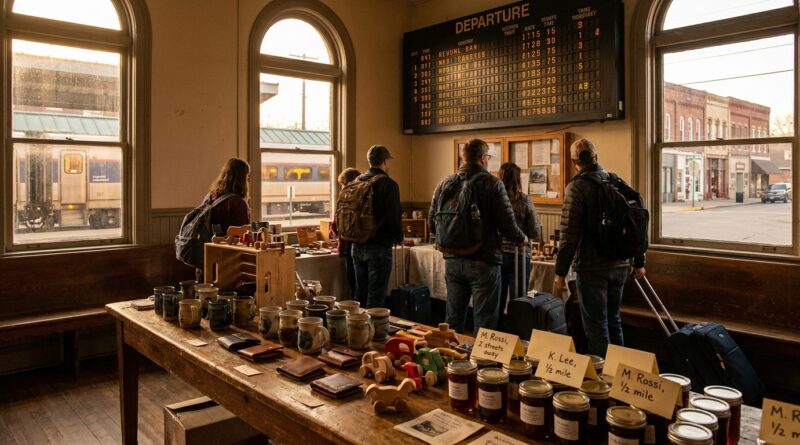
The Hyper-Local Train-Stop Workshop: How Rail-Town Makers Are Quietly Turning Tourist Layovers Into Craft Economies
It is maddening to watch a train pull in, spill out a wave of visitors, and then watch most of that money disappear into the same coffee chains and gift racks people could find anywhere. Tourists snap a photo of the station sign, maybe buy a muffin, then head back out with a mass-made souvenir that has nothing to do with the town they just visited. Meanwhile, the potter, printmaker, woodworker, soap maker, and repair shop owner down the road are still trying to get noticed. That gap is exactly where hyper local rail town makers have a real shot. A small craft room, demo bench, or rotating maker stall near a station can turn waiting time into buying time. Better yet, it can turn a rushed layover into a real local encounter. No giant funding round required. No years-long redevelopment plan either. Just a smart use of foot traffic that already exists.
⚡ In a Hurry? Key Takeaways
- Hyper local rail town makers can capture tourist spending by putting live craft, small retail, and pickup points right where travelers already wait.
- Start small with a pop-up workshop, timed demos, and easy-to-carry goods priced for impulse buys.
- The best setup is simple and safe: clear station rules, compact displays, card payments, and products that are genuinely made nearby.
Why the station matters more than the main street
Most towns still think the visitor economy begins once people wander into the center. For rail towns, that is often too late.
Visitors make decisions fast. They buy what is in front of them. If the station offers only chains, vending machines, and generic postcards, that is where the money goes. It is not because travelers do not care about local craft. It is because local craft is not in the path of least resistance.
That is the opening. Hyper local rail town makers do not need to replace the whole station retail mix. They just need one visible, well-run spot that says, “This was made here. You can watch it happen. You can take a piece home.”
What a train-stop workshop actually looks like
Forget the fancy renderings. The useful version is much more practical.
Option 1: The live demo bench
A small counter near the concourse or just outside the station entrance. One maker at a time. Short demonstrations. Block printing, leather stamping, brush lettering, mini weaving, simple bookbinding, or hand-finishing ceramics. Things people can understand in 30 seconds.
Option 2: The rotating craft room
An unused kiosk, old ticket office, side waiting room, or modular retail unit becomes a shared maker space. Each week or month features a different local producer. The point is not full production. It is visibility, storytelling, and small sales.
Option 3: Click-and-collect for travelers
Some travelers do not have time to browse. Fine. Let them scan a code, order a local item, and pick it up on their return trip. This works especially well for regional foods, prints, textiles, and gift sets.
Option 4: Workshop-lite experiences
Ten-minute make-your-own sessions can work during layovers. Stamp a luggage tag. Print a postcard. Blend a small tea mix. Assemble a small ornament. Keep it simple, clean, and fast.
Why this works better than another souvenir shelf
People are tired of fake local. They can sense it. A shelf of imported trinkets with the town name slapped on them does not build loyalty, and it does not help the people who live there.
That is why this idea lines up with what is already happening in other local-first spaces. In The Hyper-Local Taproom Economy: How Neighborhood Breweries Are Quietly Turning Fans Into Co‑Makers, the big lesson is that people want a real connection to place, not just branding. Stations can do the same thing. They can become tiny showrooms for local production instead of just pass-through zones.
The money logic is simple
Tourists on short stops buy differently from weekend visitors. They want speed, trust, and something easy to carry.
That means the winning product mix usually looks like this:
- Items under a clear impulse-buy price point
- Small goods that fit in a backpack or handbag
- Products with a visible local story
- Fast payment, ideally contactless
- Packaging that survives travel
A maker does not need every visitor. They just need a small share of station foot traffic. If even a modest slice of travelers spends on a real local product instead of a chain snack or generic gift, that starts adding up quickly.
Who needs to work together
This is where good ideas often stall. Not because the public hates them, but because the right people are not in the same room.
Station managers
They control access, safety, timing, and the practical rules. They need to know this is tidy, low-risk, and likely to improve the station experience.
Local councils
They can help with permits, introductions, micro-funding, signage, and town center coordination. More importantly, they can frame the project as economic development, not just arts programming.
Maker collectives
They solve the hardest part, which is consistency. One maker can get sick or fall behind. A group can rotate shifts, share stock, and keep the space active.
Tourism groups
They can tie the station workshop to trails, maps, events, and seasonal campaigns so the experience does not sit in isolation.
How to start without waiting for a perfect plan
A lot of towns overthink this. They picture a beautiful permanent space, then get stuck for two years. Start smaller.
Step 1: Measure dwell time
How long do people actually wait between arrival and departure? Ten minutes matters. Twenty minutes is gold.
Step 2: Find the dead corner with live traffic
Look for underused but visible space. Empty kiosk. Side wall near seating. Outdoor forecourt. You do not need the prime café unit to prove demand.
Step 3: Pick three makers, not thirty
Start with a tight mix. One visual craft, one practical gift category, one live demo-friendly maker. Too much variety can look messy fast.
Step 4: Test for one market cycle
Run it for six to eight weekends, or one full tourism season. Track sales, dwell, scans, return visits, and which products travelers actually buy.
Step 5: Fix friction points
If queues form, shorten demos. If products are too expensive, add entry-level items. If people love the story but do not buy, improve packaging or offer shipping.
What makers should sell first
Not everything belongs in a station setting. Big fragile pieces are harder. Slow explanations are harder. Think compact and immediate.
- Mini prints and postcards
- Locally made soaps and balms
- Stamped leather tags and key fobs
- Small ceramics with protective wrapping
- Town-specific textiles like tea towels or patches
- Rail-themed limited editions made by local artists
- Simple DIY kits for children and families
The best sellers usually answer one quick question in the buyer’s head: “Can I understand this, carry this, and remember this place through it?”
Common mistakes that quietly kill the idea
Making it look like a school fair
Homemade charm is good. Clutter is not. Travelers need clear pricing, neat displays, and obvious payment options.
Choosing products that need too much explanation
You may love the deeper story. The customer has seven minutes before boarding. Use one strong sentence, not a lecture.
Ignoring station rhythm
Sales spike around arrivals and departures. Staff around that rhythm. Do not run the space like a sleepy gallery.
Putting all the burden on one maker
Burnout arrives fast. Shared scheduling and simple stock systems matter.
Confusing “local-themed” with local-made
This one is big. If the goods are not really made nearby, people eventually figure it out. Trust is hard to rebuild once lost.
Why this matters beyond sales
A rail-stop workshop does more than move products. It changes how a town introduces itself.
Instead of saying, “Welcome, now go find the real place somewhere beyond the station,” the town says, “The real place starts here.” That is powerful. It helps younger makers get seen. It gives older crafts a fresh audience. It can also help residents feel the station belongs to the town, not just to commuters and chain tenants.
It is also one of the few economic ideas that does not need a huge anchor tenant to work. A well-run small space can punch above its size because the foot traffic is already there.
At a Glance: Comparison
| Feature/Aspect | Details | Verdict |
|---|---|---|
| Traditional station retail | Fast, familiar, usually dominated by chains and generic goods | Convenient, but weak for local economic spillover |
| Hyper-local maker kiosk | Small footprint, live demos, rotating goods actually made nearby | Best low-cost test for turning layovers into local spending |
| Town-center-only craft strategy | Depends on visitors leaving the station and having enough time to explore | Useful, but misses many short-stop travelers |
Conclusion
The opportunity here is not vague, and it is not years away. It is sitting in plain sight on platforms, concourses, and station forecourts where thousands of people already pass through. Small cities and historic towns on busy rail and bus corridors are seeing strong visitor flow, but too much of that spending still gets soaked up by chains instead of the people who live and make things there. A rail-stop craft room, pop-up workshop, or shared maker kiosk gives communities a concrete way to start changing that now. No giant grant. No big developer. No national retailer needed. Just a practical partnership between councils, station teams, and local makers. For hyper local rail town makers, that is the real win. Idle waiting time becomes a live showroom for local production, and a rushed stop starts leaving something valuable behind.