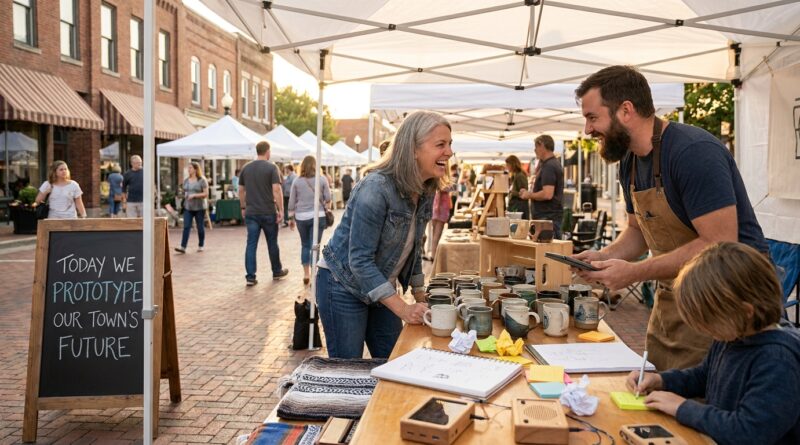
From Pop-Up Tables To Powerhouses: How Maker Markets Are Quietly Becoming Your Town’s R&D Lab
You can feel the disconnect. Your social feed says “shop local,” but the shelves in most stores still look like they were filled by a truck from three states away. If you are a maker, that gets old fast. If you are a shopper who wants your money to stay in town, it is just as frustrating. The good news is that maker markets are starting to do something bigger than sell a few candles and prints on a Saturday afternoon. They are becoming live test labs for what a neighborhood can actually make, buy, improve, and support.
That is the real answer to how local maker markets support hyper local manufacturing. They gather producers, buyers, feedback, and local taste in one place, at the same time. A market booth is not just a booth. It is a cheap way to test price points, packaging, colors, materials, and even whether a product should exist at all. When enough people pay attention to that signal, small-batch local production stops being a hobby scene and starts looking like the early version of a town’s next supply chain.
⚡ In a Hurry? Key Takeaways
- Local maker markets support hyper local manufacturing by giving small producers a low-cost place to test products, prices, and demand before taking on bigger risk.
- If you are a maker, treat your next market like a field test. Ask three simple questions about price, packaging, and what customers wish existed locally.
- If you are a shopper, your purchase is more than a sale. It is a demand signal that can shape what gets made, stocked, and hired for next season.
Why these little markets matter more than they look
From the outside, a maker market can look temporary. Folding tables. Pop-up tents. Handwritten signs. Nice, but small.
That is exactly why people underestimate them.
When 20, 40, or 80 local sellers show up in one place, you get something rare. You get density. That means customers can compare products side by side. Makers can see what stops people in their tracks. Shop owners can spot trends before they hit wholesale catalogs. Neighbors can discover that someone down the street already knows how to make the thing they keep ordering online.
That is not just commerce. That is research and development with real wallets attached.
How local maker markets support hyper local manufacturing
The phrase sounds big, but the idea is simple. Hyper local manufacturing means making more of what a community needs, wants, and identifies with, close to home. Not everything. Just more than we do now.
Maker markets help that happen in a few practical ways.
1. They test demand without a giant upfront gamble
Opening a store or renting workshop space is expensive. A table at a monthly market is not cheap, but it is far cheaper than signing a long lease and hoping people care.
A soap maker can test refill stations. A woodworker can see whether customers want cutting boards, shelves, or kid-sized stools. A local sewist can find out if people actually want repair services along with new goods.
That matters because hyper local manufacturing works best when it starts with proven local demand, not guesses.
2. They show what your town actually values
Every town has its own taste. Beach towns want different goods than farm towns. College neighborhoods buy differently than retirement communities. Markets make those preferences visible very quickly.
If everyone asks for apartment-friendly furniture, that is a clue. If shoppers keep saying, “Do you make this in school colors?” that is a clue too. If people love the product but keep putting it down at $42, that is important information, not failure.
3. They create short feedback loops
Big manufacturing often works on long timelines. Design it, ship it, stock it, hope it sells.
Local makers can work faster. If customers say a candle jar is too fragile, that can be fixed by next month. If a baker hears repeated demand for smaller portions or gluten-free options, the next market becomes the next test.
Fast feedback is one of the biggest advantages small local producers have over bigger distant brands.
4. They spark collaborations that would not happen online
A coffee roaster meets a ceramic mug maker. A printmaker meets a frame builder. A beekeeper meets a soap maker. A local illustrator meets a children’s boutique owner.
This is where markets quietly turn into miniature industrial clusters. Not in the flashy startup sense. In the practical sense. Shared customers. Shared suppliers. Shared packaging ideas. Shared workshop space. Shared delivery runs.
That is how a local product economy starts to knit together.
What makers should do at their next market
If you sell at one of these events, do not treat it as just a sales day. Treat it as a field study.
Ask better questions
Instead of “Do you like it?” ask:
- Which version would you actually buy today?
- What price feels fair?
- What would make this more useful for your home or neighborhood?
- Is there something you wish you could buy locally but cannot find?
Those answers are gold. Write them down right away. Do not trust your memory at the end of a long day.
Test one variable at a time
Change the packaging, or the display, or the price, but not all three at once. Otherwise you will not know what caused the result.
If one version sells faster, now you have real data. Not perfect data, but useful data.
Watch where people hesitate
Sometimes the best feedback is silent. People pick up the item, smile, then put it down. Why?
Maybe the label is unclear. Maybe they do not know what problem it solves. Maybe the price is fine, but the packaging makes it look gift-only instead of everyday-use.
Those little moments are often more revealing than compliments.
Build for repeatability, not just charm
A beautiful handmade object is great. But if demand grows, can you make 20 more? Can you source the same materials locally or nearby? Can you keep quality steady?
If the answer is no, that is okay. It just means you are still in discovery mode. Better to learn that at a Saturday market than after promising a wholesale order you cannot fill.
What residents and shoppers can do, starting this weekend
You do not need to open a workshop to help local manufacturing grow. You just need to shop with a little more intention.
Buy the product you want your town to keep making
If you complain that everything is generic, this is the moment to back the alternative. Buying local is not just a nice gesture. It is market research with cash attached.
When enough people buy locally made pantry goods, repair services, textiles, homewares, or small furniture, that sends a stronger signal than any “support local” slogan ever will.
Tell makers what else you would buy
Most people stop at “This is nice.” Go one step further.
Say, “I would love this in a smaller size for apartments,” or “I wish someone local made durable school lunch gear,” or “Do you offer refills?” That kind of comment can shape what shows up next month.
Think of your receipt as a vote
That sounds dramatic, but it is true. Every purchase says what deserves more shelf space, more workshop time, and possibly one more local hire.
If you want a stronger main street, your spending habits need to line up with that wish.
Why this matters even more right now
Supply chains have felt shaky for a while. Prices move. Inventory disappears. Basic goods can suddenly get weirdly hard to find. That is one reason local production is getting a fresh look.
If this topic has been on your mind, it is worth reading Tariffs, Empty Shelves and the Comeback of the Corner Workshop. It gets at the same basic truth. Communities are starting to realize that waiting for far-away systems to work perfectly is not much of a plan.
Maker markets will not replace global manufacturing. They do not need to. Their job is to reveal what can be made closer to home, in smaller batches, with shorter loops between maker and buyer.
The hidden role of local shops, libraries, and city halls
Markets are often the first stage, not the final one.
When they work well, other local institutions can help turn pop-up success into something steadier.
Independent retailers
A shop owner can walk a market in one afternoon and find five products worth stocking. That is far easier than hunting for local makers one by one.
Libraries and community spaces
These places can host classes on pricing, labeling, photography, bookkeeping, and small-batch production. Boring topics, maybe. Very useful topics, definitely.
Local government and business groups
Sometimes the most helpful thing is not a giant grant. It is simpler permit rules, reliable event calendars, shared storage, or a small indoor winter market so momentum does not disappear when the weather changes.
What keeps maker markets stuck as “just events”
There are real limits here.
Markets can become repetitive. Booth fees can creep up. The same people can end up selling to the same crowd. Social media can make a market look busy while very little money changes hands.
And yes, rent is still brutal. Algorithms still make it hard for small brands to get noticed online. A good Saturday does not magically solve those problems.
But a market does something important anyway. It reduces uncertainty. It shows what has traction. It reveals who should team up. It makes local demand visible enough to act on.
That is a lot more useful than waiting around for a distant investor or chain store buyer to bless the idea.
How to tell if your town’s market is becoming a real local R&D lab
Look for these signs:
- Makers return with improved versions of products, not just the same inventory.
- Shops start carrying goods first seen at the market.
- Vendors collaborate on bundles, shared materials, or cross-promotion.
- Customers begin asking for neighborhood-specific products.
- One-time hobby booths slowly turn into stable side businesses or small full-time operations.
When that happens, the market is no longer just a nice community event. It is part of a local production pipeline.
At a Glance: Comparison
| Feature/Aspect | Details | Verdict |
|---|---|---|
| Product testing | Makers can test pricing, packaging, size, and demand face to face before investing in bigger production. | One of the cheapest and fastest ways to learn what sells locally. |
| Community signal | Shoppers reveal what they want their town to make by what they buy, request, and come back for. | Very useful for shaping hyper local manufacturing around real needs. |
| Long-term growth | Markets alone are not enough. Makers still need repeat customers, local stockists, and manageable space costs. | Best seen as a starting point and proving ground, not the whole system. |
Conclusion
Across the country, monthly maker markets, open-studio weekends, and neighborhood fairs are doing more than filling a parking lot for an afternoon. They are concentrating local talent, local demand, and local feedback in one place. That makes them powerful. A town can start prototyping its own product economy in real time instead of waiting for outside money, planners, or national brands to decide what belongs there. For makers, that means a real chance to test pricing, packaging, partnerships, and neighborhood-specific ideas this weekend, not years from now. For residents, it means buying a candle, cutting board, jar of jam, or repair service is not just shopping. It is a vote for what your main street will make, stock, and hire for next season. That mindset shift matters. It is how local economies stop being passive and start building from the folding table up.