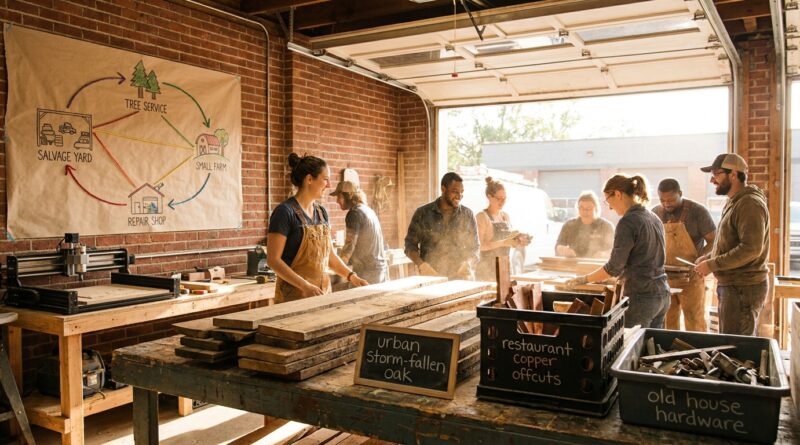
The Zero‑Mile Product: How Neighborhood ‘Material Loops’ Are Quietly Reinventing Local Manufacturing
“Buy local” sounds great until you look a little closer. A candle maker gets wax from three states away. A furniture shop uses wood shipped across the country. A “neighborhood” ceramics brand relies on imported clay. That disconnect bothers a lot of people, and fairly so. Makers want their story to be true. Buyers want the label to mean something real. This is where zero mile local manufacturing starts to matter. The idea is simple: build products from materials already moving through your own area, often as leftovers, offcuts, or waste. Think brewery grain turned into packaging, storm-felled urban wood turned into shelves, or restaurant glass turned into tiles. What looks small at first is quietly becoming a practical manufacturing model. It cuts transport, lowers material risk, and gives local businesses something better than a marketing slogan. It gives them proof. And in 2026, proof is becoming the whole game.
⚡ In a Hurry? Key Takeaways
- Zero mile local manufacturing means sourcing materials from your own community, not just making the final product there.
- Start with one reliable neighborhood waste stream, like wood offcuts, spent grain, fabric scraps, or glass, and build a simple repeatable process around it.
- The real value is not just sustainability. It is lower supply risk, better margins, and a more honest story customers can verify.
What a “Zero-Mile Product” Actually Means
Most people hear “local manufacturing” and picture a small workshop in town. That is part of it, but not the whole thing.
A zero-mile product goes one step earlier in the chain. It asks where the raw material came from, how far it traveled, and whether it was already available nearby. If the answer is “from the neighborhood,” you are much closer to the real thing.
This is why neighborhood material loops are getting attention. They connect local waste or surplus to local production. One business has too much of something. Another business can use it. A third business helps clean, sort, process, or move it. Suddenly, what used to be trash becomes inventory.
Why This Matters More in 2026
Big supply chains still work, until they do not. Prices swing. Deliveries slip. One missing material can stall a whole batch. If you run a small shop, you feel those hits fast.
Meanwhile, local makers already have one big advantage. They are close to the stuff other people throw away. That can be wood from tree removals, fabric remnants from upholstery shops, food industry byproducts, demolition salvage, or plastic scrap from local sign makers.
That is the opening. While larger manufacturers fight long and fragile supply lines, smaller businesses can build steadier systems with nearby inputs. Not perfect systems. But often tougher ones.
How Neighborhood Material Loops Work
The phrase sounds fancy. The setup usually is not.
Step 1: Find a local material stream
Look for materials that are already produced in steady volumes nearby. Good candidates are things businesses pay to remove or recycle. Those streams are often easier to access because solving the disposal problem already has value.
Examples include:
- Wood offcuts from cabinet shops
- Spent grain from breweries
- Broken glass from restaurants and bars
- Textile scraps from tailors and upholstery shops
- Old bricks, fixtures, and timber from building renovation
- Plastic sheets and trim waste from print and sign shops
Step 2: Match it to a product people will pay for
This is where some good ideas fall apart. Not every waste stream makes a good product. You need a material that can be cleaned, sorted, and turned into something useful without heroic effort.
Good matches tend to create small-batch, premium goods. Shelving from salvaged hardwood. Acoustic panels from textile waste. Coasters or tiles from crushed local glass. Soap dishes from stone offcuts. Packaging inserts from agricultural fiber.
Step 3: Build the loop
A loop only works if someone owns each step. Who collects? Who stores? Who processes? Who checks quality? Who makes the final product?
That can be one business or three businesses sharing the work. The key is consistency. “We sometimes get scraps” is not a supply chain. “We pick up 80 pounds every Tuesday from two breweries” is.
The Big Shift: Waste Stops Being Embarrassing and Starts Being Valuable
For years, many businesses hid the recycled or salvaged part of a product, as if customers would see it as second best. That has changed.
Now the material story is often the selling point, but only if it is specific. “Made sustainably” is vague. “Made from maple blown down in last year’s storm, milled three miles away” is memorable. It feels human because it is human.
That is the quiet power of zero mile local manufacturing. It turns local history into product value. Not fake nostalgia. Real traceability.
What Makers Get Out of It
This is not just a feel-good project.
Lower material costs
If a local business is paying to remove a material, you may be able to get it cheaply or even free, as long as you make pickup easy and reliable.
More stable supply
You are not waiting on a truck crossing three states. You are working with a bakery, brewery, mill, school, or contractor down the road.
Better margins on story-rich products
People will often pay more for products with clear, local, verifiable roots. That does not mean slapping a feel-good tag on junk. It means making something solid and giving it a truthful story.
Stronger community ties
Once businesses start feeding one another’s supply, they stop acting like isolated shops and start acting like an ecosystem. That can lead to shared storage, shared tools, and shared customers.
What Buyers Get Out of It
Buyers are tired of fuzzy claims. They have heard “artisan,” “sustainable,” and “locally inspired” so many times that the words barely land anymore.
A zero-mile product gives them something cleaner and simpler. They can ask where the material came from and get a real answer. Maybe even an address.
That matters because trust now drives a lot of purchasing. A product with visible local roots feels less like branding and more like participation. The buyer is not just purchasing an object. They are backing a local loop that keeps value in the area.
How to Start a Material Loop in Your Own Neighborhood
If you are a maker, do not begin with a giant circular economy master plan. Start smaller.
1. Pick one material, not five
The fastest way to get stuck is to try to solve every waste problem in town. Choose one stream that is abundant, predictable, and safe to handle.
2. Talk to the businesses already paying to get rid of it
Ask simple questions. How much do you generate each week? Is it clean or mixed? Does it need same-day pickup? Where could it be stored? You are trying to learn whether the stream is usable in the real world, not just in theory.
3. Make one product with clear quality standards
Customers do not care that the source was clever if the result is flimsy. Set rules early. Moisture content for wood. Size tolerance for scraps. Color sorting for glass. Contamination limits for fiber.
4. Track every batch
You do not need enterprise software. A shared spreadsheet or simple inventory app can be enough. Log source, date, weight, prep time, and yield. After a month or two, you will know whether your “cheap material” is truly cheap.
5. Write the story honestly
Do not say “100 percent local” if only the input material is local and the finish or hardware comes from elsewhere. People are surprisingly forgiving of partial progress when the story is plain and true.
Common Problems, and How to Avoid Them
Neighborhood loops sound neat. They can also get messy fast.
Irregular supply
Some waste streams are seasonal or lumpy. Tree removals spike after storms. Construction salvage comes in bursts. Plan for storage or choose streams with steadier output.
Too much sorting labor
Free material can become expensive if it takes hours to clean and separate. Before you commit, test a real batch and time the prep work.
Quality swings
Not every offcut or byproduct is equal. Make acceptance rules. If a batch fails, say no. A shaky product will hurt you more than a missed pickup.
Health and safety issues
This is a big one. Some local materials are not safe for casual reuse. Treated wood, unknown coatings, food-contact concerns, mold, sharp glass, and industrial residues all need serious care. If there is any question, get expert advice before turning it into a consumer product.
Best Materials for Zero Mile Local Manufacturing
Some materials are especially well suited to neighborhood loops because they are common, durable, and easy to transform.
- Urban wood: Great for furniture, shelving, cutting boards, signage, and decor.
- Textile scraps: Useful for insulation, patchwork goods, acoustic panels, stuffing, and accessories.
- Glass: Good for tiles, terrazzo-style surfaces, art pieces, and countertop accents.
- Metal offcuts: Ideal for hardware, fixtures, brackets, and small fabricated goods.
- Agricultural byproducts: Promising for packaging, composite materials, and specialty goods.
- Construction salvage: Strong option for one-of-a-kind premium products with visible history.
Why the Story Sells, but the System Matters More
Here is the trap. A lot of brands will notice this trend and stop at the story. They will market one reclaimed-material collection and call it a day.
The businesses that last will do something less flashy. They will build a repeatable local system. Pickup schedules. Storage rules. Basic processing. Supplier relationships. Documentation. Once those pieces are in place, the story takes care of itself because it reflects a real process.
That is what makes zero mile local manufacturing more than a nice idea. It is a way to make small production less fragile.
At a Glance: Comparison
| Feature/Aspect | Details | Verdict |
|---|---|---|
| Material sourcing | Traditional local brands often assemble nearby but buy inputs from far away. Zero-mile models source core materials from neighborhood waste or surplus streams. | Zero-mile wins for honesty and resilience. |
| Cost and supply risk | Imported inputs can be expensive and unpredictable. Local loops can cut costs, but only if collection and sorting stay simple. | Best value comes from one well-run local stream, not a complicated mix. |
| Customer appeal | Generic “handmade” claims are fading. Buyers respond better to products with specific, traceable local origins. | Clear local proof beats vague branding. |
Conclusion
There is a reason this idea is catching on now. Big manufacturers are stuck dealing with pricey materials and long, shaky supply chains. Local makers have a different option. They can turn nearby waste into useful, premium goods with roots people can actually check. That is the heart of zero mile local manufacturing. Start with one material stream, one dependable partner, and one product worth making well. If you do that, you are not just cutting costs. You are building a steadier business and telling a local story that is finally true from start to finish.