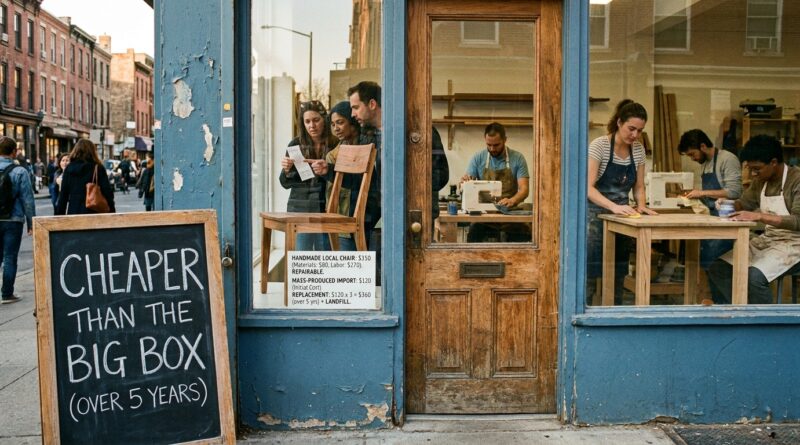
Tariffs Are Spiking Prices. Neighborhood Makers Are Quietly Becoming the Affordable Option
You are not imagining it. The same lamp, side table, cutting board, or kids’ backpack that felt “good enough” last year suddenly costs a lot more at the big-box store. Tariffs, shipping fees, fuel costs, and plain old supply chain chaos are all getting baked into the sticker price. That is frustrating, especially when local handmade goods still carry that “nice, but too expensive” reputation in a lot of people’s minds.
Here is the surprise. In many categories, local makers are no longer the pricey alternative. They are quietly becoming the smarter buy. Not always cheaper on day one, but often cheaper over the life of the product. If you have been wondering, are local handmade products cheaper than imports after tariffs, the honest answer is sometimes yes right at checkout, and very often yes once you factor in quality, repairs, shipping, and how long the item actually lasts.
⚡ In a Hurry? Key Takeaways
- Yes, local handmade products can now be cheaper than imports after tariffs, especially when you compare total cost over time instead of just the lowest sticker price.
- Before you buy, ask three things: How long will it last, what will shipping cost, and can it be repaired locally?
- The safest money move is often buying fewer, better-made items from nearby makers who can stand behind their work.
Why the math has changed
For years, imported goods had one giant advantage. They were cheap to mass-produce and cheap enough to ship that even bulky items could still undercut local work.
That gap is shrinking.
Tariffs raise import costs. Shipping containers cost more than they used to. Delays create shortages. Stores add padding to protect their margins. By the time that “budget” item gets to the shelf, it may not be much of a bargain anymore.
Meanwhile, a neighborhood woodworker, soap maker, seamstress, metal fabricator, or ceramic artist is buying materials closer to home, selling with shorter delivery routes, and often making small batches without a giant warehouse in the middle.
That does not mean every handmade item is suddenly cheaper. A hand-thrown mug from a local potter may still cost more than a discount-store mug. But a locally made coat rack, dining bench, leather belt, pet bed, candle refill, or cutting board can be surprisingly close in price, and sometimes less expensive once shipping and replacement costs show up.
Sticker price is only part of the story
Big-box pricing hides extra costs
Many shoppers compare only the tag on the shelf. That made sense when price differences were huge. It makes less sense now.
With imported goods, your real cost can include:
- Shipping fees
- Assembly time or tools
- Higher chance of damage in transit
- Return hassles
- Shorter lifespan
- Needing to replace the item sooner
A cheap bookshelf that wobbles after a year is not cheaper than a solid local one that lasts ten.
Local goods often save money later
Handmade products can win on value in ways that do not fit neatly onto a price tag:
- Better materials
- Repairability
- Custom sizing, which means fewer buying mistakes
- No long-distance freight markup
- Direct access to the person who made it
If a zipper fails on a handmade tote from a local sewist, you may get it fixed. If the seam splits on an imported bag, you usually replace the whole thing.
So, are local handmade products cheaper than imports after tariffs?
The short answer is yes, in more cases than most people think.
The better answer is this: local handmade products are often cheaper in one of three ways.
1. Cheaper at checkout
This happens most with goods that are bulky, heavy, or expensive to ship. Think stools, shelves, planters, small furniture, home decor, and some clothing basics.
Once tariffs and freight are added, the import loses its old edge.
2. Cheaper over time
This is where local craft really shines. A $75 handmade belt that lasts 15 years beats a $25 belt replaced every 18 months. Same with cutting boards, kitchen tools, handbags, aprons, and kids’ clothing made with room to grow or stronger seams.
3. Cheaper when you count the local support
This one is less obvious, but it matters. Money spent with a local maker is more likely to circulate nearby. That helps local jobs, local taxes, and other small businesses. You are not just buying an object. You are helping keep useful skills in your own community.
Where local makers are becoming especially competitive
If you want the best chance of finding a true bargain, start in categories where shipping and breakage make imports less efficient.
Furniture and wood goods
Small tables, benches, shelves, cutting boards, coat racks, and entryway organizers are strong bets. Imported versions often look cheaper until delivery fees, damage risk, and flimsy materials catch up.
Home textiles and sewn goods
Aprons, tote bags, pillow covers, cloth napkins, simple curtains, pet accessories, and baby items are often priced closer than people expect. Handmade versions also tend to use stronger stitching and better fabric.
Consumables with refill potential
Candles, soaps, cleaners, and body products can be a smart local buy, especially if the maker offers refills or returnable containers. That changes the long-term math fast.
Repairs and custom-fit items
Anything that can be adjusted, repaired, sharpened, resewn, or refinished locally deserves a second look. That includes knives, leather goods, clothing, and household pieces.
How to compare prices like a smart shopper
You do not need a spreadsheet. Just use this simple check.
Ask these five questions
- What is the full delivered price?
- How long is this likely to last?
- Can it be repaired, refinished, or altered?
- What happens if something goes wrong?
- Will I end up buying this again in a year or two?
If the local item scores better on three or more of those, it is probably the better value even if the sticker is a little higher.
Try a cost-per-year test
This is my favorite non-techie trick.
If an imported side table costs $90 and lasts 2 years, that is $45 per year.
If a local handmade side table costs $180 and lasts 10 years, that is $18 per year.
Suddenly the “expensive” one looks cheap.
What shoppers still get wrong
The biggest mistake is assuming handmade always means luxury. Some handmade goods are luxury items. Some are just practical goods made by a person nearby instead of a factory far away.
Another mistake is comparing the nicest local item to the cheapest imported one. That is not apples to apples. Compare by function, material, size, and expected lifespan.
Also, do not assume local always means tiny production and sky-high pricing. Plenty of neighborhood makers have figured out how to standardize a few products, keep material waste low, and sell at prices that are very competitive right now.
What makers should tell customers this weekend
If you sell at markets, this is your moment to make the value story easy to understand.
Do not just say “handmade.” Say:
- Made here, so no overseas freight markup
- Built to last, so you replace it less often
- Repairable or refillable
- Priced close to big-box alternatives once shipping is included
- Money stays in the community
Shoppers are not only buying with their values right now. They are buying with a little anxiety too. Help them see that buying local is not charity. It can be the practical choice.
When imports still make sense
Let us be fair. Imports are not suddenly a bad deal across the board.
If you need a highly standardized product, a very low upfront price, or something local makers simply do not produce, imported goods may still win. Electronics are an obvious example. So are some specialty tools and commodity basics.
The point is not to stop buying imported products entirely. The point is to stop assuming they are automatically cheaper.
At a Glance: Comparison
| Feature/Aspect | Details | Verdict |
|---|---|---|
| Upfront price | Imports may still look cheaper at first, but tariffs and shipping have narrowed the gap in many categories. | Tie more often than shoppers expect |
| Long-term value | Local handmade goods often last longer, can be repaired, and do not need frequent replacement. | Local usually wins |
| Convenience and support | Buying from a nearby maker can mean easier pickup, custom options, and direct help if something goes wrong. | Local has a strong edge |
Conclusion
Right now, tariffs and shipping costs are quietly rewriting what “expensive” really means at the checkout line. That is why this is a good time to pause before defaulting to the big-box option. In plenty of everyday categories, hyper-local craft is no longer the splurge people assume it is. Sometimes it is close in price. Sometimes it is cheaper outright. Very often, it saves money over the long run while keeping paychecks inside your own ZIP code. That is good news for shoppers who want to feel smart instead of squeezed, and for makers who need a clear story to tell at the market this weekend. Buy carefully, compare the real cost, and you may find that rebuilding local manufacturing starts with one practical purchase at a time.