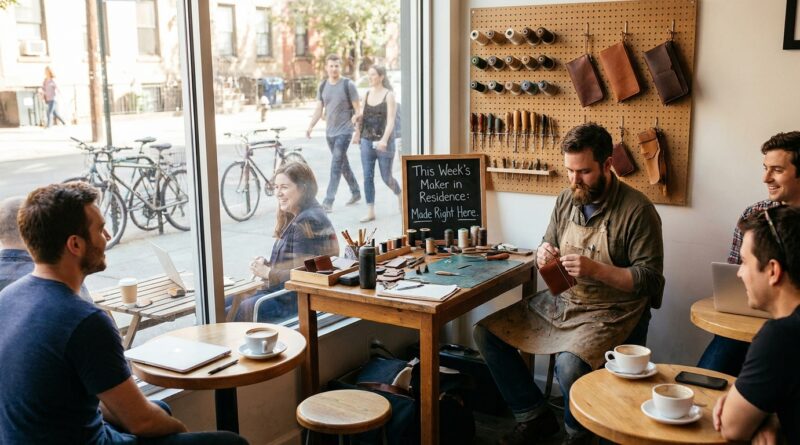
The Hyper-Local Residency: How Neighborhood ‘Maker in Residence’ Programs Turn Empty Corners Into Mini Factories
You can feel it on almost any main street. There is talent nearby, real talent, but it stays hidden. The woodworker is in a garage three blocks over. The ceramic artist sells twice a year at a market. The candle maker posts nice videos online, but you never actually see the work being made. That gets frustrating fast, especially when your neighborhood has empty corners, quiet storefronts, and plenty of people who say they want to buy local. A hyper local maker in residence program fixes that in a very simple way. It gives a working craftsperson a visible, temporary home inside the places people already pass every day. Think library lobby, transit-adjacent kiosk, spare retail bay, or an unused corner of a community center. Instead of asking neighbors to go hunting for local goods, the making comes to them. And when people can meet the person behind the product, local spending stops being an abstract idea and starts becoming a habit.
⚡ In a Hurry? Key Takeaways
- A hyper local maker in residence program places small producers in visible neighborhood spaces so people can watch, learn, and buy nearby.
- Start small with a 4 to 12 week residency in an underused corner, clear hours, basic safety rules, and one simple public activity each week.
- The big value is practical, not trendy. It helps micro-businesses earn repeat customers while turning empty space into something useful and lively.
What a hyper local maker in residence program actually is
At its core, this is not a giant factory project. It is not a fancy innovation lab either. It is a small, visible setup where one maker, or sometimes a tiny rotating group, works in public for a set period of time.
The space can be modest. A corner in a market hall. A window-front studio in a vacant shop. A sheltered plaza booth. A spare room in a library or arts center. The key is simple. People already walk by it.
The resident maker does real work there. Not just demonstrations. They may produce small-batch soap, repair bikes, print textiles, bind notebooks, roast sample coffee batches, sew bags, glaze pottery, or carve wood. Neighbors can see the process, ask questions, join a mini workshop, and buy finished goods without waiting for a once-a-year festival.
Why this works better than the occasional pop-up
Pop-ups are fun, but they come and go so fast that most people miss them. A residency gives neighbors repetition. They see the same maker on Tuesday morning, Friday after school, and Saturday on the way to lunch. That matters.
Trust builds from repeated contact. So does spending. If you bought a cutting board from someone you watched sanding and finishing it for two weeks, you are far more likely to go back for gifts, repairs, or custom work.
For the maker, that repeat visibility can mean the difference between a side hustle and a viable micro-business. For the block, it means empty space starts pulling people in instead of dragging the street down.
What cities are proving right now
The reason this idea keeps showing up in different places is that it answers a very ordinary problem. Small producers often cannot afford a full retail lease, and neighborhoods often have underused space that sits idle. Put those two facts together and a residency becomes a practical bridge.
Cities including Kansas City and Mountain View have shown versions of the same lesson. Put local producers where foot traffic already exists, and interest turns into spending more easily. People are much more likely to support local makers when doing so fits into normal life. On the school run. On the walk to coffee. On the weekend grocery trip.
That is the beauty of the model. It does not ask the neighborhood to become a tourist district. It asks the neighborhood to notice the talent it already has.
The ingredients of a good residency
1. A space people already pass
This is the heart of the whole idea. If the residency is hidden in a hard-to-find building with odd access rules, you lose the point. Good spots include transit corridors, libraries, public markets, community centers, and visible storefronts.
2. A maker who can work in public
Not every craft fits every site. A resident needs a process that is safe, understandable to passersby, and workable in a compact footprint. Quiet or low-mess production usually works best. Think jewelry assembly, textile work, small wood finishing, leather goods, printing, bookbinding, or food products where health rules allow.
3. Clear hours
People need to know when something is happening. If the maker is only present at random times, the habit never forms. Posted hours are a small detail that makes a big difference.
4. One public hook
This can be tiny. A 20-minute skill demo every Saturday. A “meet the maker” hour. A quick repair clinic. A stamp card for repeat visits. The point is to give people one easy reason to stop instead of just glancing through the window.
5. Light but real support
Makers need basics. Reliable power. Good lighting. Storage. Insurance guidance. A sink if the work needs one. Simple signage. Payment support if direct sales are allowed. None of this has to be fancy, but it does have to be thought through.
Who benefits most
The obvious winner is the maker, but they are not the only one.
Neighbors get access to goods with a story attached to them. They can ask how something was made, what it costs, and how to care for it. That kind of direct connection is hard to replace.
Property owners get life in dead space. Even a temporary studio can make a storefront look safer, more active, and more worth entering.
Local governments and business districts get a lower-cost way to test economic activity. Instead of betting everything on one permanent tenant, they can try smaller residencies and see what draws people in.
The maker economy gets a more realistic ladder. Not everyone can jump from home studio to full commercial lease. A residency creates a middle step.
How to start one on your block without making it too complicated
This is where people often get stuck. They assume the program needs grants, a huge committee, or a polished downtown strategy document. Nice if you have those. Not required.
Start with one corner
Pick a single visible space that is underused for at least a month. Empty retail bay. Community center foyer. Shared market stall. Keep it simple.
Run a short pilot
Try a 4 to 12 week cycle. Long enough for people to notice. Short enough that the host and the maker are willing to test it without panic.
Choose makers with practical fit
Ask three questions. Can the work be done safely in public? Can people understand what they are seeing? Can the maker sell or take orders without creating chaos? If the answer is yes to all three, you have a strong candidate.
Write a one-page agreement
List the hours, space rules, insurance expectations, equipment allowed, sales rules, cleanup duties, and whether workshops are included. Keep it plain English. This prevents a lot of awkwardness later.
Measure simple things
Do not overdo metrics. Count foot traffic, sales, workshop attendance, repeat visits, and inquiries about future residencies. That is enough to tell whether the idea is working.
Common problems, and how to avoid them
Problem: It feels like a display, not a working studio
If the maker is only staging products and not actually making, people lose interest quickly. The magic is in seeing real work happen.
Problem: The location is too hidden
A cheap hidden room may save money, but it defeats the purpose. Visibility is not a bonus feature. It is the program.
Problem: The maker is expected to perform all day
Public-facing work is tiring. Give the resident room to focus, not constant pressure to entertain. A few scheduled interaction moments are better than nonstop chatting.
Problem: Safety gets treated casually
Open tools, heat, fumes, food handling, and sharp equipment all need rules. Good programs set clear boundaries, not because they are stuffy, but because safe spaces last longer.
What success looks like after a few months
Success is not just a busy launch day. It is small, repeat behavior.
People start saying, “I know the bag maker by the library.” A nearby cafe starts stocking the resident’s mugs. Parents bring kids by for the Saturday demo. Someone commissions a repair instead of buying cheap and replacing it later. The host space gets more foot traffic. The maker leaves with actual customers, not just social media likes.
That is a healthy sign. It means the residency is becoming part of the neighborhood’s routine, not just a novelty.
Why this matters more than it sounds
There is a bigger shift hiding inside this small idea. For years, many neighborhoods have lost the sense that production happens locally. You can buy things anywhere, but you rarely see the person making them. A hyper local maker in residence program restores that missing link.
It reminds people that making is not distant. It can happen on your street, in a room you pass every day, by someone whose kids may go to the same school as yours. That changes how people think about spending, skill, and community.
At a Glance: Comparison
| Feature/Aspect | Details | Verdict |
|---|---|---|
| Visibility | Placed in everyday walking routes like libraries, markets, and storefront corners. | Essential. This is what turns curiosity into regular visits and sales. |
| Cost to launch | Usually lower than opening a full shop because the space is temporary and smaller. | Strong value. Good for testing demand without a huge financial risk. |
| Community impact | Creates direct contact between neighbors and makers, adds activity to empty areas, and supports local buying habits. | High payoff when hours, safety, and public access are handled well. |
Conclusion
If your neighborhood feels full of hidden talent and empty space at the same time, this is one of the more sensible fixes around. Right now cities from Kansas City to Mountain View are proving that when you put small producers in the very paths people already walk, local spending follows and micro-businesses get a real shot at surviving. A simple residency model gives your block a repeatable way to do the same thing, turning underused corners into living workshops where neighbors meet the person behind the product, learn a small skill, and start routing their everyday purchases through people who actually live nearby.