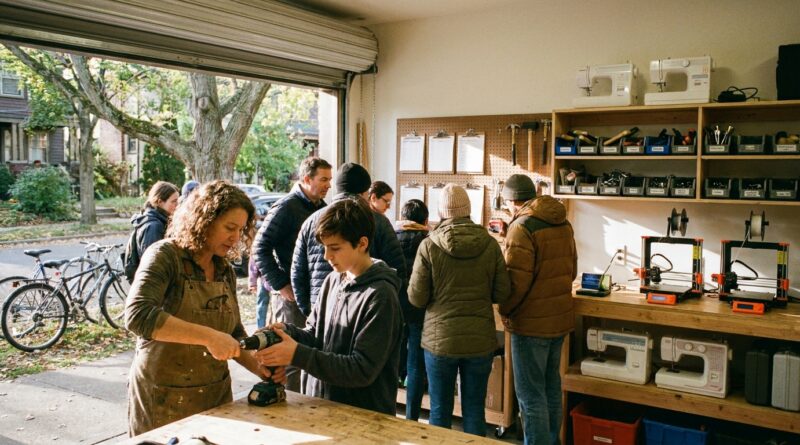
The Neighborhood Tool Library: How Shared Gear Is Quietly Powering a New Wave of Homegrown Makers
You feel it the minute you walk into the tool aisle. A basic drill costs more than it used to. The cheap starter kit looks like it will strip its screws by Saturday. And if you want to try woodworking, bike repair, sewing, or simple home fixes, the price of getting started can make the whole thing feel not worth it. That frustration is real. So is the loneliness of it. A lot of us have neighbors who know how to fix a lamp, patch drywall, sharpen chisels, or use a miter saw safely. We just do not have a good way to find each other.
That is why neighborhood tool libraries matter right now. They are one of the most practical, low-drama ways to make hands-on skills cheaper, easier, and more social. If you want to know how to start a neighborhood tool library, or simply join one, the good news is you do not need a huge budget or a city grant to begin. You need a small pile of useful gear, a simple checkout system, and a few people who care enough to keep it going.
⚡ In a Hurry? Key Takeaways
- A neighborhood tool library lets people borrow tools instead of buying everything themselves, which cuts costs and helps more people start making and repairing.
- If you want to start one, begin small. Pick one location, 20 to 50 useful items, clear rules, and a simple sign-out system before you grow.
- Safety matters. Focus on well-maintained tools, basic training, and tools that match your group’s skill level, not just the flashiest equipment.
Why tool libraries are suddenly making so much sense
Most tools are used surprisingly little. A post-hole digger might work one weekend a year. A tile saw might come out once every five years. Even a power drill, the classic “everyone should own one” item, often spends most of its life in a closet.
That makes the old model a little silly. Ten households on one block buy ten mediocre versions of the same thing, then everyone stores, maintains, and replaces them alone.
A tool library flips that around. Instead of every person buying rarely used gear, a neighborhood shares good versions of the tools people actually need. The result is simple. Lower cost. Less waste. Better tools. More conversation.
It also helps with something harder to measure. Confidence. People are more likely to try fixing a shelf, building a planter, or learning bike maintenance when they do not have to spend hundreds of dollars before they even begin.
What a neighborhood tool library actually is
Think of it as a book library, but for practical stuff. Members borrow tools, use them, bring them back, and ideally learn a little along the way.
Some are run by cities or public libraries. Some live inside makerspaces. Some are just a church basement, a garage, or a shed run by volunteers. Many also expand beyond tools into what people call a “library of things,” which can include sewing machines, ladders, pressure washers, canning gear, camping items, and repair supplies.
The best versions are not only about lending objects. They become a tiny neighborhood hub for skill-sharing. Someone borrows a jigsaw. Someone else offers a Saturday intro class. A retired electrician explains safe extension cord use. A teenager learns how to patch a bike tube and starts helping others.
Who benefits most
Almost everyone. But especially:
New homeowners and renters
You need tools for weird one-off jobs, but you do not want to buy a garage full of stuff for a small apartment.
People curious about making
If you want to try woodworking, furniture repair, gardening, electronics repair, or sewing, borrowing lowers the risk.
Families on a budget
Replacing instead of repairing gets expensive fast. Shared tools make repairs realistic again.
Local makers and side hustlers
Not every new maker can afford a full setup on day one. Shared access can be the bridge between interest and income.
Older neighbors with skills
Many people already know how to do this work and simply need a place to pass it on.
If you want to join one, start here
Before you learn how to start a neighborhood tool library, check whether one already exists near you. Search your city name plus “tool library,” “library of things,” “makerspace,” “repair cafe,” or “mutual aid tools.” Public libraries are worth checking too. Some lend out tools quietly, without much fanfare.
If you find one, ask five practical questions:
- What does membership cost?
- What kinds of tools are available?
- How long is the loan period?
- Do they offer classes or safety orientations?
- Can you volunteer instead of paying full price?
Volunteering is often the hidden bargain. A few hours helping with intake, cleaning, inventory, or basic repairs can get you access and connect you with the exact people who know how things work.
How to start a neighborhood tool library without turning it into a mess
This is the part most people overcomplicate. You do not need to start with a fancy storefront and 400 tools. In fact, that is a good way to burn out.
Start smaller than your ambition. That is the trick.
1. Figure out the real local need
Do not guess. Ask around. Post in the neighborhood group. Talk to your local library, school, church, repair shop, or garden club. Find out what people actually want to borrow.
You may discover your area needs basic home repair tools more than woodworking gear. Or bike tools more than power saws. Or sewing and mending supplies more than anything else.
A 10-question survey can save months of wasted effort.
2. Choose a starter model
Most neighborhood tool libraries begin in one of three ways:
- Hosted model. A library, community center, school, church, or nonprofit provides space and maybe insurance.
- Volunteer co-op. Members help run it, donate tools, and share upkeep.
- Neighborhood pod. A very small, local setup serving one block, building, or mutual aid group.
If you are just learning how to start a neighborhood tool library, the hosted model is usually easiest. Someone else already has a building, regular hours, and some legal structure.
3. Start with boring tools, not glamorous ones
This part matters more than people expect. The backbone of a good tool library is not the giant table saw. It is the humble stuff that solves everyday problems.
Think drills, driver bits, stud finders, hammers, socket sets, clamps, ladders, sewing kits, pry bars, level sets, hand saws, wrenches, caulking guns, gardening tools, and bike repair basics.
Those items get used. They also teach confidence.
Save the high-risk gear for later, if at all.
4. Build a simple checkout system
You do not need custom software on day one. A shared spreadsheet, a free library app, or a low-cost inventory tool can work fine.
Track:
- Tool name
- Unique ID number
- Condition
- Borrower name and contact
- Checkout date
- Return date
- Notes on damage or missing parts
If your system cannot answer “who has the impact driver” in ten seconds, it is not simple enough.
5. Write plain-English rules
Skip legal-sounding paragraphs no one will read. Be clear and human.
Cover the basics:
- Who can borrow
- Loan periods
- Late returns
- What happens if a tool breaks
- Whether training is needed for certain items
- Cleaning expectations before return
You are not trying to sound strict. You are trying to avoid awkwardness.
6. Plan for maintenance from the start
Shared tools wear out. Bits go missing. Blades get dull. Batteries die. This is normal. A tool library is not just a collection. It is a maintenance habit.
Set up a regular check-in process. Every returned item should get at least a quick look. Every month, do a deeper review of your most-used tools.
One reason local repair networks are growing is that people are tired of tossing fixable things. That same logic applies here. A well-run tool library often pairs naturally with repair culture. If this idea clicks for you, The Hyper‑Local Repair Revolution: How Neighborhood Fix‑Shops Are Quietly Outcompeting Big Retail is worth a read. It shows how local repair capacity can beat replacement culture in very practical ways.
7. Put safety ahead of growth
This is where a lot of enthusiasm needs a little adult supervision. Not every tool belongs in every lending library.
Ask yourself:
- Can a beginner use this safely with a short orientation?
- Does it need protective gear?
- Will we maintain it properly?
- Would a class or supervised use be smarter than open borrowing?
You may decide that certain items stay in “on-site use only” mode, or require a brief training session first. That is not gatekeeping. That is common sense.
8. Make it social on purpose
The best tool libraries are not vending machines. They are trust machines.
Host a monthly repair night. Do a “learn your drill” class. Run a beginner bike tune-up session. Invite one experienced neighbor to teach one thing for 45 minutes.
This is how borrowing turns into belonging.
What to collect first
If you are starting from scratch, here is a practical first-wave list:
- Drill and driver sets
- Drill bits and screw bit kits
- Hammers and mallets
- Screwdriver sets
- Pliers and adjustable wrenches
- Socket set
- Tape measures and levels
- Stud finder
- Step ladder
- Extension cords
- Hand saw
- Clamps
- Caulk gun
- Basic gardening tools
- Bicycle pump and repair kit
- Sewing machine or mending kit
Notice what is not on the list. No need to rush into the most expensive or dangerous gear. Build demand first. Then fill the gaps.
Where the tools usually come from
You do not need to buy everything new.
Donations
Many households already have duplicates or inherited tools they rarely use.
Estate clear-outs
Families often want useful tools to stay in the community instead of being sold in bulk.
Local hardware stores
Some will donate, discount, or sponsor basic items if you ask clearly and show a plan.
Mini grants
Neighborhood associations, city arts programs, and community foundations sometimes fund exactly this kind of practical project.
Member fees
Even a small annual fee can help replace bits, blades, and batteries.
Common mistakes that sink a good idea
Most failures are not about bad intentions. They are about trying to scale too fast or keeping too much in one person’s head.
Too many tools too soon
Inventory chaos is real. Start with what you can maintain.
No clear ownership of tasks
Someone needs to handle intake. Someone needs to track returns. Someone needs to inspect tools. Shared leadership is good. Vague leadership is not.
Ignoring hours and access
If borrowing is only possible every third Wednesday from 2 to 4 p.m., people will drift away. Convenience matters.
No path for beginners
If people borrow tools but still feel intimidated, the library is only half working. Pair tools with simple guidance.
Skipping neighborhood partnerships
A tool library gets stronger when it is connected to repair events, fix-shops, schools, and local makers, not isolated from them.
How tool libraries help create more local makers
This is the bigger story, and it is why the movement matters beyond simple thrift.
When people can borrow tools, they experiment more. When they experiment more, they build skills. Some of those people stay hobbyists. Some become the neighbor who can repair a chair or hem a curtain. A smaller number turn those skills into paid work, market stalls, repair services, or genuinely local products.
That is a healthier pipeline than asking everyone to “support local makers” after the fact. First you build the shared backbone. Then more makers can exist at all.
That shared backbone also makes neighborhoods more resilient. If supply chains get weird, prices jump, or replacements take weeks, a community with tools and know-how is simply in better shape.
At a Glance: Comparison
| Feature/Aspect | Details | Verdict |
|---|---|---|
| Cost to get started | Joining a tool library is usually far cheaper than buying a full starter setup. Starting one can also begin small with donated tools and shared space. | Excellent value for beginners and budget-conscious households. |
| Ease of use | Works best when there are clear hours, a simple checkout system, and basic training for members. | Very practical if kept simple and local. |
| Long-term community impact | Builds repair skills, reduces waste, supports new makers, and helps neighbors actually know each other offline. | The biggest benefit, and the reason these projects are worth the effort. |
Conclusion
If you have been feeling boxed out by rising prices, flimsy starter gear, and the strange isolation of trying to learn practical skills alone, a neighborhood tool library is one of the most hopeful answers on the table. This is already happening. City-backed programs, volunteer shelves in community spaces, and scrappy libraries of things are quietly lowering the barrier to making and repair in ordinary neighborhoods. Whether you join one or figure out how to start a neighborhood tool library yourself, the payoff is bigger than borrowing a drill. You help turn frustration into shared capacity. More people learn real skills. More broken things get fixed instead of replaced. More neighbors move from “I wish I could make that” to “I can.” And over time, that creates a stronger pipeline of local makers, repairers, and small businesses rooted in the place you actually live.