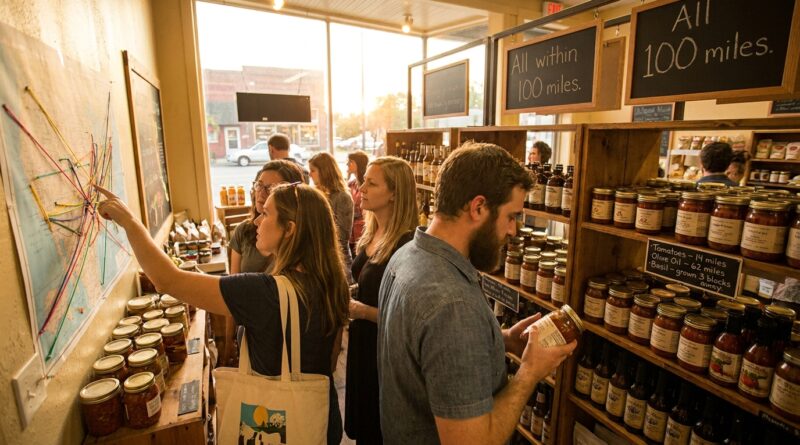
The Hyper-Local Ingredient Chain: How Neighborhood Makers Are Quietly Turning Regional Sourcing Into Their Secret Weapon
People are getting wise to fake local. You have probably seen it yourself. A product shows up with a barn on the label, a handwritten font, maybe a little map, and then you find out the ingredients came from three states away or farther. That wears customers out fast. It also puts small makers in a tough spot, because the people actually buying from nearby farms, mills, orchards, and processors often look almost the same online as brands doing clever packaging and little else. If you are a maker or small retailer, that is the opening. Hyper-local ingredient sourcing is not just a back-end operations choice. It is your sales story, your trust signal, and your proof that buying nearby means something real. The trick is making that story visible, simple, and specific, right where shoppers make decisions, on the label, on the shelf, and on the product page.
⚡ In a Hurry? Key Takeaways
- Regional sourcing for local makers works best when you show exactly where key ingredients came from, not just that they are “local.”
- Start by rewriting labels, product pages, and shelf tags with named farms, towns, distances, and small-batch details.
- Specific sourcing claims build trust and help shoppers choose you over vague “artisanal” imports.
Why “Local” Is Starting to Sound Empty
Customers are not asking for a perfect supply chain. They are asking for honesty. “Made nearby” means less when the main ingredients were hauled across the country and the local part was just the final mixing, bottling, or packing step.
That gap matters because shoppers have learned how branding works. They know a green label can hide a lot. So when a maker can say, clearly and plainly, “Our strawberries came from Hillview Farm, 11 miles away,” it lands differently. It feels grounded. It feels checkable. Most of all, it feels true.
That is why regional sourcing for local makers is becoming a secret weapon. Not because it sounds trendy, but because it gives buyers a concrete reason to trust what they are holding.
Hyper-Local Beats Generic “Artisanal”
Big marketplaces flatten everybody. Your product gets one thumbnail, a short title, and maybe a few bullet points. The result is brutal. A maker who knows every supplier by name ends up sitting next to a seller whose whole strategy is good photos and vague storytelling.
Hyper-local sourcing gives you something those generic listings cannot fake very well. Proof. Names. Distances. Relationships. Seasonality. Real trade-offs.
Think about how much stronger these lines are:
Weak version
Made with local ingredients.
Stronger version
Made with apples from Carter Orchard in Franklin County, honey from Bee Hollow two towns over, and flour milled 18 miles from our kitchen.
One sounds like marketing. The other sounds like a person telling the truth.
What Counts as a Good Hyper-Local Story
You do not need every single input to come from within five miles. Most small makers cannot do that, and customers know it. What matters is being clear about the parts that are local, the parts that are regional, and the parts that are not.
A good sourcing story usually includes:
- The names of nearby farms, mills, dairies, fisheries, orchards, or processors
- The town or county where each key ingredient comes from
- Why that source was chosen
- Whether the ingredient changes by season
- What part of the product is still sourced farther away
That last one is important. A little honesty goes a long way. If your vanilla or cocoa is imported, just say so. Customers do not expect miracles. They do notice dodging.
Redesign the Label First
If your sourcing story only lives on Instagram, most shoppers will miss it. The label is where trust gets built quickly.
What to add
Keep it simple and readable. Pick one or two key ingredients and identify them clearly.
For example:
- Blackberries grown at Mason Ridge Farm, 9 miles away
- Goat milk from Red Creek Dairy, delivered twice weekly
- Corn milled in-state at Riverbend Mill
What to avoid
Do not crowd the front with a giant paragraph. Do not use broad claims like “farm fresh,” “crafted local,” or “regional goodness” unless you back them up nearby with specifics.
A smart format
Use a small “Source Panel” on the side or back, much like a mini ingredient map in words:
Key Sources
Tomatoes: Green Valley Farm, 14 miles
Basil: North Street Community Growers, 3 miles
Sea salt: Coastal supplier, 120 miles
That last line helps, not hurts. It shows you are not trying to hide the less-local parts.
Fix the Product Page Next
Online shoppers cannot pick up the jar, bar, loaf, or bottle. So your product page has to do the work your packaging cannot.
Three website changes that matter
1. Put sourcing near the price.
Do not bury it halfway down the page. A short line near the top can say, “Made with peaches from Lawson Orchard, 12 miles from our kitchen.”
2. Add a simple sourcing section.
Use a heading like “Where our ingredients come from.” Then list your most important local inputs in plain language.
3. Show one real photo.
Not a stock field. Not a mockup. One real image of the farm, mill, or producer is enough to make the story feel rooted.
This is the same basic fix many neighborhood manufacturers are making in adjacent trades. The article The Hyper-Local Sewing Comeback: How Neighborhood Stitch Rooms Are Quietly Replacing Fast Fashion One Contract at a Time shows a similar pattern. The closer the work is to home, the more the story matters, and the more harmful it is when platforms strip that story away.
In-Store Signage Is Often the Easiest Win
If you sell through a shop, market, or co-op, shelf tags can do a huge amount of work for very little cost.
What a good shelf tag looks like
Blueberry Jam
Cooked in small batches 6 miles from here.
Blueberries from Pine Lake Farm.
Sugar sourced regionally.
That is enough. It is short, useful, and believable.
What shops should stop doing
Stop grouping everything under one “local favorites” sign if the products vary wildly in what local actually means. A candle poured nearby from imported wax is different from a sauce made with peppers grown down the road. Both can be good products. They are just not the same story.
How to Talk About Distance Without Sounding Cute
Distance works when it adds clarity. It fails when it turns into gimmick copy.
Good examples:
- Made with milk from a dairy 7 miles away
- Wheat grown and milled within our region
- Packed in our neighborhood using fruit from two nearby counties
Less helpful examples:
- From near and far, with love
- Locally inspired
- Rooted in community
Those phrases are not evil. They are just foggy. Your customers need landmarks, not mood.
Regional Sourcing for Local Makers Does Not Mean All or Nothing
This is where some makers freeze up. They worry that unless every ingredient is local, they should not talk about sourcing at all. That is the wrong move.
Instead, break your supply chain into three buckets:
1. Hyper-local
Ingredients from your town or nearby towns.
2. Regional
Ingredients or processing from within your state or neighboring states.
3. Not local, but necessary
Things you cannot get nearby, or cannot get at the quality or price you need.
Then tell the truth in that order. This gives shoppers a clean picture of what they are supporting when they buy from you.
Why This Helps Your Margins Too
Most people think sourcing stories are only about branding. They are not. They also support pricing.
When a customer understands that your flour came from a nearby mill, your fruit came from a local farm, and your batches are tied to the season, a higher price feels more reasonable. Not because you used fancy words, but because you gave a visible reason.
That can also open the door to tighter neighborhood partnerships. A retailer can feature the maker. The maker can feature the farm. The farm can mention the retailer. Everybody gets a stronger local loop instead of paying for anonymous marketplace traffic.
A Simple 30-Day Plan
Week 1: Audit your claims
Read every package, shelf sign, and product page. Circle every vague word. Local. Small-batch. Farm-fresh. Handcrafted. Replace as many as you can with specific facts.
Week 2: Gather source details
Make a list of your top five ingredients or materials. For each one, write down the supplier name, town, distance, and what makes that source worth mentioning.
Week 3: Update customer-facing copy
Rewrite one label, one product page template, and one shelf tag format. Keep it short. Use names and places.
Week 4: Test what people notice
Ask customers a simple question: “What made you pick this up today?” If they repeat your sourcing details back to you, you are on the right track.
At a Glance: Comparison
| Feature/Aspect | Details | Verdict |
|---|---|---|
| Vague “local” branding | Uses rustic design and broad claims, but gives little proof about ingredients or suppliers. | Easy to ignore. Trust is weak. |
| Specific hyper-local sourcing | Names farms, towns, processors, and distances for key ingredients on labels and product pages. | Best way to stand out and justify the price. |
| Honest mixed sourcing | Clearly explains what is local, what is regional, and what still comes from farther away. | Strong credibility. Realistic and customer-friendly. |
Conclusion
Regional sourcing is growing because people want shorter, clearer supply chains and better quality, but too much of the conversation treats it like a warehouse problem instead of a neighborhood advantage. That misses the point. For makers and small retailers, the real opportunity is to make sourcing visible in the places where buyers decide. A label with named farms. A product page with real supplier details. A shelf sign that says more than “local.” If you do that well, you can separate yourself from imported “artisanal” goods that rely on mood more than substance, keep more money moving through nearby farms and processors, and give customers a plain, satisfying reason to choose the thing made down the road over the one made overseas.