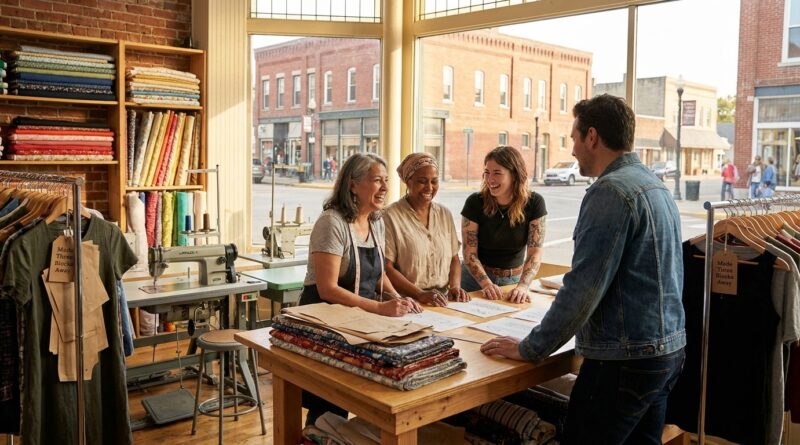
The Hyper-Local Sewing Comeback: How Neighborhood Stitch Rooms Are Quietly Replacing Fast Fashion One Contract at a Time
You can only send so many tech packs into the void before the whole thing starts to feel broken. Independent designers know the routine. You email measurements overseas, wait weeks for a sample, pay for shipping twice, then open the box and realize the fit is off, the fabric hand is wrong, or the final piece looks nothing like the values you put on your website. Meanwhile, in the same city, there may be skilled sewists, pattern cutters, and sample makers piecing together income from alterations, prom hems, and tiny online orders. The quiet shift happening now is simple. More small brands are searching for local contract sewing manufacturers near me and discovering that production does not have to start across an ocean. It can start on the next block. That changes speed, quality, trust, and who gets paid. It also gives neighborhoods a real shot at building clothing businesses that fit local bodies and local priorities.
⚡ In a Hurry? Key Takeaways
- Local contract sewing can help small brands move from sketch to small-batch production faster, with fewer surprises than overseas sampling.
- Start with one style, one clear tech pack, and one paid sample round before you commit to a full local run.
- Paying fair local rates matters. A cheap quote often means rushed work, unclear quality control, or a relationship that falls apart fast.
Why neighborhood stitch rooms are having a moment
Fast fashion trained everyone to think clothing has to come from far away, in giant quantities, on a long timeline. That model works for scale. It often fails for small brands.
If you are making 25 dresses, 40 kids’ sets, or a run of workwear aprons, the giant-factory model can be a bad fit. Minimums are too high. Communication is slow. Fixes take forever. And if your brand says it cares about local jobs, size inclusivity, or lower shipping waste, the production side can feel out of step with the message.
That is why hyper-local sewing is coming back. Not as nostalgia. As practical business.
A city block can now hold most of what a micro brand needs. A designer with sketches. A pattern maker. A sample sewer. A cutter. A two- to five-person sewing room. A local print shop for labels. A neighborhood photographer. A popup shop or weekend market. Suddenly, the supply chain is not a mystery. It is a map you can walk.
What “local contract sewing” actually means
Contract sewing is simple. You design the product. Someone else sews it for your brand, usually for a fee per piece, per sample, or per production run.
That “someone else” might be:
- A small sewing studio with industrial machines
- An independent sample maker working from a shared workspace
- A cut-and-sew shop that handles cutting, sewing, pressing, and packing
- A specialty maker focused on one niche, like lingerie, kidswear, uniforms, bags, or knit basics
When people search for local contract sewing manufacturers near me, they are often really looking for a local production partner. Not necessarily a big “manufacturer” in the old-school sense. Sometimes the right fit is a tiny shop with three excellent operators and a strong network.
Why small brands are moving production closer to home
1. Samples get fixed faster
Instead of sending notes across time zones, you can meet in person, pin a sleeve, adjust a rise, and see the next version in days, not months.
2. Fit gets more realistic
Local makers often understand the bodies actually buying in your city. That matters if your customer base does not match generic fit blocks used by mass-market factories.
3. You can produce smaller runs
Small brands do not always need 500 units. Sometimes 18 well-made pieces are the smart move. Local shops are often better set up for that.
4. Your money stays in the neighborhood
That is not just a nice story for your About page. It means more local jobs, stronger small-business networks, and a supply chain you can build on instead of restarting every season.
5. Quality problems are easier to catch
It is much easier to spot bad seam finishing, mismatched fabric grain, or inconsistent topstitching when the production room is a short drive away.
How to find local contract sewing manufacturers near me without wasting weeks
This is the part most coverage skips. People say “make it local,” but not how.
Start with the right search terms
Do not just search “seamstress near me.” Try a mix of these:
- local contract sewing manufacturers near me
- cut and sew near me
- sample maker near me
- small batch clothing manufacturer [your city]
- pattern maker and sewing contractor [your city]
- industrial sewing shop [your city]
- apparel production studio [your city]
The best local partners are often not great at search engine marketing. Their websites may be old. Their Instagram may be better than their homepage. Their best leads may come from referrals only.
Ask the people already making things
Talk to:
- Alteration shops
- Fashion design instructors
- Textile arts centers
- Fabric stores
- Costume shops
- Local theater wardrobe departments
- Maker spaces
One of the best clues is not “Who makes clothing?” It is “Who do good sewists trust?”
Check community production spaces
Not every city has a formal garment district anymore, but many have shared workspaces hiding in plain sight. In some places, the same neighborhood energy behind The Neighborhood Sharing Shop: How Tool Libraries Are Quietly Becoming Your Town’s Most Powerful Micro‑Factories is also showing up in textile spaces, shared studios, and maker co-ops. If a town can share table saws and laser cutters, it can also support sergers, cutting tables, and pressing stations.
What to have ready before you contact a sewing shop
This is where many first-time founders stumble. A local shop is not a mind reader, and “I have an idea for a really cute set” is not enough.
Your starter package should include:
- A sketch or photo reference
- A basic tech pack with measurements
- Fabric type and stretch info
- Target quantity
- Timeline
- Your budget range
- Whether you need help with pattern making, grading, cutting, sourcing, or labels
If your materials are messy, the quote will be fuzzy. If your materials are clear, the conversation gets much easier.
You do not need a perfect tech pack
You do need an understandable one. Think of it like handing a contractor a home-renovation plan. The clearer the plan, the better the estimate.
If you are not strong on technical design, pay for help upfront. A few hours with a technical designer or pattern maker can save you a pile of money later.
How a hyper-local production chain can work on one city block
Here is the version people rarely spell out.
- Designer creates sketch and concept.
- Local pattern maker turns it into a production-ready pattern.
- Sample sewer creates first sample.
- Fit session happens in person with real local models or customers.
- Pattern is revised and graded.
- Fabric is sourced locally or regionally when possible.
- Cutter prepares pieces in a small batch.
- Sewing room assembles garments.
- Pieces are pressed, checked, tagged, and packed.
- Brand sells through markets, local retail partners, online preorder, or studio pickup.
That is the comeback in plain English. Not one giant factory replacing another. A local chain of specialists, each handling the part they do best.
How to tell if a local sewing partner is the real deal
Good signs
- They ask smart questions about fabric, finishing, and quantities
- They are honest about what they do well and what they do not
- They can show samples or past work
- They explain pricing clearly
- They set realistic timelines, not magical ones
Red flags
- They quote instantly without seeing specs
- They say yes to every category, from swimwear to heavy canvas, with no caveats
- They cannot explain quality control
- They avoid written agreements
- They underprice everyone else by a suspicious amount
A cheap sew cost can get expensive fast if half the run has puckered seams or wrong measurements.
What small brands should expect to pay
Local production often costs more per piece than offshore production. That part is true. It is not the whole story.
You also need to count:
- Lower shipping costs
- Lower minimums
- Fewer bad samples
- Faster revisions
- Less dead inventory
- Better storytelling for customers who care where things are made
If you are a micro brand, the real comparison is not “local vs giant overseas factory at 10,000 units.” It is “local 30-piece run vs months of delay, sample confusion, and inventory risk.” For many founders, local wins because it reduces expensive mistakes.
Best first projects for local sewing rooms
Not every garment is a good first production run.
Easier starter categories
- Elastic-waist pants
- Aprons
- Tote bags
- Simple dresses
- Kids basics
- Chef wear and uniforms
- Soft accessories
Harder first projects
- Structured bras
- Tailored jackets
- Technical outerwear
- Complex denim fits
- Swimwear with tricky grading
Start with one style that proves the relationship works. You are not just testing a product. You are testing communication, quality, and rhythm.
How under-the-radar sewists can turn skill into steadier work
This comeback is not only about brands. It is also about the people with real sewing skill who are tired of scraping together income from one-off gigs.
If that is you, there is a clear opening right now.
Ways local sewists can position themselves
- Offer sampling only
- Specialize in one category, like kidswear or knit basics
- Partner with a cutter or pattern maker instead of doing everything alone
- Create a simple rate sheet for samples, small runs, and repairs
- Photograph finished interiors and details, not just finished fronts
Brands want reliability almost as much as they want talent. If you answer emails, set boundaries, and turn in clean work on time, you are already ahead of a lot of the field.
Why this is about more than clothes
When sewing work stays local, something bigger happens. A city keeps practical knowledge alive. Industrial machines get used. Younger makers have somewhere to learn. Neighborhoods get more than boutiques. They get production capacity.
That matters for fashion, but it also matters for resilience. A place that can cut, sew, repair, and produce in small batches is a place that can support school uniforms, restaurant aprons, event merch, medical accessories, and community projects without sending every dollar away.
At a Glance: Comparison
| Feature/Aspect | Details | Verdict |
|---|---|---|
| Speed to sample | Local partners can often revise fit and construction in days or weeks instead of months, especially with in-person fittings. | Best for small brands that need quick learning loops. |
| Cost per unit | Local production usually costs more per garment, but it can reduce shipping, bad samples, and inventory mistakes. | Worth it when you are producing in small batches. |
| Brand alignment | Producing near home makes it easier to support local jobs, show transparency, and build clothing that fits your actual community. | Strong choice for values-led brands. |
Conclusion
The local sewing comeback is quiet, but it is not small. It is a practical answer to a problem many designers are tired of pretending is normal. If you have been stuck shipping ideas far away and getting back something that feels off, this is your reminder to look closer to home. July’s National Contract Sewing Month is bringing fresh attention to domestic cut-and-sew work, but the real opportunity is knowing how to plug into it. Start with one style. Build one clear tech pack. Meet one local pattern maker or sewing room. From sketch to rack, a lot more can happen inside a neighborhood than most people realize. That means more money staying local, more steady work for skilled sewists, and a real alternative to anonymous fast fashion for people who want to spend where it matters.