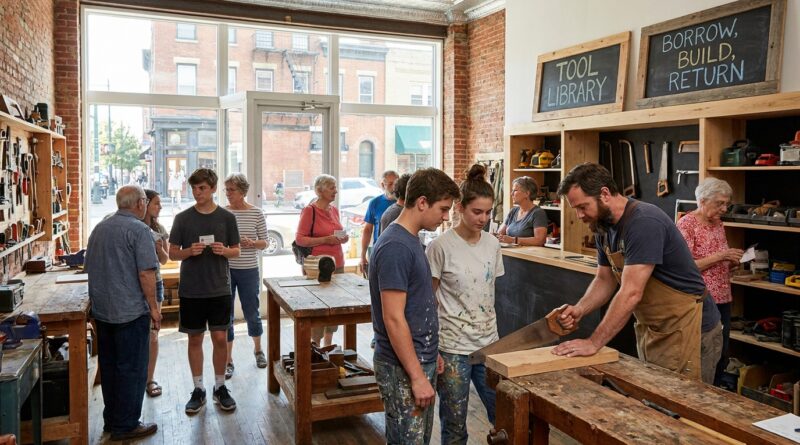
The Neighborhood Sharing Shop: How Tool Libraries Are Quietly Becoming Your Town’s Most Powerful Micro‑Factories
You finally decide to build the raised garden bed, fix the loose stair rail, or test that side business making custom shelves. Then the shopping list hits. Drill press. Tile saw. Orbital sander. Rivet gun. Suddenly a simple plan turns into a four-figure problem. That is maddening, especially when you know most of those tools will spend 95 percent of their life sitting on a shelf. Meanwhile, three houses down, somebody else bought the same thing last month. A neighborhood tool library solves that waste in the most practical way possible. It lets a block, a church, a school, or a small business district share the expensive gear that people only need now and then. Better yet, it can grow from a money-saving idea into something much bigger. Done right, a neighborhood tool library becomes a tiny local factory. It helps residents repair more, build more, and keep more jobs and cash close to home.
⚡ In a Hurry? Key Takeaways
- A neighborhood tool library cuts costs by letting many households and small makers share rarely used but expensive equipment.
- Start small with 20 to 40 high-demand tools, a simple checkout system, and clear rules for deposits, training, and late returns.
- The real value is not just borrowing tools. It is creating safe access to equipment that helps local repairers, builders, and side hustlers take on better jobs.
Why a neighborhood tool library matters more than it used to
A few years ago, shared tools might have sounded like a nice community project. Now it feels a lot more serious.
Budgets are tight. Materials can still be oddly hard to get. Replacement parts show up late. And plenty of people are trying to do more with less. In that kind of environment, owning every tool yourself is not realistic.
A neighborhood tool library changes the math. Instead of ten homes each buying a miter saw, one shared saw can serve all ten. Instead of a local maker turning down a cabinet job because they cannot justify one specialty tool, they can borrow it, finish the work, and get paid.
That is why this is not only about saving money. It is about local capacity. A neighborhood with shared tools can respond faster, repair more items, and produce more useful things without waiting for a big retailer or distant supplier to solve the problem.
What a neighborhood tool library actually is
At its simplest, it is exactly what it sounds like. People borrow tools the way they borrow books.
But the best ones do a bit more. They usually include:
- Basic home repair tools
- Yard and garden equipment
- Power tools for wood, metal, or light construction work
- Safety gear
- Training or quick how-to sessions
- A repair bench for keeping tools in shape
Some are run by libraries. Some by nonprofits. Some by neighborhood groups, schools, churches, housing co-ops, or maker spaces. The structure matters less than the habits. Good inventory. Fair rules. Easy access. Safe use.
Why these shared shops become micro-factories
“Micro-factory” sounds fancy, but the idea is simple. If people on one block can access the right tools, they can make and fix more things right there.
That can mean:
- A handyman taking on custom trim work
- A parent repairing bikes for neighbors
- A student starting a furniture side hustle
- A gardener building planters for local apartments
- A repair volunteer restoring small appliances instead of sending them to the dump
One shared tool cabinet does not turn your zip code into an industrial park. But it does raise the ceiling on what people nearby can do.
This is also where tool libraries connect naturally with repair culture. If you want to see how local fixing can turn into a serious economic force, read The Rise of the Neighborhood Repair Studio: How Fixers Are Quietly Becoming Your Town’s Most Important Manufacturers. Repair studios and tool libraries often feed each other. One provides know-how. The other provides gear.
How to find a neighborhood tool library near you
Check the obvious places first
Start with your public library system. Many people are surprised to learn their branch lends tools, sewing machines, garden kits, or repair gear.
Then check:
- Maker spaces
- Community development groups
- Habitat-style reuse centers
- Neighborhood associations
- Churches and schools
- Local hardware stores with rental programs
Use search terms that work
Search for “neighborhood tool library” plus your town name. Also try “tool lending library,” “community workshop,” “maker space,” and “tool share.”
Ask the people who already fix things
Independent contractors, bike co-ops, repair cafes, and woodworking teachers usually know where shared gear lives. If nobody has a formal answer, that is often your clue that your area is ready for one.
How to start one without turning it into chaos
The biggest mistake is trying to launch with 300 tools and a grand vision. Start smaller. A neighborhood tool library works best when it feels boring in the right ways. Predictable. Trackable. Easy to trust.
Step 1: Pick a home base
You need a dry, secure, easy-to-reach spot. This could be:
- A library storeroom
- A church basement
- A garage with lockable cabinets
- A shipping container on shared property
- A room in a community center
Do not overthink the first location. Good access and decent security beat perfection.
Step 2: Start with tools people actually need
A solid starter inventory often includes:
- Drills and driver sets
- Circular saws and jigsaws
- Ladders
- Stud finders and levels
- Socket and wrench sets
- Tile tools
- Sanders
- Shop vacs
- Pressure washers
- Hedge trimmers and lawn tools
- Wheelbarrows
- Clamps
- Safety glasses, gloves, ear protection
Skip weird specialty gear at first unless you already know there is demand.
Step 3: Use a simple checkout system
You do not need custom software on day one. A spreadsheet, a basic library app, or an inventory platform with barcodes is enough.
Track:
- Tool name and serial number
- Condition before checkout
- Who borrowed it
- Due date
- Deposit or membership status
- Notes on damage or missing parts
Step 4: Set rules before the first loan
This is where many good-hearted projects fall apart. People are usually decent, but systems still matter.
Spell out:
- Loan length
- Renewal policy
- Late fees
- Cleaning expectations
- What happens if a tool breaks
- Who can borrow power tools
- Whether training is required
Clear rules protect friendships.
Step 5: Build in maintenance time
Tools wear out. Blades dull. Batteries fail. Chargers disappear into another dimension.
Assign someone to inspect items on return. Keep spare consumables. Put a small slice of membership fees aside for repairs and replacement.
What fair sharing rules look like
People hear “shared tools” and immediately worry about damage, hoarding, or unsafe use. Those are fair concerns. Good rules answer them without making borrowing feel like applying for a mortgage.
Keep pricing low but not zero unless funding is solid
Free can work if grants or public funding cover the gap. Otherwise, a low annual membership or small per-borrow fee helps keep the system alive.
Examples:
- $25 to $75 yearly household membership
- Reduced rates for low-income residents
- Small refundable deposits for higher-risk tools
- Business memberships for local tradespeople
Separate basic tools from advanced tools
Not every borrower should walk out with every machine on day one.
A smart model is tiered access:
- Tier 1: hand tools and simple power tools
- Tier 2: tools requiring a short safety class
- Tier 3: high-cost or higher-risk equipment, available only to trained members
Require return-ready condition
Borrow it clean. Return it clean. If a blade is broken or a battery is dead, report it. Make honesty easier than hiding damage.
How to connect local tradespeople and makers to the shared inventory
This is the step that turns a neighborhood tool library from a thrift move into a local economic engine.
Offer business-hour access or reserved slots
A carpenter or repair tech cannot always wait for Saturday checkout hours. If you want local pros to use the inventory, create windows that fit real working schedules.
Create a “pro request” list
Ask local makers what tools are stopping them from taking bigger jobs. You may find that one bench planer, one tile saw, or one heavy-duty sewing machine opens up a surprising amount of work.
Pair tools with referrals
If a resident borrows tools and then realizes they need help, the library can keep a list of trusted local repairers, woodworkers, welders, and handypeople.
That keeps work local. It also keeps projects from stalling out.
Host skill nights
One evening class on cabinet hardware, bike repair, or basic drywall can pay off for months. People learn to use tools safely. Local pros get visibility. Borrowers become more confident.
What to include if you want the library to support small local manufacturing
If your goal is not just sharing but making, stock tools with repeat local demand in mind.
Useful categories include:
- Woodworking tools for shelving, planters, trim, and furniture
- Metalworking basics for brackets, repairs, and gates
- Textile tools for alterations, upholstery, and soft goods
- Electronics repair gear for small appliances and devices
- Garden build tools for fencing, beds, compost systems, and irrigation fixes
The point is not to copy a full machine shop. The point is to ask, “What local jobs get turned down because one needed tool is missing?” Then solve that problem.
Safety is not the boring part. It is the whole thing.
If people get hurt, the project will not last. Safety has to be easy, visible, and routine.
Keep a safety kit with the tools
For each higher-risk item, include the right protection and a one-page instruction sheet.
Use short orientation sessions
Most people do not need a semester-long class. They do need ten useful minutes on setup, use, cleanup, and common mistakes.
Post clear “do not lend” rules
If a tool has a cracked housing, missing guard, or bad battery, it comes off the shelf. No debate.
Check insurance and waivers
This part is not exciting, but it matters. If your neighborhood tool library is tied to a nonprofit, library, church, or association, talk with an insurer and use a plain-language borrower agreement.
How much money can a neighborhood actually save?
Quite a lot, especially when you count avoided purchases instead of just annual fees.
Imagine a block of 30 households. If even 10 of them skip buying a pressure washer, a tile saw, a hedge trimmer, or a ladder because they can borrow instead, the shared savings quickly run into thousands of dollars.
And that is only the household side.
If two local makers can borrow the right equipment to finish jobs they would otherwise turn down, the value jumps again. Shared tools can create income, not just reduce spending.
Common problems, and how to avoid them
Problem: The same few people do all the work
Fix: Rotate volunteer shifts. Make maintenance a formal role. Keep tasks small and scheduled.
Problem: Fancy tools sit unused
Fix: Buy for demand, not bragging rights. Let actual borrowers guide expansion.
Problem: Tools come back damaged
Fix: Inspect on checkout and return. Take photos for pricier items. Use deposits for certain categories.
Problem: People do not trust the system
Fix: Publish the rules, costs, replacement policy, and maintenance routine. Transparency builds confidence fast.
Problem: The library becomes cluttered with donations nobody wants
Fix: Use a donation list. Accept only approved categories. “Free” junk still costs storage space and volunteer time.
At a Glance: Comparison
| Feature/Aspect | Details | Verdict |
|---|---|---|
| Cost vs owning tools | Shared memberships and deposits are usually far cheaper than buying specialty tools you only use a few times a year. | Big win for most households and side hustlers. |
| Ease of starting | A small neighborhood tool library can begin with one secure room, a starter inventory, and a basic checkout system. | Very doable if rules are clear from day one. |
| Impact on local work | Shared access helps repairers, makers, and tradespeople take on more complex jobs without major upfront spending. | Best long-term benefit. This is where saving money turns into making money. |
Conclusion
A neighborhood tool library is one of those rare ideas that is both warm-hearted and hard-headed. It helps people help each other, sure. But it also solves a very real money problem. Families stop buying the same expensive tools over and over. Waste goes down. Local makers and repairers get access to gear that helps them say yes to better jobs. That matters right now because neighborhoods everywhere are trying to stretch thin budgets while supply chains still wobble at the worst moments. If you can find or start a local tool library, set fair borrowing rules, and connect that inventory to the people already fixing and building things nearby, you are not just sharing equipment. You are building a small manufacturing asset right on the block. And that is a lot of power for one shelf of tools.