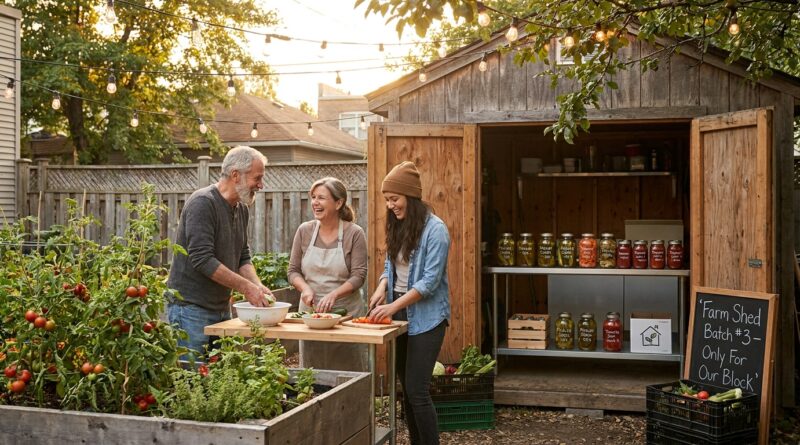
The Hyper-Local Farm Shed: How Backyard Food Makers Are Quietly Turning Neighborhood Harvests Into Micro-Factories
It is hard not to feel a little ripped off when you pay extra for “artisanal” food that traveled farther than you did this year. The label says small-batch. The taste says warehouse. Meanwhile, a few blocks away, someone has too many figs, another neighbor has a licensed home kitchen, and someone else knows how to pickle, ferment, dry, bake, or bottle. The frustrating part is not a lack of food or talent. It is that these pieces rarely connect in a way that creates steady income or reliable local supply. That is where hyper local food manufacturing starts to get interesting. Think of the backyard, shed, church kitchen, garage prep space, and community hall not as hobby zones, but as a tiny neighborhood factory system. Done right, it can turn surplus harvests into sauces, jams, spice blends, baked goods, preserves, and pantry staples people actually want to buy all year.
⚡ In a Hurry? Key Takeaways
- Hyper local food manufacturing means treating neighborhood growers, cooks, and shared spaces like a small coordinated production network, not just a weekend market.
- Start with one crop, one product, and one simple sales channel, such as surplus peaches turned into chutney sold through a local shop or pickup club.
- Check cottage food rules, labeling laws, and food safety requirements first, because the best local brand in the world still needs to be legal and safe.
What a “farm shed” really means now
The phrase sounds old-fashioned, but the idea is surprisingly modern. A hyper-local farm shed is not just a wooden building behind a house. It is a neighborhood production hub. Sometimes it is a real shed. Sometimes it is a converted garage, a shared commercial kitchen, or a backyard wash-and-pack station for produce.
The shift is simple. Instead of selling every tomato, herb, plum, or cucumber raw and hoping it moves before it spoils, local makers process part of that harvest into something with a longer shelf life and a higher value.
That changes the math fast. Ten pounds of bruised tomatoes might struggle at a market table. Ten jars of roasted tomato relish with a good label and a local story can become a real product.
Why this matters right now
Food prices are still high. People trust giant supply chains less than they used to. And plenty of neighborhoods are full of underused abundance.
Fruit trees drop more than one family can eat. Garden beds overproduce for two weeks, then stop. Small growers are good at growing, but not always set up for packaging, branding, distribution, or compliance. Home bakers and preservers often have the skill, but not the supply.
Hyper local food manufacturing connects those dots.
It also gives communities something many of them are missing. A food identity that feels real. Not a slogan. Not a tourism campaign. Something you can taste.
From hobby jam to micro-factory
This is the big mental switch. A lot of local food economies stall because they stay trapped in hobby mode. Nice labels. Great intentions. No repeatable system.
A micro-factory mindset asks different questions.
Can this be repeated?
If one neighbor makes amazing pear butter once, that is lovely. If five growers can supply pears, one licensed kitchen can process them, and one local store can restock every week for two months, that is a business.
Can it use surplus that would otherwise be wasted?
The sweet spot is often food that is abundant but awkward to sell fresh. Seconds, overripe fruit, extra herbs, bumper crops, and seasonal gluts are perfect inputs for sauces, syrups, dried goods, vinegars, and preserves.
Can it earn enough to keep going?
The product has to support labor, ingredients, packaging, and compliance. If it does not, it stays a fun weekend project and never becomes neighborhood infrastructure.
What products work best
Not every backyard harvest should become a branded product. The best early products are simple, safe, and easy to explain.
Low-complexity winners
Start with items that use familiar ingredients and have obvious uses:
- Jams and fruit butters
- Pickles and relishes
- Dried herbs and seasoning blends
- Chili oils, if local rules allow
- Syrups and shrubs
- Salsa, chutney, and tomato sauce
- Baked goods built around local fruit or grains
These products tell a clear story. They also turn a short harvest window into a longer selling season.
Products with a strong neighborhood identity
The magic happens when the product tastes like where you live. Blackberry jam from the creek trail. Lemon marmalade from the old houses on the south side. Herb salt made from community garden beds.
That sense of place matters. It is one reason local pantry goods are popping up in other settings too, including hospitality. If you want to see where these neighborhood-made products can head next, The Hyper-Local Hotel Pantry: How Neighborhood Makers Are Quietly Moving Into Luxury Lobbies shows how local food products are finding a market beyond the farmers market crowd.
The simple blueprint any community can copy
You do not need a giant food incubator to start. You need a tight loop.
Step 1: Map what is already there
Start with an inventory. Who grows what. Who has extra. Who has kitchen skills. Who has licenses. Who can design labels. Who can sell. Who has refrigeration. Who owns a dehydrator, canner, or bottling setup.
Most places already have the pieces. They are just scattered.
Step 2: Pick one anchor crop
Do not begin with “local food.” That is too broad. Begin with one thing. Figs. Apples. Basil. Cucumbers. Peaches.
One crop keeps planning sane. It also makes sourcing, branding, and scheduling easier.
Step 3: Create one product people will actually reorder
This is not the time for twelve flavors and a fancy backstory. Make one good thing. Test it. Improve it. Price it properly.
The goal is repeat purchase, not applause.
Step 4: Build one dependable sales channel
Again, keep it simple. A neighborhood grocer. A CSA add-on. A school fundraiser. A weekly pickup point. A local café. A community market table with preorders.
When one channel works, add another.
Step 5: Standardize the boring stuff
This is where small operations often wobble. Recipes need consistency. Labels need to be correct. Batches need dates. Supply pickup needs a schedule. Payments need tracking.
Boring systems are what turn a good idea into income.
What people get wrong about hyper local food manufacturing
There is a romantic version of this story, and then there is the version that survives contact with reality.
Mistake 1: Thinking local automatically means profitable
It does not. Small-batch production can be expensive. Glass jars, sugar, vinegar, labels, time, and certified kitchen hours add up.
You need honest pricing. If the neighborhood only supports bargain-bin pricing, choose a different product or a different market.
Mistake 2: Ignoring food safety
This is not optional. Depending on the product, you may need approved recipes, pH controls, inspected facilities, allergen labeling, or shelf-stability testing.
Good intentions do not stop spoilage or contamination.
Mistake 3: Making too many products too soon
Too much variety kills momentum. It complicates sourcing, labeling, production, and customer understanding.
One reliable product beats seven confusing ones.
Mistake 4: Treating it like a fundraiser forever
Community spirit is great. But if growers and makers are not paid fairly, the whole thing fades once the novelty wears off.
How cities can do this without farms
This model is not just for rural areas and cute small towns. Cities may have even better odds because they often have dense demand, skilled home cooks, and strong neighborhood identity.
Urban inputs can come from backyard trees, community gardens, rooftop beds, gleaning programs, and relationships with peri-urban farms just outside the city. Production can happen in church kitchens, commissaries, or licensed home kitchens where rules allow.
The point is not to pretend every city block is a farm. The point is to create a short, visible, trusted food loop.
Where the money actually comes from
Readers usually ask the practical question next. Nice idea, but who gets paid and how?
Growers earn from surplus
Instead of watching extra produce rot, growers can sell seconds or bumper crops into a neighborhood processing stream.
Makers earn from processing skill
The person who knows how to preserve, bake, ferment, blend, or bottle is doing real manufacturing work. That labor deserves real margins.
Sellers earn from local distribution
Shops, cafes, hotels, and subscription boxes can all carry local pantry products that feel distinct from generic wholesale stock.
The neighborhood earns an identity premium
That sounds fancy, but it is simple. People will pay for food that feels specific, trustworthy, and rooted in place, especially when the story is true and the quality is there.
How to make it feel trustworthy, not gimmicky
People are tired of fake-local branding. They can smell it a mile away.
Trust comes from details. Name the block, garden, orchard, or grower when appropriate. Use simple labels. Explain the season. Show what the raw ingredient looked like before it became the finished product.
If your neighborhood product only exists for six weeks because the fruit is only ripe for six weeks, say that. Scarcity feels honest when it actually is.
The tech side nobody talks about enough
Even a tiny local food network needs a little digital plumbing. Not flashy apps. Just useful tools.
Use a shared inventory sheet
Track what is available, how much, when it was picked, and who has claimed it. A basic spreadsheet can save a lot of wasted text messages.
Use simple order forms
Preorders reduce waste and help makers plan batch sizes. A lightweight online form is often enough.
Use batch logs and labeling templates
This keeps products consistent and helps with traceability if something goes wrong.
That is one reason this idea feels so timely. It combines very old skills with very ordinary modern coordination tools. You do not need a venture-backed platform. You need decent organization.
At a Glance: Comparison
| Feature/Aspect | Details | Verdict |
|---|---|---|
| Raw produce sales only | Fast, familiar, but highly seasonal and vulnerable to spoilage and price swings. | Good starting point, but limited income on its own. |
| Hyper local food manufacturing | Turns surplus into shelf-stable or higher-value goods using neighborhood kitchens, growers, and small retail channels. | Best option for year-round value and stronger local identity. |
| Large outside co-packing | Can scale faster, but often loses the local connection and may require bigger volumes than small communities can supply. | Useful later, but not ideal for proving the neighborhood model first. |
Conclusion
The big idea here is not complicated. Stop thinking of backyard abundance and home kitchen skill as scattered hobbies. Start seeing them as the parts of a small, local manufacturing system. That is what makes hyper local food manufacturing so promising right now. Food costs are up. Trust in faraway supply chains is shaky. Yet many communities already have the raw ingredients, the know-how, and the buyers. What they need is a practical blueprint to connect them. Start with one crop, one product, one kitchen, and one sales outlet. Keep it legal. Keep it simple. If it works, you have more than jam or pickles. You have new income, less waste, stronger local food security, and a neighborhood brand people can literally taste. In a city or a small town, that is something worth building this season.