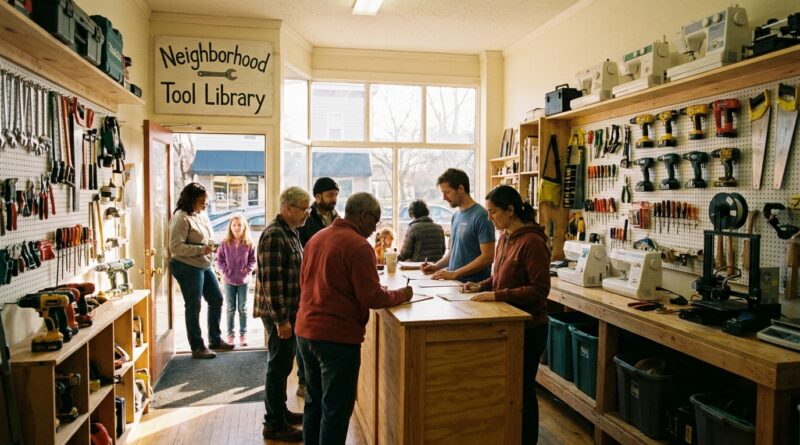
The Hyper-Local Tool Library: How Neighborhoods Are Quietly Turning Shared Tools Into Mini Factories
You know the feeling. A shelf needs fixing, the garden beds need edging, or a side hustle idea is stuck because the one tool that would make the job easy costs more than the project itself. So the work waits. Materials sit in a corner. Good ideas turn into another weekend of “maybe later.” That is why the neighborhood tool library is getting real attention. It is not just about borrowing a drill instead of buying one. In many places, shared tools are quietly becoming mini factories for the block. A miter saw helps one person build planters. A heat press helps another make shirts for a school fundraiser. A sewing machine repairs bags, hems uniforms and starts small paid jobs. If you have been wondering how to start a neighborhood tool library, the good news is this can begin small, stay practical and grow into something far more useful than a storage room full of stuff.
⚡ In a Hurry? Key Takeaways
- A neighborhood tool library is a shared system for borrowing tools, learning skills and helping residents finish repair, garden and maker projects without buying everything themselves.
- Start with a small inventory, simple borrowing rules, one storage location and a short list of the most-requested tools before you expand.
- Safety matters. Track tool condition, require basic training for higher-risk gear and do not lend damaged equipment just to keep the shelves full.
Why tool libraries matter right now
For years, we were told the answer was simple. If you need something, buy it. If it breaks, replace it. If your project needs a specialized tool, that is just the cost of doing it.
That model is wearing thin. Prices are up. Delivery times can still be weird. And a lot of people are tired of buying flimsy products that fail early and cannot be repaired.
A tool library changes the math. Instead of twenty households each buying a tool they use twice a year, one neighborhood keeps a few good ones in circulation. That cuts waste, lowers costs and gets projects moving again.
But here is the more interesting part. Once tools are shared, skills start getting shared too. Then materials. Then project ideas. Before long, the block has the bones of a tiny production space. Not a giant factory. A local one. Human-sized. Useful.
What a hyper-local tool library really looks like
Forget the image of a giant workshop with expensive membership cards and rows of industrial gear. Most neighborhood tool libraries start much smaller.
It can be one room, one shed or one church basement
The first version might be a locked cabinet in a community center. It might be a corner of a co-op garage. It might even begin with a sign-out system and ten donated tools.
It usually starts with boring tools, not flashy ones
People borrow drills, ladders, stud finders, socket sets, hedge trimmers, post-hole diggers and carpet cleaners more often than fancy CNC machines. The everyday tools matter because they remove friction from common jobs.
It grows when people see real outcomes
One repaired fence leads to a better garden. One borrowed tile saw helps finish a bathroom. One shared sewing machine starts alterations for neighbors. The value becomes visible fast.
How neighborhoods are turning shared tools into mini factories
This is the part that makes the story bigger than simple borrowing.
When a neighborhood has access to tools, people do not just maintain their homes. They start making things for each other. Small batches. Custom work. Repairs that would otherwise be thrown away.
Repair becomes normal again
A shared soldering station, basic hand tools and a work table can keep lamps, stools, bikes and kitchen gear in use. That is one reason the rise of tool libraries fits so well with the ideas in The Hyper-Local Repair Table: How Neighborhood Fixers Are Quietly Beating Throwaway Culture One Broken Thing At A Time. Once repair happens in public, people stop assuming every broken thing belongs in the trash.
Small maker income becomes possible
Someone with access to a laser cutter, sewing machine, circular saw or button maker can test products without spending thousands up front. They can make custom signs, fix furniture, stitch tote bags, produce planter boxes or teach beginner classes.
Skills stay in the neighborhood
Every time a retired carpenter shows someone how to use a jigsaw, or a bike mechanic helps tune brakes, the area gets a little more capable. That knowledge is as valuable as the tools themselves.
How to start a neighborhood tool library without making it too complicated
If you are looking up how to start a neighborhood tool library, the biggest mistake is trying to build the final version on day one. Start lean. Prove demand. Then add structure.
1. Find out what people actually need
Do a simple survey in your group chat, local Facebook group, HOA email list or apartment bulletin board. Ask three basic questions.
- What tools do you wish you could borrow?
- What tools would you donate or lend?
- What projects are people trying to finish?
You are looking for patterns. If fifteen people need lawn tools and nobody needs a biscuit joiner, you know where to start.
2. Start with a core inventory
A strong starter set often includes:
- Cordless drill and bits
- Hammer, screwdrivers, pliers, wrenches
- Stud finder and measuring tools
- Ladder
- Socket set
- Circular saw or jigsaw
- Shop vacuum
- Garden tools like pruners, rake, shovel and hedge trimmer
- Sewing machine or repair kit if your area has interest
Buy or accept only tools you can maintain. A free broken tool is not a gift. It is a future headache.
3. Pick a home base
You need a place that is dry, secure and easy to access. Common options include:
- Community center closet
- Library annex
- Church or school storage room
- Shared garage or shed
- Local nonprofit space
Do not overthink aesthetics. Clean, labeled shelves beat a fancy setup you cannot sustain.
4. Create simple borrowing rules
Keep the system easy enough that volunteers will actually use it.
- Require a name, phone number and address
- Set a standard loan period, like three or seven days
- Add late return rules
- List replacement expectations for lost or badly damaged items
- Mark tools that need training before checkout
A shared spreadsheet can work at first. Later, you can move to a proper inventory app.
5. Decide how money will work
Some tool libraries are free. Others use low annual memberships. Some ask for donations per checkout. There is no magic formula.
What matters is covering basics like maintenance, replacement blades, batteries, labels, insurance and storage costs.
6. Build in safety from the start
This is not the glamorous part, but it is important. Keep a check-in checklist. Inspect cords, guards, blades and batteries. Retire damaged tools. Post plain-language safety notes. For higher-risk tools, require a short demo before first use.
You do not need to scare people. You do need to be responsible.
7. Add workshops once borrowing is stable
The real magic happens when the library hosts short how-to sessions. Think “how to patch drywall,” “basic bike tune-up,” “how to use a sewing machine,” or “raised bed basics.”
That is when a tool library stops being a lending shelf and starts acting like neighborhood infrastructure.
The tools that create the most value
Not every tool earns its keep equally. Some are cheap enough that sharing does not matter much. Others are used so often, or save so much time, that they quickly justify the effort.
High-value home repair tools
- Power drill
- Oscillating multi-tool
- Tile cutter or wet saw
- Stud finder
- Extension ladder
- Shop vac
High-value yard and garden tools
- Wheelbarrow
- Post-hole digger
- Hedge trimmer
- Seed spreader
- Compost sifter
High-value small business and maker tools
- Sewing machine
- Heat press
- Button maker
- Quality paper cutter
- Work lights and folding tables
The mini-factory idea usually starts here. A few well-chosen tools can support classes, micro-businesses and one-off neighborhood jobs.
Common problems, and how to avoid them
Problem: people do not return tools on time
Use reminders. Keep loan periods short. Make renewals easy. Most late returns are not malicious. People forget.
Problem: the inventory fills with random junk
Set donation rules. Accept only working, useful items that match your needs list. If nobody wants it, do not store it.
Problem: a few people do all the work
Create small volunteer roles. One person does intake. Another checks tool condition. Another runs workshops. Spread the load early.
Problem: no one knows the library exists
Show project results, not just shelves. Post before-and-after photos. Share stories about repaired bikes, built planters and saved money. People respond to outcomes.
Why this works better than everyone owning everything
Most tools spend almost all of their life sitting idle. That is expensive for households and inefficient for communities.
A shared system puts those tools to work. It also lowers the barrier for trying something new. A person who would never buy a specialty saw might absolutely borrow one for a weekend and finally finish a repair that prevents bigger damage later.
And there is a social effect that is easy to underestimate. People who borrow together talk. They ask questions. They trade tips. They trust one another a bit more. That matters, especially in neighborhoods where people live side by side but rarely work side by side.
At a Glance: Comparison
| Feature/Aspect | Details | Verdict |
|---|---|---|
| Startup cost | A small tool library can begin with donated basics, a simple sign-out sheet and low-cost storage instead of a full workshop buildout. | Much cheaper than everyone buying their own gear. |
| Community impact | Shared tools support repair, gardening, classes and side income while helping neighbors meet and trade skills. | High value if managed consistently. |
| Safety and upkeep | Requires inspection, clear rules, tool tracking and basic training for riskier equipment. | Worth it, but do not skip the admin work. |
Conclusion
A neighborhood tool library is not a cute side project. Done well, it is practical local infrastructure. It helps people fix what they already own, build what they actually need and stop waiting for perfect timing or big budgets. That matters right now, when households are squeezed by higher costs, supply delays and a real hunger for things that last. The encouraging part is that the model is copyable. Start with a few useful tools, a safe system and a group of neighbors willing to share. From there, a shelf of borrowed gear can become a repair culture, a teaching space and even a launchpad for small local makers who want to prototype, produce and earn without massive upfront costs.