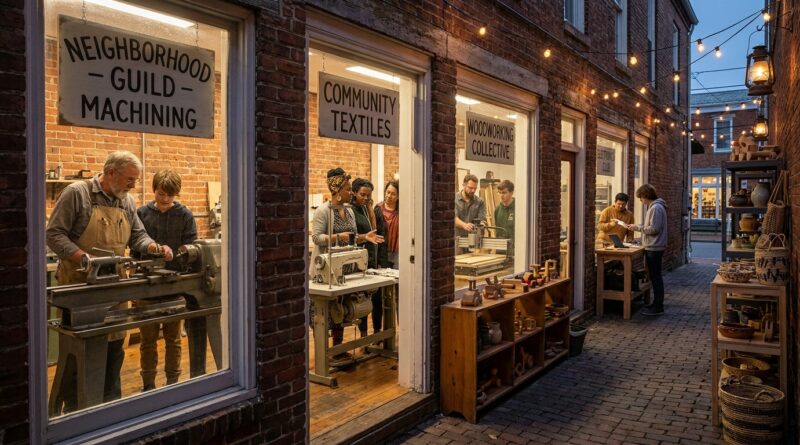
The Hyper-Local Apprenticeship Alley: How Neighborhood Guilds Are Quietly Turning Empty Main Street Shops Into Micro-Factory Classrooms
You can feel the gap, and it is maddening. Town leaders talk about bringing manufacturing back, yet the jobs showing up are often warehouse shifts, delivery routes, and forklift work. Meanwhile, the old machine repair guy is still on Maple Street. The cabinet maker is two blocks over. The sign shop has a laser cutter sitting idle three mornings a week. Young people who want to build real things do not need another speech about the future. They need a path, a place, and someone nearby willing to teach. That is where the idea of a hyper local manufacturing apprenticeship starts to make sense. Instead of waiting for one giant factory to save Main Street, a town can turn three, five, or eight existing shops into a walkable learning corridor. Small spaces. Real tools. Short training loops. Actual products going out the door. It is practical, local, and a lot closer than people think.
⚡ In a Hurry? Key Takeaways
- A hyper local manufacturing apprenticeship can start with existing neighborhood shops, not a giant new factory.
- Pick 3 to 5 walkable businesses and create short, paid skill rotations with clear tasks, safety rules, and simple certificates.
- This works best when training is tied to real production, so learners build useful skills while local businesses get help and towns keep knowledge close to home.
Why this idea is catching on
There is a reason people keep talking about reindustrialization. Folks want jobs that feel solid. They want work that produces something real. They want downtowns that do more than sell coffee, ship boxes, and hope for foot traffic.
But here is the snag. Big manufacturing projects take years. Grants move slowly. New factories usually want a trained workforce before they arrive. So towns end up stuck in a loop. No factory because there are not enough skilled workers. No skilled workers because there is no easy place to learn.
A hyper local manufacturing apprenticeship breaks that loop on a smaller scale. It says, start with what is already here. A repair shop. A print studio. A welding bay. A sewing room. A ceramics kiln. A bike builder. A wood shop behind a retail storefront. None of these spaces has to do everything. Together, they can teach the basics of making, measuring, finishing, packing, quoting, and fixing.
What “Apprenticeship Alley” actually looks like
Think of it less like a campus and more like a short walking route through town.
One storefront teaches measuring, layout, and material handling. Another teaches cutting, joining, and maintenance. A third covers finishing, quality checks, and customer orders. A fourth might handle digital design, small-batch production, or machine setup.
The learner rotates through each place for a few hours or days each week. Not forever. Just long enough to pick up useful, stackable skills.
Example of a simple neighborhood corridor
A town could map out a beginner track like this:
- Metal shop: safe tool use, deburring, drilling, simple fabrication
- Wood shop: measuring, cutting, assembly, sanding, finishing
- Print or sign shop: file prep, machine workflow, packaging, customer proofs
- Repair shop: troubleshooting, parts identification, service logs
- Shared back room or library lab: basic CAD, quoting, inventory, and job scheduling
That is not theory. It is the bones of a local production economy.
Why empty storefronts matter more than people think
Empty Main Street shops are usually treated as a failure. Sometimes they are also an opening.
A vacant unit can become the shared front door for a guild-style training program. It does not need to be a full factory. It can be the orientation space, tool-safety classroom, sample gallery, and small finishing room. Learners check in there. Shop owners use it for shared demos. Residents can look through the window and actually see making happen again.
That visibility matters. It turns manufacturing from an abstract policy idea into something your neighbors can touch.
If your town has already seen the rise of neighborhood workshops, the next step is not hard to picture. In fact, The Hyper-Local Makerspace Wave: How Neighborhood Workshops Are Becoming the New Factory Floor shows how small workspaces are already starting to fill this role. The apprenticeship alley idea simply connects them into a path people can follow.
What makes this different from old-school apprenticeships
Traditional apprenticeships are often long, formal, and tied to one trade, one employer, or one union path. Those programs can be excellent. They can also be hard to enter, slow to set up, or too narrow for someone still figuring things out.
A hyper local manufacturing apprenticeship is lighter and more flexible.
It is modular
Learners can start with a two-week safety and shop-readiness block. Then add short rotations. Then choose a focus area.
It is cross-trained
Modern small-scale manufacturing is rarely one skill only. The same person may need to read a drawing, use a sander, update a digital file, talk to a customer, and pack a shipment.
It is close to home
That removes one of the biggest hidden barriers. Transportation. A lot of talent never gets started because the bus route is bad or the training center is 40 minutes away.
Who benefits most
This model is almost designed for people who get overlooked by bigger systems.
- High school graduates who do not want a four-year degree right now
- Career shifters burned out on office or service work
- Parents returning to work who need local schedules
- Retirees with shop skills who want to teach part time
- Small businesses that need help but cannot run a full training department
It also helps the older masters everyone says they value but rarely supports. A seasoned machinist or upholsterer may not want a full classroom. They may be very willing to teach one person, two afternoons a week, if someone handles the coordination.
How a town can start without waiting for a huge grant
This is the part many people miss. You do not have to begin with a million-dollar plan.
Start with an inventory
Make a list of every business, garage operation, art-industrial studio, repair shop, and maker space that already produces, fixes, or finishes physical goods. Do not overthink the categories. If they make things people use, they count.
Find the teachable tasks
Not every shop owner wants to teach advanced craft. Fine. Ask what a beginner can safely learn in four hours, ten hours, or twenty hours. There is usually more than you think.
Build one shared schedule
Instead of each shop recruiting on its own, create one neighborhood training calendar. Monday at the wood shop. Wednesday at the sign studio. Friday in the shared storefront classroom.
Pay for participation if possible
Even a modest stipend changes who can join. If money is tight, start with paid trial projects tied to real orders.
Keep the paperwork simple
One intake form. One safety checklist. One attendance system. One badge or certificate for each completed skill block.
The safety piece cannot be an afterthought
Friendly and local does not mean casual.
If tools are involved, safety training has to come first. Every learner should complete a basic shop-readiness session before touching equipment. That should include protective gear, lockout basics where relevant, machine boundaries, material handling, cleanup rules, and when to stop and ask for help.
Shops should also be honest about what cannot be taught in a tiny storefront or by a part-time mentor. Some work needs more formal oversight. That is not failure. That is common sense.
Minimum safety habits worth standardizing
- Shared orientation before any rotation starts
- Signed task limits for beginners
- Color-coded tool access by skill level
- Incident reporting, even for near misses
- Clean, visible supervision rules
Why this can revive Main Street in a very practical way
People often imagine local manufacturing as one giant anchor employer. But a healthy town can also be built from dozens of tiny productive places linked together.
That matters because small shops spend locally. They hire locally. They solve nearby problems. They create the kind of street-level activity that makes a downtown feel alive at 10 a.m. on a Tuesday, not just on festival weekends.
And when apprentices move through those shops, they do not just learn technique. They learn the rhythm of local business. How jobs are quoted. Why materials are delayed. What customers ask for. How quality gets checked. How waste gets reduced.
That kind of learning is hard to fake in a classroom.
What success looks like in year one
It probably will not look flashy.
Success might be:
- 12 learners completing a basic production pathway
- 5 local businesses sharing training duties
- 1 vacant storefront turned into a visible skills hub
- Several learners moving into paid part-time or full-time work
- Older craftspeople documenting methods before that know-how disappears
That is enough to matter. It creates proof. It gives the town a story that is grounded in real work, not just branding.
Common pitfalls to avoid
Turning it into a talk shop
If there is too much planning and not enough making, people drift away. Keep the program tied to real output.
Asking one shop to carry the whole load
This only works if the burden is shared. No single owner has time to become the entire workforce pipeline.
Forgetting transportation and timing
Walkable is ideal. If it is not walkable, it has to be easy to reach. Also, not everyone can train at 2 p.m. on a weekday.
Confusing aesthetics with production
A nice-looking maker space is not enough. The point is repeatable skill building connected to actual orders, repairs, and fabrication.
At a Glance: Comparison
| Feature/Aspect | Details | Verdict |
|---|---|---|
| Big factory recruitment | Can create many jobs, but takes major funding, long timelines, and a ready workforce. | Good long-term goal, weak short-term fix. |
| Standalone training center | Useful for classes, but can get separated from real production pressures and customer work. | Helpful, but strongest when linked to local shops. |
| Hyper local manufacturing apprenticeship corridor | Uses existing businesses, empty storefronts, and nearby mentors to teach practical skills through short rotations. | Best low-cost way to start building local production talent now. |
Conclusion
For all the big talk about rebuilding American industry, the most useful first move in many towns is much smaller and much closer. Skills transfer. That is the real starting line. A hyper local manufacturing apprenticeship lets a community use the spaces, tools, and wisdom it already has, instead of waiting for a giant outside rescue plan. If you treat a few underused shops and one empty storefront like a walkable classroom, you can give young people and career shifters a faster path into real craft. Weeks, not years. Just as important, you keep money, knowledge, and pride moving around your own streets. That is what makes this idea so grounded. It fits the national conversation about reindustrialization, but it works at the human scale. Your block. Your shops. Your neighbors. Sometimes bringing manufacturing back starts with opening one door, then the next, and finally connecting them.