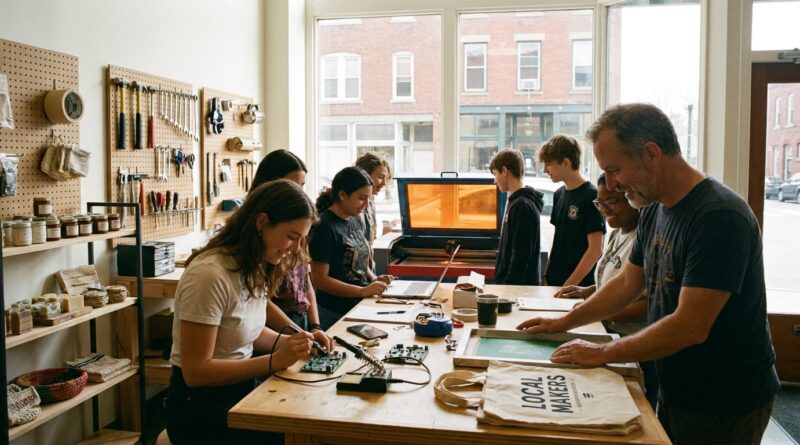
The Hyper-Local Makerspace Wave: How Neighborhood Workshops Are Becoming the New Factory Floor
You can feel the frustration in small, ordinary moments. A broken shelf bracket that should be easy to replace. A local shop that wants custom displays but has to order them from three states away. A teenager who loves building things but has nowhere nearby to learn beyond YouTube. It makes a town feel like all the skill, money and momentum are constantly draining outward. That is why the rise of the hyper local makerspace community manufacturing model matters right now. Across the country, neighborhood workshops, reuse labs and small fabrication hubs are turning into practical civic tools. They are not just places for hobby projects anymore. They are becoming shared workshop floors for repair, short product runs, job training and local problem-solving. If your town has an empty storefront, a few experienced hands and some people willing to organize, it may already have the raw materials for a small manufacturing backbone.
⚡ In a Hurry? Key Takeaways
- Neighborhood makerspaces are increasingly acting like mini factory floors for repair, training and small-batch production, not just tinkering clubs.
- Start by mapping the spaces, tools, mentors and small businesses already in your area, then connect them through simple projects like repair nights or local product runs.
- The biggest value is resilience. Shared local workshops can lower costs, teach skills and keep more money and know-how in the community.
Why this shift is bigger than it looks
For years, a lot of local talent had only two choices. Move somewhere expensive where the tools and networks already existed, or stay put and work alone with limited equipment. That gap pushed ideas outward. So did money. So did opportunity.
What is changing now is simple and powerful. More communities are treating makerspaces as infrastructure. Not a novelty. Not a side hobby. Infrastructure.
A shared laser cutter, wood shop, sewing lab or electronics bench can do the same kind of quiet civic work as a library meeting room or a public ball field. It gives people a place to gather, learn, fix things and make useful stuff close to home.
That matters when shipping is slow, storefronts are empty and small businesses need short runs of custom parts, signage, packaging or displays without huge minimum orders.
What a hyper local makerspace community manufacturing model actually looks like
Think smaller than a giant factory. Think closer, quicker and more flexible.
A neighborhood workshop might help a bakery make custom display stands. A reuse lab might turn donated materials into fixtures for a local event. A fabrication hub might train teens to use CNC machines, 3D printers or sewing equipment while doing paid work for nearby businesses.
That is community manufacturing in plain English. Local people using shared tools to meet local needs.
It often starts with assets a town already has
You do not need a shiny industrial park to start. Many of these spaces grow out of what is already sitting there:
- Underused school shop rooms
- Vacant retail units
- Old warehouses or garages
- Library annexes and community centers
- Retired machinists, welders, carpenters and sewists
- Teens who want hands-on work
- Small local grants and donated equipment
That is the playbook. Modest pieces, put together well.
Why towns are paying attention now
Three pressures are pushing this wave along.
1. Supply chains feel shaky
When one tiny missing part can hold up a repair or product launch for weeks, local capacity starts to look very attractive. Not for everything, of course. But for a surprising number of things, local production is good enough and fast enough.
2. Small businesses need short runs
A local business may need 20 shelves, 50 signs, 100 gift boxes or a custom fixture. Big factories usually do not care about those jobs unless the order is large. Makerspaces do.
3. Communities want visible economic wins
People are tired of hearing abstract promises about growth. A repair clinic, an open studio weekend or a student-built product run is visible. You can point to it. You can meet the people doing it. That makes the local economy feel real again.
How to find the makerspaces already in your orbit
This is where most people get stuck. They assume nothing exists because nothing is branded as a formal manufacturing center.
Start wider than the word “makerspace.” Search for:
- Tool libraries
- Creative reuse centers
- Community wood shops
- Public school fabrication labs
- Art centers with kiln, print or metal facilities
- Library maker labs
- Vocational training shops
- Nonprofit STEM labs
- Coworking spaces with prototyping tools
Then make a simple map. A spreadsheet is fine. Add these columns:
- Name of space
- Tools available
- Who can use it
- Hours
- Training requirements
- Key contact person
- Possible local business use cases
Once you do this, your town usually looks less empty than you thought.
How to treat these spaces as shared infrastructure
The big mental shift is this. Stop seeing a makerspace as “their club” and start seeing it as a platform your neighborhood can use.
Ask practical questions
Could the space host monthly repair nights? Could it produce event signage? Could it train high school students for summer work? Could it help local sellers test a first product batch before spending a lot of money?
That is how workshops become civic assets.
Build around repeatable services
The strongest spaces often move beyond random one-off projects and offer simple repeatable things:
- Bike and appliance repair clinics
- Custom display and fixture builds for local stores
- Short-run product packaging
- Prototyping for local inventors
- Sign-making for neighborhood events
- Beginner tool certification classes
- Teen job pathways and apprenticeships
Those services create rhythm. Rhythm brings users. Users bring revenue, volunteers and momentum.
Schools are an important part of the picture
Some of the most promising local production spaces are hiding in plain sight inside schools. A well-run student shop can do real work for the community while teaching skills that matter immediately.
If that idea interests you, The Schoolyard Micro‑Factory: How Student‑Run Shops Are Quietly Rewiring Your Town’s Supply Chain shows how school-based shops can support local needs in a very practical way.
This is especially useful in places where adult-run makerspaces are still small. A school wood shop, print lab or fabrication room can become part of the local production mix with the right supervision and partnerships.
A simple step-by-step plan for your block or town
Step 1: Inventory people, not just tools
Tools matter, but mentors matter more. Make a list of retired tradespeople, art teachers, repair experts, hobby machinists, costume makers, bike mechanics and engineers in your area. Many are happy to help if the ask is clear and manageable.
Step 2: Pick one visible community need
Do not begin with a grand master plan. Start with one useful problem:
- Fix broken household items once a month
- Make market displays for five local vendors
- Create neighborhood event signage
- Train ten teens on basic shop safety and paid project work
A small win beats a big promise every time.
Step 3: Match spaces to projects
A sewing lab may be better for banners and tote bags than hard goods. A wood shop may be perfect for retail displays. A reuse center may be ideal for low-cost material sourcing. Use what already exists instead of forcing one space to do everything.
Step 4: Set basic rules early
This part is boring, but it keeps projects alive. Define tool training, supervision, scheduling, cleanup, material storage, payment handling and liability. If no one handles these early, the project tends to stall after the first burst of excitement.
Step 5: Invite local business owners in
Many owners do not know these spaces can help them. Host a short open house. Ask what they routinely outsource. You will hear the same needs again and again: displays, repairs, signs, fixtures, prototypes, packaging and small custom runs.
Step 6: Show the work publicly
Open-studio weekends, demo nights and local showcase events do more than market the space. They help residents see that useful making is happening nearby. That visibility builds trust.
What works best as first projects
Not every product belongs in a neighborhood workshop. The sweet spot is usually low-volume, custom or time-sensitive work.
Good early wins
- Retail displays
- Festival booths and signs
- Custom shelving and fixtures
- Repair parts and adapters
- Branded merchandise in small batches
- Furniture refinishing and reuse
- Simple home and garden products
Harder jobs to avoid at first
- Anything requiring heavy regulatory compliance
- Products with tight tolerances beyond the team’s skill level
- Large orders that need full-time industrial output
- Projects with unclear ownership or payment terms
The trick is to choose jobs that build confidence, not chaos.
How communities can pay for this without huge budgets
This is often more doable than people think.
Many spaces get started with a mix of:
- Small arts or workforce grants
- Municipal support for youth programs
- Tool donations from businesses
- Membership fees
- Class fees
- Sponsorship from local employers
- Paid fabrication work for nearby organizations
The goal is not to build a giant facility overnight. It is to create a stable, useful workshop that earns community trust and can grow in layers.
What success really looks like
Success is not just a room full of cool machines.
It looks like a student getting their first paid fabrication job. A café replacing broken fixtures in days instead of months. A church fair using locally made booths. A retiree passing on welding skills. A vacant building buzzing again on Saturday morning.
Those are not tiny side stories. That is local capacity being rebuilt in public.
Common mistakes to avoid
Trying to be everything at once
A makerspace does not need to serve every craft, trade and industry from day one. Start narrow. Grow carefully.
Buying equipment before building programs
A donated CNC machine sounds exciting. But if no one can maintain it, teach it or schedule it, it becomes expensive furniture.
Ignoring business outreach
If local business owners are not in the conversation, the space may stay stuck as a hobby hub. That can still be valuable, but it will not become a true community manufacturing asset.
Forgetting youth pathways
Young people are not just future users. They are present-day contributors. Paid internships, summer jobs and mentorship tracks should be part of the plan early.
At a Glance: Comparison
| Feature/Aspect | Details | Verdict |
|---|---|---|
| Startup cost | Can begin with donated tools, shared space, volunteer mentors and small grants instead of major industrial investment. | Very realistic for neighborhoods and smaller towns. |
| Best use case | Short runs, repairs, prototypes, custom fixtures, youth training and local event production. | Strong fit for community needs that big factories tend to ignore. |
| Long-term value | Builds skills, keeps money local, supports small businesses and makes towns more resilient during supply and economic shocks. | High value if the space is treated as shared infrastructure, not just a club. |
Conclusion
The encouraging part is that this is not a theory anymore. There is a clear pattern. Volunteer-run makerspaces, creative reuse labs and small fabrication hubs are popping up and expanding across the country, and they are openly positioning themselves as engines for local innovation, small-batch manufacturing and youth skills. That matters because it gives any neighborhood a practical path forward using assets that already exist. An underused building. A retired carpenter. A few ambitious teens. A modest grant. If you map the spaces already around you, treat them as shared infrastructure and connect them to schools, businesses and events, you can start real things fast. Repair clinics. Open-studio weekends. Teen maker jobs. Small local product runs. When global economics feels far away and out of your hands, hyper local makerspace community manufacturing offers something rare. A way to build visible, useful capacity right where you live.