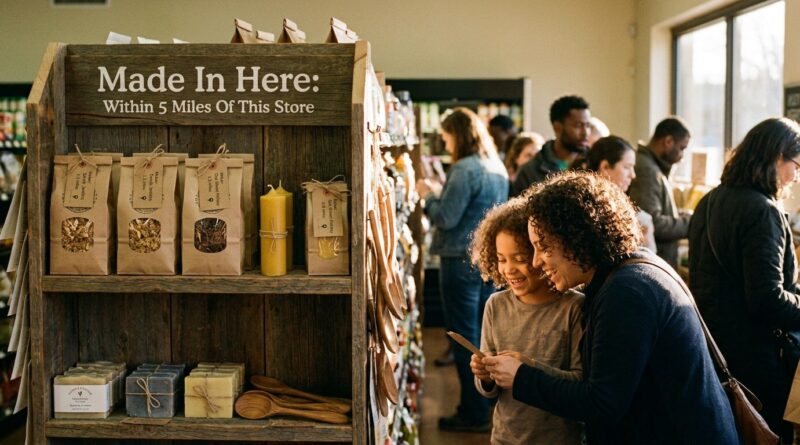
The Hyper‑Local Checkout Revolution: How Neighborhood ‘Made Here’ Labels Are Quietly Beating Amazon In The Last 500 Feet
You want to buy local. Really local. Not “inspired by the region,” not “small-batch style,” and not a giant brand hiding behind a folksy label. But once you are standing in the store aisle, it gets weirdly hard to tell what was actually made nearby. That frustration is real. Most packaging is built to sell scale, not truth. Big brands have the budget to look handcrafted, while actual neighborhood makers often get one small shelf tag, if that. That is why hyper local made here product labeling for neighborhood stores matters so much. It solves a very ordinary problem in a very practical way. It helps shoppers make a fast, confident choice in the last few steps before checkout. And those last few steps turn out to be where Amazon, national chains, and hometown businesses are quietly fighting for your wallet.
⚡ In a Hurry? Key Takeaways
- A simple, trusted “Made Here” label helps shoppers quickly spot products genuinely made in or near their neighborhood.
- If you run a store, start with clear shelf tags, maker stories, and one easy standard for what counts as local.
- This is not just feel-good branding. It can keep more money in the community and make local supply more dependable when prices or shipping shift.
Why “Buy Local” Breaks Down at the Shelf
People do not usually fail to buy local because they do not care. They fail because the signal is weak.
At the shelf, shoppers are rushed. Kids are asking for snacks. Dinner still needs to happen. Nobody wants to pull out a phone and investigate every jam jar, candle, soap bar, or bag of granola.
That is where big brands win. They are louder. Their packaging is cleaner. Their claims sound warm and familiar. “Crafted,” “heritage,” “artisan,” and “family recipe” can mean almost anything.
A real neighborhood maker often has the better story, but the worse visibility.
What the Last 500 Feet Really Means
We hear a lot about last-mile delivery. But for local retail, the more important battle may be the last 500 feet. That is the distance between your front door, the corner shop, and the final moment when your hand reaches for one product instead of another.
This is where a neighborhood-wide “Made Here” signal can do something online ads cannot. It can create instant trust in a real-world setting.
If the label is consistent across several local stores, even better. The shopper does not need to relearn the system every time. They just know, “This mark means someone nearby actually made this.”
What Hyper Local Made Here Product Labeling for Neighborhood Stores Looks Like
Done right, it is simple.
Clear visual markers
Think shelf tags, window decals, endcap signs, or a small badge on the product itself. The point is not to be fancy. The point is to be obvious from a few feet away.
A real standard
Stores need a plain-English rule. Made in the neighborhood. Made in the city. Made within 25 miles. Pick one and say it clearly.
Short maker context
One line helps a lot. “Roasted 2 miles away.” “Poured in Eastwood.” “Baked in the next neighborhood.” That beats vague marketing every time.
Consistency across shops
This is the quiet power move. When several neighborhood stores use the same label system, local buying starts to feel normal instead of niche.
Why This Can Beat Amazon Quietly
Amazon is built for breadth, speed, and convenience. It is not built for physical trust in a neighborhood aisle.
Amazon can recommend “local-ish” products. It can target ads by ZIP code. Big retailers can run neighborhood-themed campaigns. But a trusted in-store label has something those systems do not. It connects the product to place in a way that feels immediate and checkable.
You might know the street. You might know the maker. You might have seen them at the weekend market.
That changes the math. The product is no longer just an item. It becomes part of a local loop.
Why Small Shops Are in the Best Position to Start
Independent stores do not need to outspend giant platforms. They need to be clearer.
In fact, many are already halfway there. If you liked the idea of a dedicated local section, you will probably enjoy The Neighborhood Craft Shelf: How Small Shops Are Turning One Aisle Into A Hyper‑Local Maker Launchpad. It gets at the same basic truth. Local products do better when stores make them easy to notice, compare, and trust.
A single aisle helps. A storewide labeling system helps even more.
What Shoppers Should Look For
If you are a customer, you do not need a perfect system to start making better calls.
Ask one direct question
“Was this actually made nearby, or is it just local-themed?” Store staff usually know, or can find out fast.
Watch for fuzzy wording
“Designed locally” is not the same as made locally. Neither is “inspired by local makers.”
Reward clear labeling
When a store makes local products easy to identify, buy those items if they fit your needs. That tells the retailer the effort is worth it.
What Store Owners Can Do This Month
You do not need a huge rollout.
Start with 10 products
Pick a handful of truly local items and give them a visible, consistent tag.
Define “made here” in one sentence
Put the rule on a sign. Keep it honest and easy to read.
Use plain shelf language
“Made 4 miles away” is stronger than “locally sourced lifestyle brand.”
Train staff for one-minute conversations
When customers ask, they should get a quick, confident answer.
Track what moves
If the labeled items sell faster, you have proof that clarity works.
Why This Matters Beyond Feel-Good Shopping
This is not just about pride.
When more everyday spending stays local, small-batch production becomes more realistic. Makers can plan better. Stores can build tighter relationships with suppliers nearby. Communities keep more dollars circulating close to home.
There is also a resilience angle. When national shipping costs jump or supply chains wobble, local production can soften the blow. Not for everything, of course. But for enough categories to matter.
Food, gifts, pantry basics, soaps, candles, coffee, home goods. Those are not tiny categories.
At a Glance: Comparison
| Feature/Aspect | Details | Verdict |
|---|---|---|
| Generic “artisan” branding | Looks local, but often gives no clear proof of where the item was actually made. | Weak for shoppers who want the real thing. |
| Hyper-local made here labeling | Uses simple, visible tags and clear standards to show products made nearby. | Best option for quick trust at the shelf. |
| Online “shop local” filters | Helpful for discovery, but often too broad or too vague when compared with in-store decisions. | Useful support tool, not a full replacement. |
Conclusion
The big shift is not happening in some flashy app. It is happening quietly in the aisle, right before checkout. Big platforms and national brands are racing to make local feel like a marketing theme, from hyper-local ad targeting to neighborhood-specific retail rollouts, but the real advantage is still in those last few steps between your front door and the shelf. A clear, trusted, neighborhood-wide “Made Here” signal helps people spend with intention, not guesswork. It pushes everyday dollars away from anonymous supply chains and toward real people in the community. Over time, that can make local production stronger, give small shops a better shot, and leave neighborhoods a little more steady the next time prices jump or shipping gets messy. Small label. Big difference.