The Schoolyard Micro‑Factory: How Student‑Run Shops Are Quietly Rewiring Your Town’s Supply Chain
You can feel the problem in ordinary errands. A broken bracket. A store sign that needs replacing. A simple display stand for a weekend event. Ten years ago, you might have known a local shop or a handy young person who could make it. Now too often the answer is a long shipping delay, a mystery seller online, or nobody at all. At the same time, plenty of parents are watching kids spend hour after hour on screens, wondering where the real-world skills went.
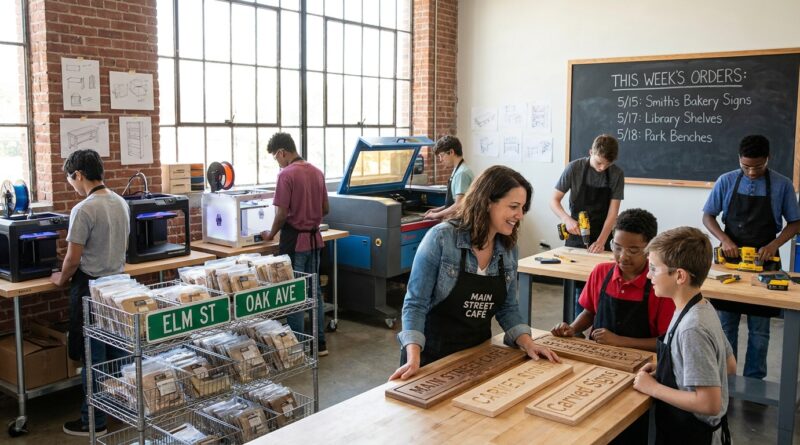
That is why the rise of the student run makerspace local manufacturing model matters more than it first appears. In towns across the country, school fab labs, career centers, and community college workshops are starting to act like tiny local factories. Students design, cut, print, assemble, and ship real products for nearby customers. Businesses get useful work done. Students get paid practice that means something. And communities start rebuilding the local “we can make that here” muscle they have been missing.
⚡ In a Hurry? Key Takeaways
- Student-run school shops can handle small local jobs like signage, fixtures, packaging, and simple repairs faster and more personally than distant online vendors.
- Start small by asking a nearby school or community college to pilot one paid project with a clear deadline, budget, and safety rules.
- The best setups protect students and customers with adult supervision, quality checks, and limits on what work the shop will accept.
What a schoolyard micro-factory actually looks like
Do not picture a giant industrial plant. Picture a room with laser cutters, 3D printers, CNC routers, sewing machines, electronics benches, and students who are learning how to turn ideas into useful things.
One school might make engraved signs for local offices. Another might build custom jigs for a machine shop. A community college might produce small-batch packaging inserts, acrylic displays, replacement parts, trophies, or event materials for businesses nearby.
This is not theory. It is practical local production at a small scale. And for many towns, that is exactly the missing middle between hobby crafting and full-scale manufacturing.
Why this matters now
Small businesses are tired of ordering basic custom items from anonymous websites three states away, or three countries away. Families are tired of hearing that every future job is “digital” while kids rarely get to make, repair, test, or build anything with their hands. Schools are under pressure to prove that career education leads somewhere real.
A student-run makerspace local manufacturing program answers all three frustrations at once.
It gives businesses a nearby production partner
If a bakery needs branded display pieces, a realtor needs yard sign stakes, or a plumber needs labeled parts bins, those are not fantasy projects. They are small, useful jobs that a supervised student shop can often handle well.
It gives students paid work that feels real
There is a huge difference between a classroom exercise and a customer deadline. When students know a local shop owner is waiting on that order, quality suddenly matters in a new way. So do communication, pricing, rework, and time management.
It gives towns a local skills pipeline
You do not fix a skilled labor shortage with posters and slogans. You fix it by letting young people practice useful work early, often, and close to home.
What these student-run shops can realistically make
This is where people either get excited or skeptical. So let us keep it grounded. Most school-based shops are not going to produce aerospace components next week. But they can often handle plenty of valuable work.
- Laser-cut signage for stores, events, and offices
- Custom shelving labels, tags, and branded displays
- 3D-printed prototypes and simple replacement parts
- Small-batch packaging inserts and product holders
- Jigs, templates, and fixtures for local tradespeople
- Awards, plaques, and school or civic merchandise
- Basic electronics enclosures and housings
That may sound small. It is. But small jobs are exactly what many local businesses struggle to source affordably.
Why local owners should care
If you run a small business, you already know the pain of minimum order quantities, high shipping costs, and vendors who do not care that your “tiny” job is actually urgent.
A local student shop can be more flexible. You can visit. You can show them the problem. You can look at a prototype. You can ask for one more hole, a different material, or a size tweak without starting from scratch with an online seller.
And the money stays in the same ZIP code. That matters more than people admit.
If you want to see the wider version of this trend, From Library Card To Local Factory: How Public Makerspaces Are Quietly Powering Hyper‑Local Manufacturing shows how local fabrication spaces are already filling production gaps without needing giant facilities.
What schools and colleges get out of it
Schools are often told to prepare students for “future jobs,” which can mean almost anything and therefore nothing. A student-run production shop is different. It creates visible proof.
Students can point to parts they made, orders they fulfilled, invoices they helped process, and customers they served. Teachers can connect CAD, robotics, shop safety, materials science, business math, and even marketing to real outcomes.
That makes advanced manufacturing feel less abstract. It also helps schools explain why expensive equipment should not sit idle between class periods.
It also changes how students see work
When teenagers help solve a real problem for a local business, they stop seeing technical education as the backup plan. It starts to look like what it is. Useful, skilled, respected work.
The smart way to start this in your town
You do not need a giant grant proposal to test the idea. Start with one paid pilot job.
Step 1: Find the right shop
Look for a high school career center, vocational program, community college fabrication lab, public makerspace, or library lab with adult supervision and production-capable tools.
Step 2: Pick a low-risk job
Choose something simple, repeatable, and not safety-critical. Good first projects include laser-cut signage, engraved tags, display stands, packing aids, or non-structural fixtures.
Step 3: Define the job clearly
Put the basics in writing.
- What needs to be made
- How many units
- What material to use
- What quality standard matters
- What the deadline is
- How much the school or shop will be paid
Step 4: Build in quality checks
One adult instructor or lab manager should approve the design, inspect the first article, and sign off before final delivery.
Step 5: Review and repeat
If the first job works, do another. Then another. That is how a pilot becomes part of the town’s supply chain.
What can go wrong, and how to avoid it
This is a good idea, but it still needs guardrails.
Do not treat students like cheap labor
The goal is training plus value, not free work dressed up as education. If the shop is producing real commercial output, compensation and credit should be handled fairly and transparently.
Do not accept every kind of project
School shops should avoid highly regulated, safety-critical, or liability-heavy work unless they truly have the expertise, insurance, and approval process. That means no guessing on medical parts, load-bearing components, or anything that could put people at risk.
Do not skip workflow and customer communication
Many technical programs are good at making things and weak at quoting, scheduling, version control, and delivery. Those business basics matter just as much as machine skills.
Where AI actually fits into this
People hear “advanced manufacturing” and assume robots are replacing everyone. In a school micro-factory, AI is usually much less dramatic.
It might help students estimate material usage, organize orders, improve CAD drafts, write customer updates, or spot production bottlenecks. The hands-on part still matters. In fact, AI can make the hands-on part more valuable by clearing out some of the busywork.
That is the point many communities are missing. The future is not screens versus tools. It is software plus tools, used by people who know how to think and make.
Why this feels different from old shop class
Old shop class often ended at the classroom door. Student-run fabrication labs can connect directly to a paying customer, a local need, and a business process.
That changes the stakes. It also changes the pride. A student is not just making a practice piece for a grade. They are making the sign you see in a café, the fixture used in a machine shop, or the packaging insert protecting a local product on a store shelf.
That kind of visibility matters. It tells students their town needs them.
At a Glance: Comparison
| Feature/Aspect | Details | Verdict |
|---|---|---|
| Cost and speed | Student-run labs can often handle small custom jobs with lower shipping costs and quicker revisions than distant vendors. | Best for short runs and local custom work. |
| Education value | Students learn design, machine use, quality control, customer service, and deadlines through real paid projects. | Huge win when schools treat it like real work, not just a class exercise. |
| Risk and reliability | Projects need adult oversight, clear limits, and inspection standards to avoid missed deadlines or unsafe output. | Very promising, but only with good supervision and realistic project selection. |
Conclusion
Right now, educators and policymakers are scrambling to connect advanced manufacturing, AI and real jobs, while families search for hands-on alternatives to endless screen time and local businesses hunt for people with practical skills. A student-run fabrication lab is not a magic fix. But it is one of the few ideas that solves several problems at once, in a way you can actually test this week.
If you own a business, call a nearby school, career center, or community college and ask about a simple paid pilot job. Think laser-cut signage, custom fixtures, labeled storage, or small-batch packaging. If you are a parent or educator, ask whether existing equipment is being used only for lessons or also for real community work.
The value is simple. Keep the money local. Keep the skills local. Give young people work that matters in their own town. And replace one more anonymous online vendor with neighbors you actually know.