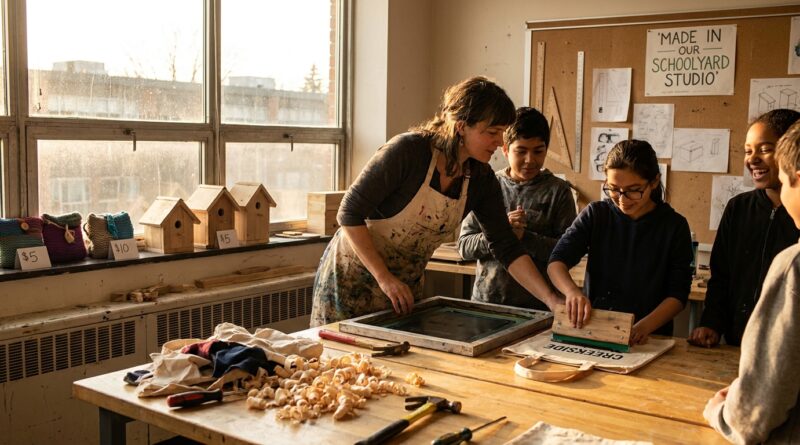
The Hyper-Local Schoolyard Studio: How Student‑Maker Collabs Are Quietly Turning Class Projects Into Real Products
Parents know the feeling. A child spends days on a class project, proudly brings it home, and a week later it is bent in a corner or headed for the recycling bin. Teachers feel it too. They want hands-on learning that means something, not just another poster board. And local makers, the woodworkers, printmakers, sewists, ceramic artists, and laser-cutting tinkerers in nearby garages, often feel just as stuck. They have real skills, but not many clear ways to share them with schools in a practical, paid, repeatable way. That is where a hyper local school maker collaboration can change the story. Instead of ending with one-off schoolwork, a class project becomes a tiny product run for the school fair, a fundraiser, or a neighborhood event. Students learn how ideas turn into things people actually want. Makers get visibility and income. Families get to buy something with a story attached to it.
⚡ In a Hurry? Key Takeaways
- A hyper local school maker collaboration turns ordinary class projects into small, real products students can help design, price, and sell.
- Start small with one teacher, one local maker, and one simple item like bookmarks, tote bags, seed kits, or printed cards.
- Keep it safe and sustainable by using clear adult supervision, simple production steps, and transparent rules about money, permissions, and student credit.
Why this idea is catching on quietly
Schools are under pressure to make learning feel more real. Families want less passive screen time. Kids want to make things they can touch, test, and show off. At the same time, many local makers are looking for steadier work and better ways to be part of their own neighborhoods.
The nice part is that this does not need a giant district plan, a shiny innovation lab, or a grant with a 14-page application. A PTA, classroom teacher, librarian, or after-school coordinator can start it with one project and one maker.
Think of it as a tiny studio that pops up around a class assignment. Students create the ideas. The maker helps shape those ideas into something realistic. Then a small batch gets made and sold locally. Not mass market. Not a startup pitch. Just useful, local, and doable.
What a “Schoolyard Studio” actually looks like
The model is simple enough to repeat.
Step 1: Start with a class theme
Pick a project that already fits the curriculum. Maybe a history class creates local landmark illustrations. Maybe science students design pollinator seed kits. Maybe an art class makes patterns for tea towels or notebooks.
Step 2: Match with a nearby maker
This is where the hyper local school maker collaboration becomes real. A local screen printer, woodworker, bookbinder, ceramic artist, or digital fabricator visits the class, in person or virtually, and explains what can actually be made within budget and time.
Step 3: Narrow the product
Students vote or test ideas. The group picks one or two products only. That limit matters. Too many choices turns a fun learning exercise into chaos.
Step 4: Make a small batch
The maker produces the final item with student input, or students help with safe steps like packaging, labeling, naming, and display.
Step 5: Sell locally
School fairs, concerts, farmers markets, library events, and PTA nights are perfect. Families are not just buying a product. They are buying the story behind it.
Why families respond to this so well
People like to support things that feel real. A product designed by local students and made with a neighborhood craftsperson has that feeling. It is the same reason certain small businesses build loyalty fast. You can see the human fingerprints on the work.
If you have watched local businesses thrive by leaning into community identity, the pattern will feel familiar. That same energy shows up in The Hyper-Local Scoop Shop: How Neighborhood Ice Cream Makers Became Summer’s Most Powerful Local Business Engine. People show up when the business feels rooted in place. School-maker projects can tap into that same local pride.
What students learn that poster boards never teach
This is the part teachers care about most. Students are not just “making stuff.” They are learning how ideas survive contact with the real world.
Design with limits
A drawing is easy to imagine. Turning it into a shirt print, mug decal, or laser-cut ornament forces students to simplify, revise, and think clearly.
Cost and pricing
Kids quickly learn that materials cost money. Time costs money. Packaging costs money. That lesson lands harder, and better, when it connects to something they helped create.
Teamwork with stakes
Classroom teamwork can feel fake to students. Product teamwork feels different because there is a real deadline and a real audience.
Feedback without drama
When students hear, “That design line is too thin to print,” they are learning an important life skill. Not every change is personal. Sometimes it is just production reality.
What local makers get out of it
Local makers are often treated like hobbyists until someone needs a silent auction donation. That gets old fast. A schoolyard studio model treats makers as working professionals who bring technical skill, creative judgment, and teaching value.
They can be paid for workshops, consulting, prototype development, or batch production. They also get a visible role in the neighborhood. Parents learn their names. Schools learn what they do. Students see a path between making things and making a living.
That matters. A lot of talented people do not need charity. They need a fair, local way to be included.
How to start a hyper local school maker collaboration without making it too big
The biggest mistake is starting with a grand vision. Start with a humble win.
Pick one grade, one teacher, one maker
Do not launch school-wide in month one. Try a four-week pilot with one classroom.
Choose a low-risk product
Good first products include greeting cards, calendars, tote bags, simple zines, bookmarks, seed packets, stickers, or small wooden ornaments. Avoid anything that needs complex sizing, food safety handling, or hard-to-manage inventory.
Keep the production run small
Twenty-five to one hundred units is plenty for a first test. Selling out is better than dragging home leftovers.
Pay the maker clearly
Do not be vague. Decide up front whether the maker gets a workshop fee, a per-unit fee, or both.
Assign one adult coordinator
This can be a PTA volunteer, art teacher, librarian, or assistant principal. Someone needs to keep the moving parts from scattering.
Questions schools should answer early
A little planning saves a lot of headaches.
Who owns the student designs?
In most cases, keep it simple. Students should be credited. Schools should have parent permission for use in the project. The maker should have a limited agreement to produce that batch. Put it in writing, even if it is basic.
Where does the money go?
Decide whether proceeds support the classroom, a club, future studio projects, or a school fundraiser. Be transparent. Families appreciate clarity.
What safety rules apply?
Students can help with brainstorming, design, finishing touches, packaging, and display. Adults should handle tools, heat equipment, cutting systems, chemicals, and anything else with real risk unless there is proper training and supervision.
How do you keep it inclusive?
Not every student has to draw the winning design to be part of the work. There are roles in naming, testing, writing product descriptions, setting prices, making signage, and talking to customers.
Simple project ideas that work in the real world
If you want examples, here are a few that tend to travel well from classroom to community:
Art class to printed goods
Student drawings become note cards, tea towels, or tote bags sold at a spring fair.
Science class to garden kits
Students create pollinator packs with seed envelopes, planting guides, and hand-drawn labels.
Local history class to neighborhood merch
Students make illustrated maps, postcards, or mini zines about local landmarks.
Middle school entrepreneurship unit
Students compare material costs, write product names, test pricing, and pitch the final item at a family night.
Common worries, answered plainly
“Isn’t this too much work for teachers?”
It can be, if the teacher has to invent every step. That is why the repeatable model matters. One coordinator, one maker, one product, one event. Keep it light.
“Do we need expensive equipment?”
No. The point is not to turn the school into a factory. The maker already has the tools or knows how to access them.
“Will families actually buy this?”
If the item is useful, priced fairly, and tied to a student story, often yes. People love buying local when it feels personal.
“What if the first run is imperfect?”
Then the students get the most honest lesson of all. Real products go through revisions. That is not failure. That is how making works.
At a Glance: Comparison
| Feature/Aspect | Details | Verdict |
|---|---|---|
| Traditional class project | Often ends as a one-time display piece with limited life after grading | Good for practice, weak on real-world impact |
| Schoolyard Studio model | Turns student work into a small local product run with maker guidance and community sales | Best for hands-on learning, local support, and student buy-in |
| Large grant-funded innovation program | Can offer more tools and scale, but usually needs more time, approvals, and money | Useful later, but not required to start |
Conclusion
Right now, schools need learning that feels alive, not just assigned. Kids are tired of staring at screens and producing work that vanishes after a grade. Local makers are tired of being seen as side characters when they could be part of the learning itself. A simple, repeatable Schoolyard Studio model gives everyone something practical. Teachers get a hands-on format that fits real lessons. Students learn design, revision, pricing, and teamwork in a way that sticks. Makers get paid teaching work and a visible place in the neighborhood. Families get a clear, satisfying way to support both education and local craft. And the best part is that a hyper local school maker collaboration does not need a big brand, a perfect lab, or a giant grant. It just needs one good project, one willing maker, and one school community ready to treat student creativity like it matters after the bell rings.