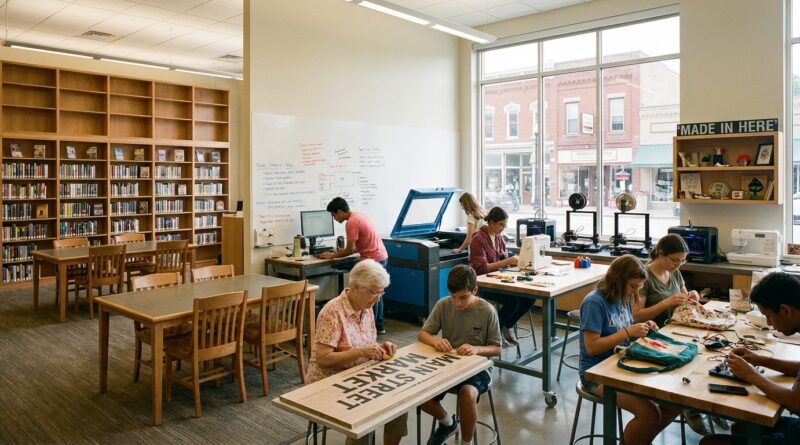
The Hyper-Local Makerspace Library: How Public Libraries Are Quietly Turning Into Neighborhood Factories Of Ideas
You can feel the itch to make something real. A sign for your side hustle. A prototype for a product idea. A custom gift that is not another cheap thing from a big box store. Then reality hits. You do not have a laser cutter in the closet, a 3D printer in the basement, or a spare $2,000 for gear you might use twice a month. That is where a lot of people get stuck. They hear about makerspaces and fabrication labs, but it all sounds a little too technical, a little too expensive, and maybe meant for robotics kids or startup founders, not regular neighbors.
Here is the quiet shift most people are missing. Public libraries, city rec centers, and local nonprofits are turning into small neighborhood factories of ideas. Many now offer 3D printers, sewing machines, vinyl cutters, audio booths, woodworking tools, and classes that cost little or nothing. If you have searched for a local library makerspace near me and assumed the results were not really for you, it is worth another look. These spaces are often built for beginners first, and they can be one of the simplest ways to test an idea before you spend serious money.
⚡ In a Hurry? Key Takeaways
- Yes, your local library makerspace may be open to ordinary residents, not just students or pros, and many are free with a library card.
- Start small. Book an orientation, try one beginner class, and pick one simple project like stickers, a repair part, or a sewn tote.
- Check training rules and material fees first. The space may be low cost, but some machines require safety classes or paid supplies.
Why libraries are getting into the making business
Libraries have always been about access. First it was books. Then computers and internet. Now, in many towns, it is tools, fabrication gear, and creative software.
The reason is pretty practical. Communities want more local skills, more small business activity, and more places where people can learn by doing. A 3D printer or embroidery machine sitting in a public space can help dozens or hundreds of people, instead of gathering dust in one garage.
That is a big deal if you are trying to start small. You do not need a full workshop on day one. You need a place to test, mess up cheaply, and try again.
What a library makerspace actually looks like
Do not picture a giant industrial lab with scary machines and everyone wearing engineering badges. Some are like that, sure. But many are much more approachable.
Common tools you might find
A local library makerspace near me search may turn up spaces with:
- 3D printers for prototypes, replacement parts, and hobby projects
- Laser cutters for signs, jewelry, boxes, and engraved gifts
- Vinyl cutters for stickers, labels, and T-shirt transfers
- Sewing and embroidery machines
- Podcast or video recording booths
- Photo scanners and digitization gear
- Electronics benches with soldering tools
- Basic woodworking or hand tools
Some focus on crafts. Some lean into fabrication. Some are more media labs than machine shops. That variety is why you should not give up after looking at just one location.
Who these spaces are really for
This is the part people often get wrong. They assume the room belongs to the most technical person in it.
In many cases, libraries built these spaces for the opposite reason. They wanted a low-pressure on-ramp for beginners, job changers, teens, retirees, side hustlers, and curious adults who just want to learn without buying a bunch of stuff first.
If you can use a public library, you can probably use its makerspace too. You may need a card, a waiver, or a short training session. That is normal. It does not mean you are not welcome.
How to find a good one without wasting an afternoon
Search is the easy part. Sorting the good options from the dead pages is harder.
Use better search terms
Start with:
- local library makerspace near me
- public library makerspace [your city]
- fabrication lab library [your county]
- maker lab public library [your area]
What to look for on the website
A legit, active space usually has:
- A current class calendar
- A list of equipment
- Reservation or orientation details
- Pricing for materials, if any
- Photos that look recent
- Contact info for a real staff member
If the page looks abandoned, call anyway. Library web pages are not always updated quickly, even when the program is alive and well.
Ask these five questions
- Do I need a library card or city residency?
- Which tools are available to beginners?
- Do I need training before I can book equipment?
- What do I pay for, machine time or just materials?
- Can staff help me start a first project?
What “free” usually means
This trips people up. The room may be free to access, but that does not always mean every project costs nothing.
Often, the training is free and the machine use is free, but you pay for consumables. That might mean filament for a 3D print, wood or acrylic for a laser cutter, or vinyl rolls for decals. That is still far cheaper than buying the machine yourself.
Think of it like using a public grill at a park. The grill is there. You still bring the food.
Your first project should be boring on purpose
Most people dream too big for the first visit. They want to build a product line, print a complex gadget, or launch an Etsy shop by Saturday.
Slow down. Pick a tiny win.
Good first projects
- A custom sticker sheet with a vinyl cutter
- A simple engraved keychain
- A 3D printed cable organizer or replacement knob
- A hem or tote bag on a sewing machine
- A scanned family photo archive
These projects teach the rhythm of the place. How to check in, ask for help, reserve time, prepare files, and clean up. That matters more than making something flashy.
Why this matters for side hustles and local business
This is where the story gets bigger than hobbies. Makerspaces are becoming low-risk testing grounds for micro-businesses.
You can prototype packaging. Cut signs for a market stall. Print product tags. Record a product demo. Test a custom part before ordering a production run. For local sellers, that is huge. It cuts the cost of experimenting.
It also keeps more of that early business energy local. Instead of every idea going straight to an online vendor three states away, neighbors can sketch, build, refine, and maybe even sell from the same community where they live.
And if your project needs basic tools at home too, pair the makerspace with a tool-lending option. A good companion read is The Hyper-Local Utility Closet: How Neighborhood Tool Libraries Are Quietly Turning Renters Into Makers. It is a nice reminder that you do not need to own everything to start making useful things.
Red flags to watch for
Not every makerspace is equally useful. Some are wonderful. Some are basically a room with one broken printer and a poster from 2019.
Be cautious if you notice:
- No beginner classes at all
- Equipment lists without booking rules
- Very limited open hours
- Staff who cannot explain how newcomers get started
- Machines that are always “temporarily unavailable”
A great community makerspace does not need to be fancy. It does need to be active, clear, and welcoming.
How to act like you belong there, because you do
The easiest way to feel out of place is to walk in apologizing for not knowing enough. Try a different approach. Be curious. Be direct.
Say, “I am new to this and want to make a simple first project. What do you recommend?”
That gives staff something useful to work with. In my experience, people who run these spaces love helping beginners who show up ready to learn and follow the rules.
Simple plan for your first month
Week 1
Search for a local library makerspace near me. Make a list of three options. Check hours, equipment, and orientation rules.
Week 2
Visit one in person or attend a tour. Do not judge it only by the website.
Week 3
Take one beginner class. Pick the least intimidating tool, not the most impressive one.
Week 4
Finish one small project and write down what you learned, what it cost, and what you would try next.
That is enough to go from “I heard about these places” to “I know how to use one.”
At a Glance: Comparison
| Feature/Aspect | Details | Verdict |
|---|---|---|
| Cost | Usually free entry with a library card, with small fees for materials or special classes | Excellent value for trying tools before buying anything |
| Ease for beginners | Best spaces offer orientations, starter workshops, and staff guidance | Very approachable if the program is active and well-run |
| Best use case | Testing ideas, making simple products, learning new skills, and prototyping small business concepts | Ideal as a neighborhood production studio, not a full factory |
Conclusion
There is a real opportunity hiding in plain sight here. Libraries, city programs, and nonprofits are adding makerspaces and fabrication tools to community spaces because they want more local creation, more practical skills, and more small businesses with local roots. The odd part is that many of these rooms sit underused because people assume they are too technical or not meant for them. If you take the time to find your nearest spot, ask a few smart questions, and try one simple project, you may discover that your neighborhood already has the bones of a shared workshop. That matters. It turns public equipment into real local value, gives future makers a realistic path into small-scale production, and keeps more experimentation close to home, where ideas can grow into something useful, and maybe even into a business.