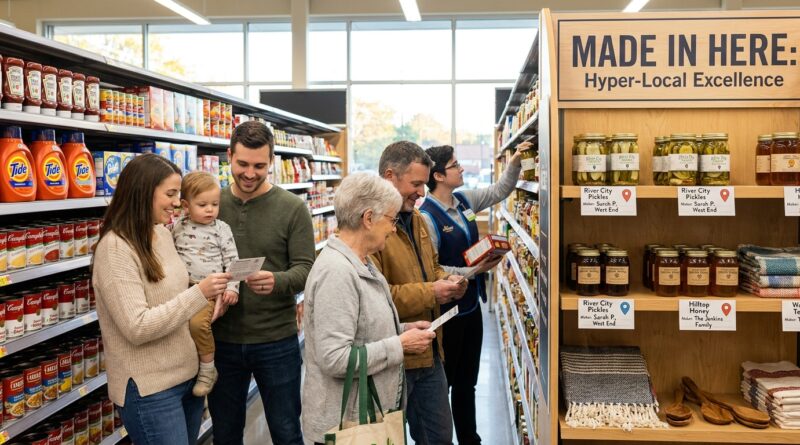
The Hyper-Local Shelf Takeover: How Neighborhood Makers Are Quietly Winning Space Inside Big-Box Stores
You can feel the frustration. Your jam, soap, hot sauce, candles, or snacks sell out at the weekend market. Orders come in online. Neighbors rave about them. Then you walk into the big-box store five minutes away and see the same giant brands taking up every shelf. A lot of local makers hear retailers talk about “community” and “support local,” but when it is time to assign shelf space, the local product still gets treated like a nice idea instead of a real business.
That is starting to change. Big retailers want stores to feel more local because shoppers respond to products with a nearby story. The problem is that most small producers do not know how local makers get products into big box stores, and buyers are not exactly posting a step-by-step guide. The good news is that getting in often starts smaller than people think. One regional test, one seasonal display, one endcap, or one store cluster can open the door. If you can show steady demand, clean operations, and a simple pitch, you have a real shot.
⚡ In a Hurry? Key Takeaways
- Local makers usually get into big-box stores by starting with a small regional test, not a chain-wide launch.
- Bring buyers proof that your product already sells, plus pricing, packaging, barcodes, and production capacity.
- Do not chase shelf space before your operations are ready. Late orders and sloppy labeling can kill the opportunity fast.
Why big-box stores are suddenly paying attention to local products
Retailers have a sameness problem. Walk into enough chain stores and they start to blur together. Shoppers notice that too. A local coffee rub, neighborhood salsa, or small-batch body butter breaks that pattern. It makes the store feel connected to the place it sits in.
There is also a business reason. Local items can create excitement without the retailer having to invent a whole new private label. They give shoppers a reason to browse. They can also lift the basket size when people toss in “just one more thing” that feels special.
We are seeing a similar shift in food and convenience formats too. If you want a broader picture of how local sourcing is changing the aisle, The Hyper-Local Pantry Subscription: How ‘Bright Stores’ Of Fresh Staples Are Quietly Rewiring The Grocery Aisle is worth a look.
How local makers get products into big box stores
Here is the short version. Buyers are not just buying a product. They are buying reliability. They want to know three things.
1. Will it sell?
This is where your pop-up results, online reviews, repeat customers, wholesale history, and social proof matter. You do not need celebrity buzz. You need evidence that regular people buy the thing more than once.
2. Can you supply it consistently?
A store can forgive a slow craft fair restock. It cannot forgive empty shelves for weeks. Buyers want to know your batch size, lead time, ingredient sourcing, packaging timeline, and backup plan if demand jumps.
3. Will it fit inside a retail system?
This is the unglamorous part. UPC barcodes, case packs, invoice terms, insurance, shelf-ready packaging, labeling rules, food safety paperwork if needed, and clean product photos. A great product can get passed over if this basic stuff is messy.
Start smaller than your ego wants to
Many makers picture a chain-wide rollout. That is usually not how this works. A buyer may be far more open to:
- One-store trials
- Regional test runs
- Seasonal promotions
- Holiday gift displays
- Local endcaps
- “Made nearby” shelves
This is good news, not bad news. Smaller tests lower the risk for the store and for you. They also give you something better than hope. They give you data.
What to prepare before you contact a buyer
A simple one-page sell sheet
Keep it clear. Include product name, price, wholesale price, margin, pack size, shelf life, barcode status, your story, and contact details. Add one strong product image.
Sales proof
Show monthly units sold, repeat rate if you have it, best-selling flavor or scent, and where it already performs well. If your product sells out every Saturday at a market, say that. Better yet, show the numbers.
Operations basics
Be ready to explain how much you can make per week, how quickly you can restock, and whether you have backup suppliers. If you make food, have your certifications and compliance details lined up.
Packaging that can survive real retail
Your product has to look good on a shelf, not just on Instagram. Labels need to be readable. Containers need to survive shipping and stocking. Cases need to stack without turning into a mess.
Clear pricing
This is where many deals quietly die. If your margins are too thin, a big order can hurt you instead of helping you. Know your cost of goods, labor, packaging, freight, and promo budget before you quote anything.
How to find the right way in
Not every path starts with a national buyer. In many cases, the easier entry points are local or regional.
Store managers and regional contacts
Some chains allow local managers or regional teams to bring in neighborhood products for a trial. Ask politely how local vendor submissions work at that specific chain. You are not asking for a favor. You are asking about the process.
Supplier portals
Many large retailers have online vendor forms. They can feel cold and slow, but they matter. Fill them out completely. Then follow up with a short, human email if you can identify the right category contact.
Local business programs
Some retailers run “local maker,” “made here,” or incubator-style programs. Watch for them. They often open around holidays, local events, or regional buying cycles.
The pitch buyers actually want
Do not send a novel. Do not lead with your life story. Start with the buyer’s problem.
Try this structure:
- What the product is
- Why customers buy it
- Proof that it sells
- Why it fits this store and this region
- What kind of test you are asking for
Example: “We make small-batch chili crunch in Columbus, and our 8-ounce jar is our top seller. We sold 1,200 units at local markets and independent grocers over the last 90 days, with repeat orders from three stores. We think it fits your Ohio stores because customers are already buying local pantry items at a premium. We would love to discuss a 10-store regional test.”
That is clean. Specific. Easy to forward.
Mistakes that sink local products fast
Confusing popularity with readiness
Selling out at a fair is great. It does not automatically mean you can serve a chain store. Retail success depends on consistency, not just excitement.
Ignoring margin math
If the retailer needs room for markup, promos, and occasional markdowns, your numbers have to work. If they do not, say no and fix your costs first.
Pitching too many products at once
Lead with one hero SKU. Maybe two. Buyers do not want to sort through your full dream catalog on day one.
Underestimating packaging rules
A pretty label is not enough. It has to scan, stack, ship, and meet category rules.
Skipping follow-up
Retail moves slowly. A polite follow-up in a couple of weeks is normal. Pestering is not.
If you get a test run, treat it like a final exam
A small placement is not the finish line. It is the audition.
During a test run:
- Track sell-through by store if possible
- Restock fast
- Watch for packaging damage or shelf confusion
- Give the retailer simple promo support
- Collect shopper feedback
If one flavor or format lags, do not get defensive. Learn from it. Buyers respect suppliers who solve problems quickly.
Why even one shelf can matter so much
This is bigger than a single purchase order. One local item in a chain store can create steady work for a neighborhood kitchen, workshop, or small production team. It can keep more money moving inside the community. It can also make “shop local” easier for people who do not have time to visit three markets and two boutiques every week.
That convenience piece matters more than many makers realize. People often want local products, but they still shop where life is easiest. That is part of why these retail shifts matter.
At a Glance: Comparison
| Feature/Aspect | Details | Verdict |
|---|---|---|
| Best entry point | Regional test, single-store trial, or seasonal local display | Most realistic for small makers |
| What buyers care about | Proof of demand, reliable supply, clean packaging, workable margins | Get these right before pitching |
| Biggest risk | Winning placement before operations are ready to handle orders and restocks | Grow carefully, not just quickly |
Conclusion
Right now, major retailers are trying hard to make their aisles feel more local and neighborhood-specific. That creates a real opening, but only for makers who show up prepared. If you have been wondering how local makers get products into big box stores, the answer is usually not magic and not luck. It is a small test, solid numbers, retail-ready packaging, and a pitch that makes a buyer’s job easier. Land even one endcap or regional run, and the effect can spread far beyond your own business. It can bring steadier orders to local workshops, put “made here” stories in front of everyday shoppers, and help more retail dollars stay in town instead of drifting off to distant headquarters. Start small. Get organized. Then ask for the shelf.