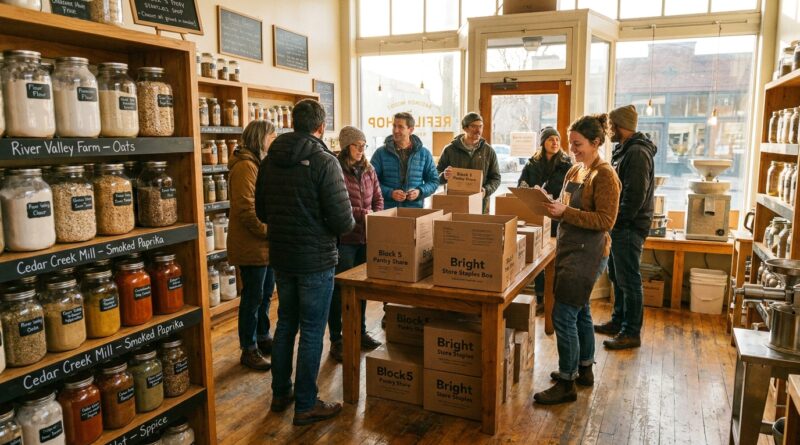
The Hyper-Local Pantry Subscription: How ‘Bright Stores’ Of Fresh Staples Are Quietly Rewiring The Grocery Aisle
You know the drill. You want to buy local. You really do. Then it is 6:15 p.m., dinner needs to happen, and the boring reliable bag of supermarket rice wins again. Same with flour, oil, lentils, spices. The big chains are not always better. They are just easier. That is the real problem tiny neighborhood mills, oil presses, spice blenders and bulk refill shops are trying to solve. Most people are happy to buy local for a weekend treat. Very few have a system for making it their default pantry.
That is where a hyper local pantry subscription starts to matter. Done right, it turns “I should support local more” into a repeatable routine. One order. One pickup or delivery window. A short list of staples that actually match how your household cooks. For shoppers, that means less guilt and less mental load. For small producers, it means steadier demand, fewer random slow weeks and a real shot at competing with the grocery aisle on convenience, not just on values.
⚡ In a Hurry? Key Takeaways
- A hyper local pantry subscription works best when it replaces just 5 to 10 staple items first, not your entire grocery run.
- Start with a fixed weekly or biweekly bundle of things you always use, like flour, oil, rice, beans and spices.
- Reliability matters more than romance. If local staples are predictable, clearly priced and easy to get, people stick with them.
Why local pantry shopping keeps stalling out
Fresh produce gets the spotlight. Pantry staples do not. But staples are where routines live. They are the quiet backbone of most meals. If your flour, oil and grains still come from the big-box store, then local food stays a side quest.
That is not because people are lazy. It is because pantry shopping has to be low-friction. You cannot ask a tired parent, a shift worker or a busy student to remember which mill has rye flour, which refill shop has olive oil this week and which spice blender is open after 5 p.m. That is not a shopping system. That is homework.
A hyper local pantry subscription fixes that by bundling small producers into one dependable flow. Think of it as a neighborhood pantry rail line. The customer does not need to know every stop. They just need the train to show up on time.
What a hyper local pantry subscription actually is
At its simplest, it is a recurring order of locally made or locally packed staples from several nearby producers, sold through one shared menu, one payment system and one pickup or delivery schedule.
For residents
It feels like a standing grocery shortcut. You set your staples, skip weeks if needed, add a few extras, and stop thinking so hard about it.
For makers and shop owners
It acts like a tiny distributed warehouse. One mill handles flour. One producer bottles oil. One shop packs beans or rice. Another blends spices. Together, they offer enough consistency to become part of everyday life.
If this sounds familiar, it is close in spirit to The Hyper‑Local Craft CSA: How Weekly Maker Boxes Are Quietly Turning Neighborhoods Into Open‑Air Factories. The same basic truth applies. People may love local products, but they need a simple recurring format before local becomes routine.
The big shift: from Saturday treat to Tuesday default
The most important change is not what people buy. It is when and how they buy it.
Right now, local food often lives in the “special trip” category. Farmers market Saturday. Holiday gift box. Nice loaf from the weekend fair. That is lovely, but it does not build a durable local pantry economy.
A hyper local pantry subscription moves local staples into the “default replenishment” category. That is powerful. Defaults are what shape habits. Habits are what stabilize demand. And stable demand is what lets small food businesses plan inventory, staffing and pricing with less chaos.
How to build one as a shopper
Step 1: Audit what your home actually uses
Do not start with ideals. Start with proof. Look at the last month of meals and receipts. Which staples disappear no matter what?
- Flour
- Rice
- Cooking oil
- Beans or lentils
- Salt
- Core spice blends
- Oats
- Sugar or sweeteners
Circle the five to ten items that are truly routine. Those are your subscription base.
Step 2: Build a “boring on purpose” starter bundle
This is where many people go wrong. They fill the box with interesting things. Start with useful things.
A better first bundle looks like this:
- One bag of local flour you will actually bake or cook with
- One bottle of cooking oil in a practical size
- One grain, like rice or oats
- One legume, like lentils or chickpeas
- Two spice staples, like chili blend and turmeric, or cinnamon and cumin
If that bundle helps make six to ten ordinary meals easier, you are onto something.
Step 3: Pick one predictable cadence
Weekly sounds efficient, but biweekly is often easier for pantry goods. Staples do not spoil fast, and most households do not need a fresh bag of flour every seven days.
Good options:
- Weekly for heavy-cooking households
- Biweekly for most households
- Monthly for singles or low-cook homes
The goal is not maximum frequency. It is minimum forgetting.
Step 4: Use a short add-on list
The best subscriptions are not giant catalogs. They are small, easy menus. A few extras are good. Too many options turn convenience back into decision fatigue.
A smart add-on section might include:
- A seasonal grain
- A featured spice blend
- A local jam or sauce
- A refill item
Think “small upgrade,” not “browse for 40 minutes.”
Step 5: Tie pickup or delivery to another routine
This matters more than people think. A pickup point next to your coffee shop, school run, train station or gym has a much better chance of sticking than a romantic but inconvenient location.
Convenience is not a betrayal of your values. It is how values survive a busy week.
How to build one as a producer or neighborhood shop
Start with complementary staples, not overlapping ones
If three vendors all want to sell flour, things get messy fast. Better to create a clear mix:
- Mill for flour and grains
- Oil press or refill partner for cooking oils
- Spice blender for seasonings
- Dry goods packer or co-op for rice, beans and lentils
Each partner needs a lane.
Agree on service standards before branding
Logos are easy. Reliability is hard. Before anyone prints tote bags, settle the basics.
- What is the cutoff time for orders?
- Who handles substitutions?
- What happens if one item is out of stock?
- Who owns customer service?
- What package sizes stay consistent?
If customers cannot count on the system, they will drift back to the supermarket without much debate.
Create a shared “always available” list
This is the secret sauce. Keep a small menu of staples that are almost always there. Maybe it is eight items. Maybe twelve. But they should be dependable.
People can handle seasonal produce surprises. They do not want olive oil roulette.
Use one simple subscription format
The cleaner the offer, the better. For example:
- Essential Box, 5 staples
- Family Box, 8 staples
- Refill Box, bring-your-own-container pickup
Then let people swap one or two items. Too much customization creates operational pain.
Think of it as a distributed warehouse
No one small maker has to become a national chain. That is not the point. The point is to act together like a tiny local network with enough shared stock, scheduling and communication to feel dependable.
The future of local pantry retail may look less like one big heroic store and more like several small specialists moving in sync.
What shoppers should look for before signing up
Clear pricing
If local staples cost more, people can accept that when the pricing is transparent and the quality is obvious. Confusing fees kill trust.
Flexible skipping
Subscriptions should not feel like a trap. Being able to pause, skip or edit builds confidence.
Useful pack sizes
A household that cooks twice a week does not need restaurant-size sacks. A large family may need more than boutique jars. Good subscriptions match real kitchens.
Simple substitutions
If one flour is out, what happens next? A decent system tells you upfront and offers a close replacement or credit.
Basic freshness and handling standards
Especially for oil, spices and whole grains, freshness matters. Look for packed-on dates, storage guidance and clean refill or packaging practices.
The hidden win: fewer errands, less mental load
There is a practical reason this idea is getting traction. It saves brainpower.
When staples become automatic, you stop making the same low-stakes decisions over and over. That is the same reason grocery apps took off. The winning local model will not beat national chains by asking people to care more. It will win by asking them to think less.
That is not cynical. It is realistic. Good systems protect your time.
Common mistakes that sink a hyper local pantry subscription
Trying to replace the entire grocery store at once
Bad move. Start with staples only. Fresh produce, dairy and prepared foods can come later.
Making every box a surprise
People like surprise in gifts. They like predictability in dinner ingredients.
Overloading customers with origin stories
The story matters, but not before the order is easy. Lead with function. Follow with story.
Ignoring stock discipline
Local customers are forgiving once. Maybe twice. After that, “sold out again” starts to feel like a warning sign.
Using too many pickup points with weak coordination
Better to have fewer dependable locations than many confusing ones.
What this means for neighborhoods
When staple spending shifts even a little, the effect is bigger than it looks. Pantry goods are repeat purchases. Repeat purchases create recurring revenue. Recurring revenue helps tiny food businesses survive the boring months, not just the festive ones.
That means more than good feelings. It can support real neighborhood infrastructure. Small processing spaces. Shared delivery routes. Better refill systems. More stable jobs. More reasons for residents to think of local food as normal, not niche.
At a Glance: Comparison
| Feature/Aspect | Details | Verdict |
|---|---|---|
| Convenience | One recurring order, shared pickup or delivery, fewer separate errands across multiple local vendors. | Best reason to try it. Convenience is what turns local into a habit. |
| Reliability | Works only if staple sizes, stock levels and substitution rules stay consistent. | Non-negotiable. Reliability matters more than branding. |
| Local economic value | Keeps more routine spending with nearby mills, blenders, refill shops and micro-factories. | Strong long-term upside for both residents and small producers. |
Conclusion
The real promise of a hyper local pantry subscription is not that it makes shopping feel noble. It is that it makes local staples boring in the best possible way. Easy to order. Easy to trust. Easy to repeat. Right now, money and attention are pouring into hyper-local fresh-staple brands and micro-factories, but most people still meet local food as an occasional treat, not a weekday system. A practical pantry subscription can change that. It helps households turn one-off good intentions into a default routine that keeps more money circulating close to home, gives small producers steadier demand and makes local flour, oil and spices feel as simple as tapping a grocery app. For makers and shop owners, it is also a workable blueprint. Band together, keep the offer tight, and act like a tiny distributed warehouse. That is how local starts competing on reliability while staying human and rooted in place.