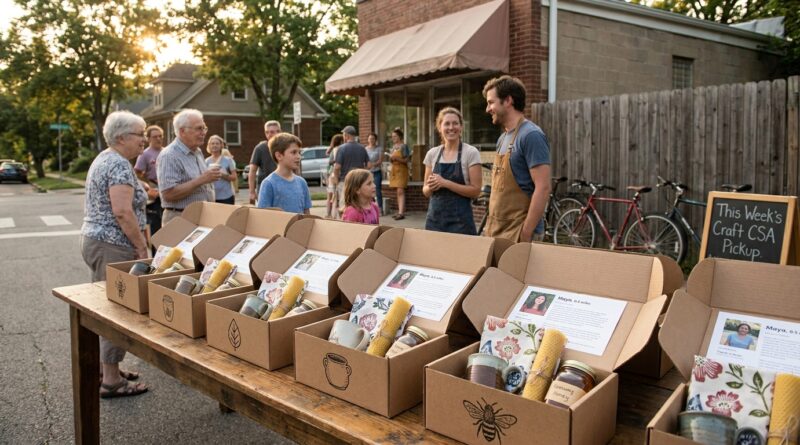
The Hyper‑Local Craft CSA: How Weekly Maker Boxes Are Quietly Turning Neighborhoods Into Open‑Air Factories
You can believe in buying local and still never make it to the market. That is the part people do not say out loud. Life gets busy. Saturdays fill up. You do not need a full afternoon of parking, browsing, and impulse buying just to find a candle, a loaf of sourdough, or a birthday gift made by someone who lives ten minutes away. Makers have the same problem from the other side of the table. They spend money on booth fees, load up their cars, stand outside for hours, and hope the right people wander past. A hyper local craft CSA fixes both headaches with one simple idea. Subscribe once, pick up regularly, and get a curated box of useful, local goods from nearby makers. It borrows the community-supported agriculture model and applies it to soaps, ceramics, pantry goods, textiles, prints, and other handmade items people actually use.
⚡ In a Hurry? Key Takeaways
- A hyper local craft CSA is a subscription box for handmade goods from makers in your own neighborhood or ZIP code.
- If you want to start one, keep it simple first. Monthly pickups, a small group of makers, and a clear theme work better than a huge free-for-all.
- The big value is predictability. Residents save time, makers get steadier income, and more money stays in the community.
What a hyper local craft CSA actually is
CSA usually means Community Supported Agriculture. You pay up front, or subscribe on a schedule, and get a regular share of local farm goods. A hyper local craft CSA uses the same setup, but for neighborhood makers.
Instead of only tomatoes and lettuce, a box might include hand-poured candles, small-batch jam, notebooks, mending kits, ceramic mugs, spice blends, greeting cards, or seasonal decorations. Some boxes mix food and craft. That is where things get interesting.
Most towns already have the pieces. A baker. A potter. A soap maker. A printmaker. A microgreens grower. What they often do not have is one repeatable system that helps busy residents buy from all of them without chasing five different event calendars.
Why this model works better than random pop-ups
For residents, it cuts the time cost
People say they want to support local, and many really do. But they also want convenience. A hyper local craft CSA turns local shopping into something closer to a standing grocery pickup than a weekend scavenger hunt.
You sign up once. You know when pickup is. You know roughly what kind of goods will be included. That predictability matters more than people think.
For makers, it reduces the gamble
Craft fairs can be great. They can also be brutal. Weather changes. Foot traffic drops. The crowd shows up for jewelry when you make tea towels. A CSA-style model gives makers a better read on demand before they pack the car.
That can mean fewer wasted materials, more stable production schedules, and less dependence on social media luck. A maker who knows 40 boxes are going out next Thursday can plan like a business, not like a gambler.
For neighborhoods, it keeps money nearby
When local residents buy from giant online marketplaces, most of that money leaves the area fast. With a hyper local craft CSA, a larger share stays in circulation. The maker buys supplies locally. The pickup host gets paid. A local café might serve as the pickup point and gain extra traffic.
That is how a neighborhood starts feeling less like a row of disconnected addresses and more like a working local economy.
Why “craft” and “food” should not be separate lanes
This is the quiet shift underneath the trend. Communities often treat food as essential and craft as optional. That is too narrow.
A bar of handmade soap is useful. A sewn produce bag is useful. A mug, a beeswax wrap, a cutting board conditioner, a set of cards you keep on hand for birthdays. These are not luxury museum objects. They are daily-life products made by people close to home.
When a box mixes food and handmade household goods, it starts to look less like a gift basket and more like neighborhood infrastructure. That is a big reason the hyper local craft CSA idea has legs.
What usually goes into a good box
The best boxes are curated, not stuffed. More is not always better. People stay subscribed when the items feel usable and thoughtful.
Common categories
Here is what tends to work well:
- Small pantry items, like jam, honey, tea blends, or spice mixes
- Home goods, like candles, soaps, dish cloths, or ceramics
- Paper goods, like prints, cards, or notebooks
- Seasonal items, like holiday ornaments, seed kits, or picnic bundles
- Repair and care goods, like mending kits, leather balm, or wood conditioner
What usually does not work
Very fragile items, one-off novelty products, or goods with unclear practical use can hurt retention. So can boxes that feel random. If one month is “cozy kitchen” and the next is “three unrelated trinkets,” subscribers notice.
How neighborhoods start to feel like open-air factories
That phrase sounds dramatic, but the change is pretty simple. Production becomes visible, distributed, and local. Instead of one store importing everything from far away, dozens of tiny producers each make part of what the neighborhood uses.
One person roasts coffee. Another throws mugs. Another prints labels. Another grows herbs. Another hosts pickup from a church hall, bookstore, or corner café. You get a network instead of a storefront.
That network matters because it spreads risk. If one maker takes a month off, the whole system does not collapse. If demand grows, more neighbors can join in. It is flexible in a way a traditional retail setup often is not.
How to start a hyper local craft CSA without making it too complicated
This is where many good ideas go off the rails. People try to launch with too many makers, too many box options, and too many custom requests. Start smaller.
1. Pick a tight service area
Hyper local should mean something. One neighborhood, one small town, or a few adjacent ZIP codes is enough. If pickup or delivery becomes a cross-county road trip, the model loses its charm fast.
2. Start with 5 to 8 dependable makers
Do not begin with 25. You want people who can hit deadlines, communicate clearly, and make consistent products. Reliability matters more than variety in the early months.
3. Choose a simple rhythm
Monthly is easier than weekly for most craft-focused boxes. If food is a major part of the mix, biweekly can work. Weekly only makes sense if the logistics are already solid and the audience is there.
4. Set one pickup point first
A bakery, café, community center, or local shop can work well. One dependable pickup location beats four confusing ones.
5. Use a clear theme
Think “kitchen basics,” “winter comfort,” “spring refresh,” or “host gift box.” Themes help customers understand the value and help makers plan items that fit together.
6. Keep subscriptions easy to pause
People are more likely to join if they are not locked into a painful cancellation process. A pause option lowers the barrier and builds trust.
The business part that makes or breaks it
The magic is not just in the products. It is in the planning.
Pricing has to be honest
If a box costs $40, people should feel like they got $40 worth of useful goods, not $18 worth of filler and a nice story. Do not underprice either. Makers need real margins, or the whole model turns into volunteer labor with ribbon on it.
Packaging should be reusable if possible
Returnable totes, stamped boxes, or simple crates help the whole setup feel rooted in place. They also cut waste and lower long-term packing costs.
Communication should be boring in the best way
Pickup windows, item lists, allergy notes for edible goods, and maker spotlights should all be easy to read. No mystery. No last-minute chaos if you can help it.
The social upside is bigger than the box
A good hyper local craft CSA does more than move products. It builds recognition. Neighbors start knowing who made their soap, who baked their crackers, who illustrated the card tucked into the box.
That familiarity changes spending habits. Once people connect a face to an item, buying local stops feeling abstract. It becomes personal. And once that happens, the local economy gets a little stickier. People come back.
It also creates a low-pressure entry point for residents who want to support local businesses but do not enjoy crowded events or hard-sell market stalls. They can still participate, just in a calmer format.
Challenges to watch for
This model is promising, but it is not magic.
Consistency is hard
If one month is great and the next is sloppy, subscribers leave. The organizer has to act like a project manager, not just a cheerleader.
Quality control matters
If you mix food, skincare, and home goods, basic standards need to be clear. Labeling, ingredients, packaging, and freshness are not small details.
Too much customization can slow everything down
People love choices until choices create confusion. One standard box and one premium box is usually enough to start.
Maker burnout is real
Steady orders are great, but only if production levels are realistic. It is better to cap subscriptions than to grow so fast that every participant is stressed out by month three.
Who should try it first
Some places are especially well suited to a hyper local craft CSA:
- Neighborhoods with active farmers markets but no year-round maker outlet
- Small towns with a strong “shop local” culture
- Urban districts with cafés, bookstores, or co-ops that can host pickups
- Communities with both food producers and craft makers who already know each other
If your area has talented makers but scattered demand, this model can be the missing layer between hobby selling and a full retail lease.
At a Glance: Comparison
| Feature/Aspect | Details | Verdict |
|---|---|---|
| Convenience for buyers | One signup, regular pickup, curated local goods instead of hunting across multiple events | Big win for busy households |
| Income stability for makers | Subscription demand gives better forecasting than hoping for walk-up traffic at fairs | Much better than event-by-event selling |
| Community impact | Connects food and craft, builds local relationships, and keeps more spending inside the neighborhood | Strong long-term value if managed well |
Conclusion
The smart part of a hyper local craft CSA is not that it invents something new. It takes habits people already understand, subscriptions, pickups, seasonal shares, and uses them to solve a very old problem. How do neighbors support local makers without turning it into another time-consuming chore? Right now there is a surge of interest in hyper local everything, from vertical farms to neighborhood third spaces, but most communities still treat food and craft as separate worlds. A craft CSA model bridges that gap fast. It gives residents an easy, repeatable way to back real people in their own ZIP code, helps small makers lock in more predictable income without gambling on foot traffic, and keeps more money cycling inside the neighborhood instead of leaking to anonymous ecommerce platforms. For many towns, that is not a cute side project. It is a practical way to make local commerce feel local again.