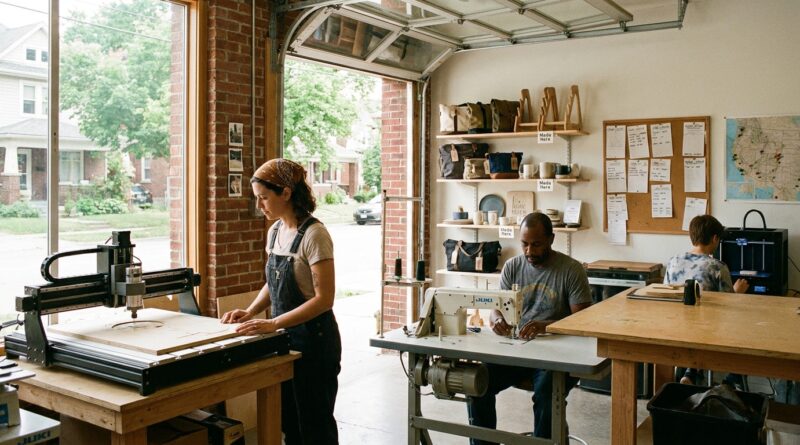
The Hyper-Local Micro‑Factory Next Door: How Tiny Neighborhood Workshops Are Quietly Replacing Container Ships
You know the feeling. A basic item breaks at home, you go online to replace it, and somehow the choices are either cheap junk that arrives in three weeks or a “premium” version that costs far more than it should. Then, when it finally shows up, it still feels flimsy. That frustration is real, and a lot of people assume it is just how shopping works now. It is not. Quietly, a new kind of workshop is popping up in cities and suburbs: tiny, tech-powered shops that laser-cut, 3D-print, mill, sew, and assemble goods a few blocks from where people live. This is hyper local micro factory neighborhood manufacturing in plain English. Small shops making useful things nearby, often faster and better than the faraway supply chain most of us rely on without thinking. You may not notice them because they do not buy giant ads. But they are there, and they are changing what “made local” can mean.
⚡ In a Hurry? Key Takeaways
- Hyper-local micro-factories can often make replacement parts, home goods, accessories, and small-batch products faster than big overseas supply chains.
- Start with one practical purchase, like a repair part, shelf bracket, sign, gift, or custom organizer, and ask a nearby maker if they can build it.
- You usually get better communication, easier repairs, and fewer shipping headaches, but always ask about materials, durability, and return policies first.
What a micro-factory actually is
Forget the old picture of a factory with smokestacks and endless conveyor belts. A micro-factory can fit into a storefront, garage-sized workshop, or shared makerspace. Inside, you might find a laser cutter, 3D printer, CNC router, embroidery machine, sewing station, or small assembly bench.
That setup lets one small team make short runs of useful products without waiting for a container ship, a customs delay, or a giant warehouse restock. It is neighborhood manufacturing, but updated with modern tools.
These shops are not trying to make millions of identical plastic doodads. Their sweet spot is different. They are great at custom work, repair parts, small batches, local business supplies, and products that need quick changes.
Why this matters now
People usually notice supply chains only when something goes wrong. Empty shelves. Random shortages. Strange price jumps. Delivery windows that slide from three days to three weeks.
That is where hyper local micro factory neighborhood manufacturing starts to look less like a nice idea and more like a practical backup plan. If a part can be cut, printed, stitched, or assembled nearby, you skip a lot of the fragile links in the chain.
You also get something else that is easy to forget. A real person you can talk to.
What these neighborhood workshops can make well
Replacement parts and repair items
This is one of the most useful cases. A broken bracket, missing knob, cracked clip, or odd spacer can leave a perfectly good item unusable. Big brands often stop carrying the part, or make you replace the whole product.
A local shop may be able to scan, measure, and recreate it. If you want a deeper look at how local workshops are filling this exact gap, The Hyper-Local Makerspace Wave: How Neighborhood Workshops Are Becoming the New Factory Floor captures the frustration well.
Home organization and decor
Drawer inserts, cable organizers, wall hooks, plant stands, small shelving parts, nameplates, and custom storage pieces are ideal for small local production. These are items where fit matters more than mass scale.
Local business needs
Cafes, salons, schools, and neighborhood shops often need signs, menu holders, display stands, branded packaging, or custom fixtures. A nearby micro-factory can turn those around quickly and tweak them when needed.
Small-batch apparel and textile goods
Some workshops focus on stitched products, not plastic or wood. Think aprons, tote bags, simple uniforms, patches, cushions, and short-run merch. That helps local groups and small businesses avoid giant minimum orders.
Why people miss them
Most of us discover products through big marketplaces, social feeds, and national brands. Those systems are built to push whatever already has ad money and scale.
Micro-factories often grow through word of mouth, local fairs, neighborhood business groups, or community workshops. They are not always polished marketers. Sometimes the work is excellent, but the website looks like it was built during lunch.
So people assume local production does not exist, when really it just is not shouting.
How to find a good one near you
Search with plain, specific terms
Try searches like “3D printing near me,” “laser cutting local,” “custom sewing shop,” “makerspace in [your city],” “CNC shop small batch,” or “neighborhood fabrication studio.”
Check local business networks
Look at your chamber of commerce, neighborhood Facebook groups, Reddit communities, craft fairs, and local maker events. Libraries and community colleges sometimes know who does this work too.
Ask to see past work
You do not need to be technical. Just ask, “Have you made something like this before?” and “Can I see photos?” Good shops are usually happy to show examples.
Start small
Do not begin with a huge custom order. Try one item first. A single replacement part or a short run of organizers tells you a lot about communication, quality, and turnaround.
Questions to ask before you order
Keep it simple:
- What material will you use?
- Is it meant for indoor or outdoor use?
- How strong is it compared to the original?
- What is the turnaround time?
- Can it be repaired or re-made later?
- What happens if the fit is off?
These questions save money and awkward surprises. They also help you tell the difference between a careful craftsperson and someone just pressing “print” and hoping for the best.
Where micro-factories beat big-box shopping
The big win is not always lower price. Sometimes it is speed. Sometimes fit. Sometimes durability. Sometimes just the fact that the thing exists at all.
If your choice is a custom part in two days or a full product replacement in three weeks, the math changes fast.
Local shops also tend to be better at updates. Need an extra hole, different color, thicker material, your logo, or a slight size change? That is normal for them. For a giant overseas production line, it is a headache.
Where they do not beat the big factories
It is only fair to say this: micro-factories are not magic.
They usually will not win on ultra-cheap mass-produced basics. If you need 5,000 identical phone chargers, your neighborhood workshop is not the right source. Some items also require certifications, specialized materials, or safety testing that small shops cannot handle.
That is why the smart move is not “buy everything local.” It is “shift the purchases that make sense.”
A simple way to try it this month
Pick one frustrating item in your life that falls into one of these buckets:
- A broken part you cannot easily replace
- A home item that never quite fits your space
- A gift that would mean more if it were custom and local
- A small business item you need quickly
Then contact one nearby workshop and ask, “Can you make this?” Send photos and measurements. That is it. You do not need to become a manufacturing expert. You just need to test the option once.
At a Glance: Comparison
| Feature/Aspect | Details | Verdict |
|---|---|---|
| Speed | Local workshops can often produce or adjust an item in days instead of waiting weeks for overseas restocks and shipping. | Best for urgent, practical needs |
| Customization | Micro-factories are good at custom sizing, short runs, design tweaks, and one-off replacement parts. | A strong reason to buy local |
| Price | Mass factories still win on the lowest sticker price for generic items, but local shops may save money by avoiding waste and full replacements. | Worth it when fit, quality, or availability matters |
Conclusion
You do not have to wait for the whole economy to fix itself before you shop differently. Supply chains are still jumpy, and it is easy to feel stuck when prices jump or products vanish overnight. But shifting even one purchase from a distant mega-factory to a nearby micro-factory is a real, useful step. You keep money closer to home. You often get the item faster. You may get something that lasts longer, too. Most of all, you prove to yourself that small-scale, home-grown production is not a nostalgia project. It is a working option right now, hiding in plain sight in neighborhoods all around us.