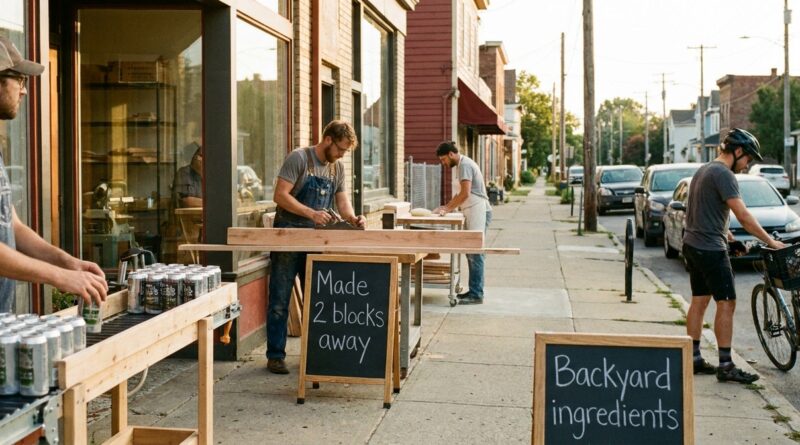
The Backyard Supply Chain: How Hyper‑Local Makers Are Quietly Replacing Global Brands On Your Block
You are not imagining it. The shelf is emptier, your usual brand is missing, and the replacement somehow costs more while feeling cheaper. That is frustrating. It also makes shopping feel oddly impersonal, like every store is carrying the same narrowed-down handful of things. At the same time, the small brewery down the street just won a medal, the neighborhood bakery is selling out by noon, and a local fabricator is making custom parts for schools and contractors. That split is the real story. Big brands are trimming choice and pushing prices up. Small local producers are getting better, more capable, and still struggling to win steady hometown demand. If you have ever wondered about hyper local manufacturing in my neighborhood, the answer is simpler than it sounds. It is the growing network of nearby people making real goods close to where you live, and it matters more now than it has in years.
⚡ In a Hurry? Key Takeaways
- Hyper-local makers are quietly filling gaps left by global brands, especially as prices rise and product choice shrinks.
- Start small. Route one regular weekly purchase, like bread, beer, gifts, printing, or home goods, to a nearby producer.
- This is not charity spending. Done carefully, it can mean fresher products, better service, faster turnaround, and more local resilience.
What “hyper local” actually means on your block
Hyper-local manufacturing sounds like a buzzword, but it is really pretty plain. It means products are being made close enough that you can often meet the person who made them, visit the workshop, or at least know the town they work in.
That could be a brewery, bakery, screen printer, metal shop, woodworker, roaster, soap maker, small food producer, or custom fabricator. Some sell direct to you. Others quietly supply restaurants, schools, offices, and local stores.
The key difference is distance. A global brand might cross oceans, ports, warehouses, and trucking hubs before it reaches your cart. A hyper-local product may travel ten miles.
Why this is happening now
Several trends are crashing into each other at once.
Big brands are simplifying
Large companies love efficiency. When costs rise, they often cut slower-selling sizes, colors, flavors, and variations. That keeps operations simpler, but it leaves shoppers with fewer choices.
Prices are getting jumpy
Imported materials, freight, labor, tariffs, and retail markups all stack together. That is one reason many shoppers are noticing that mainstream goods no longer feel like the easy bargain they once were. We have seen this play out across home goods and everyday products in Tariffs Are Spiking Prices. Neighborhood Makers Are Quietly Becoming the Affordable Option.
Small makers have better tools than they used to
This part gets missed. Tiny shops are not stuck in the past. They now use better ovens, canning lines, CNC routers, laser cutters, online storefronts, payment systems, and local delivery tools. A one-room workshop today can do things that used to require a much bigger operation.
People say they want local, but habits are hard to change
This is the sticking point. Lots of us like the idea of supporting nearby businesses. But when life gets busy, we fall back on one-stop chains, apps, and auto-reorders. That is normal. It also means local demand stays patchy, even when the interest is real.
The hidden cost of buying “generic” all the time
When every dollar goes to distant brands, your neighborhood loses more than charm.
It loses practical capacity. The bakery that closes is not just a bakery. It is local jobs, local training, local ingredients, and a fallback source of food production. The print shop is not just a place for flyers. It is the ability to make signs, labels, school materials, event posters, and business supplies quickly when something changes.
Think of hyper local manufacturing in my neighborhood as a backup system. Not a full replacement for big retail, but a useful second layer. The more skills and production your area keeps, the less fragile daily life becomes.
Where hyper-local makers are already replacing national brands
This is not some future trend. It is already happening in a lot of categories.
Food and drink
Local roasters, breweries, bakeries, spice blenders, pasta makers, jam producers, and snack brands are often faster to adapt and more willing to try small batches. They can respond to local tastes in a way national brands usually cannot.
Home goods
Cutting boards, shelves, tables, candles, ceramics, and textiles are increasingly coming from nearby workshops. Sometimes the price is higher. Sometimes it is surprisingly close. And in some cases, the local item lasts longer, which changes the math.
Services with a physical product attached
This is a big one. Print shops, embroiderers, sign makers, cabinet shops, bike repair shops, and metal fabricators often make or finish real products locally. They are part retail, part manufacturing, and part problem-solving.
Business-to-neighborhood supply
Your favorite coffee shop may already buy pastries from a local bakery and signage from a local printer. Schools may source custom fixtures from a nearby shop. Offices may use local branded merchandise instead of waiting weeks for national vendors.
How to make “buy local” practical instead of performative
You do not need to replace your whole shopping life. That is where people get overwhelmed and give up.
Instead, build a repeatable routine.
Pick one weekly category
Choose one thing you already buy often. Bread. Beer. Coffee beans. A lunch treat on Fridays. Flowers. Pet treats. Printed cards. Start there.
Set a small target
Aim to route 10 percent of your flexible weekly spending to nearby producers. Not all spending. Just the slice you can control without stress.
Use geography, not guilt
Try a three-mile or five-mile rule. If a local option exists within that range, check it before ordering from far away. This keeps the habit simple.
Batch your local buys
Make one neighborhood run each week. Pick up bread, a six-pack, and a gift card for later. This saves time and makes the habit stick.
Ask one useful question
When you find a shop you like, ask, “What do you make here?” You may discover products or services you never knew they offered.
How to search for hyper local manufacturing in my neighborhood
If you want to find the real makers near you, skip the broad shopping apps at first.
Try these search phrases
Use terms like “made in [your town],” “small batch [product] near me,” “custom fabrication near me,” “local bakery wholesale,” “screen printing [your neighborhood],” or “hyper local manufacturing in my neighborhood.”
Check who supplies local stores
Look at shelf tags in independent markets. Ask your coffee shop where the pastries come from. Read the back of the label at the bottle shop.
Use community channels
Farmers markets, neighborhood Facebook groups, school fundraisers, local business associations, and town event pages are often better than search engines for this.
Look for business hours that match real production
If a shop has odd pickup windows, limited releases, or preorder days, that is often a sign they are actually making things locally rather than reselling.
What to expect when you buy from neighborhood makers
It helps to go in with realistic expectations.
You may get less convenience
Hours can be limited. Packaging may be simpler. Inventory may run out. Online ordering may be clunky.
You often get more flexibility
You can ask questions. Request custom sizes. Fix a mistake quickly. Reorder directly. That kind of access is rare with giant brands.
Price is not always higher
Sometimes local goods cost more upfront. Sometimes they do not. Especially when shipping, middlemen, and premium branding are stripped away. And if the item lasts longer or fits your needs better, the value can be stronger.
You are paying for capacity nearby
This is the part many people miss. Your purchase helps keep skills, tools, and production alive close to home. That matters during shortages, delays, seasonal demand spikes, and economic shocks.
How to avoid the common mistakes
Supporting local does not mean buying random stuff you do not need.
Do not turn it into a personality test
You are not a bad person if you still shop at chains. Most of us will keep doing both. The goal is not purity. It is balance.
Do not assume every small maker is cheaper or better
Compare. Taste. Read reviews. Ask about materials. Some are excellent. Some are still learning. That is fine.
Do not wait for a perfect all-local lifestyle
That never arrives. One good recurring purchase beats a grand plan that never starts.
At a Glance: Comparison
| Feature/Aspect | Details | Verdict |
|---|---|---|
| Price stability | Global brands can swing with freight, tariffs, and retail markups. Local makers may have smaller scale but fewer layers of cost. | Local is often more competitive than people expect. |
| Choice and customization | Big brands are cutting options. Neighborhood producers can often do small batches, special orders, or direct feedback. | Local wins if you want something specific. |
| Convenience | Chains usually have longer hours and smoother logistics. Local shops may need preorders, pickups, or limited schedules. | Big brands still win on pure convenience. |
Conclusion
Right now there is a strange split. Big brands are cutting SKUs and raising prices, while micro producers are winning awards, expanding tiny workshops, and still fighting for consistent local demand. That gives regular shoppers a real opening. You do not need to change everything. Just start directing a small, steady slice of your weekly spending to nearby breweries, print shops, food producers, and fabricators. That turns “support local” from a nice sentiment into a routine with actual effect. It keeps jobs, skills, and problem-solving power close to home. And on a very practical level, it can also get you better bread, better gifts, faster service, and a neighborhood that feels a little less generic.