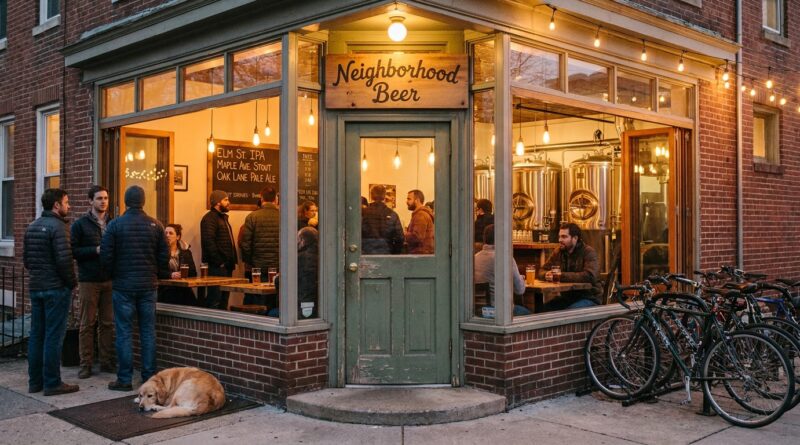
The Hyper‑Local Taproom: Why Tiny Neighborhood Breweries Are Surviving the Craft Beer Crash
It is a weird, lousy feeling when the brewery that hosted your trivia night, your first date, or your Sunday reset suddenly posts a goodbye message. A lot of beer fans are living that right now. Big craft beer expanded fast, shelves got crowded, costs went up, and many once-buzzy breweries ended up making far more beer than they could actually sell. But that is not the whole story. While regional craft brands are stalling, a different kind of beer spot is hanging on, and in some places, growing. The small neighborhood brewery trend is real. These are tiny taprooms tucked into old storefronts, light-industrial corners, and even garage-scale spaces. They are not trying to conquer three states. They are trying to pour fresh beer for the people within a ten-minute walk. That smaller goal turns out to be a pretty smart survival plan, and for regulars, it can mean getting their third place back.
⚡ In a Hurry? Key Takeaways
- Hyper-local taprooms are surviving because they brew small, keep overhead lower, and focus on regulars instead of wide distribution.
- Look for neighborhood breweries with steady foot traffic, fresh rotating taps, simple food partnerships, and community events.
- Your visits matter. A few pints, to-go cans, and event nights can help keep local jobs and gathering spaces on your block.
Why bigger craft breweries started struggling
For years, craft beer looked unstoppable. More styles, more cans, more shelf space, more cities. Then the math got ugly.
Many breweries built for constant growth. They added tanks, staff, packaging lines, and wider distribution. That works when demand keeps climbing. It hurts when drinkers start buying less beer, spread their spending across cocktails, THC drinks, NA options, coffee, and food, or simply stay home more.
Nationally, a lot of craft breweries are now running at barely half their brewing capacity. That means expensive equipment is sitting there, while rent, debt, labor, and ingredient costs keep showing up every month.
And when a brewery’s business depends on moving lots of packaged beer through stores and wholesalers, the squeeze gets worse. Shelf competition is brutal. Margins are thin. Freshness becomes harder to control.
Why the tiny neighborhood model looks better right now
This is where the small neighborhood brewery trend starts to make sense.
A hyper-local taproom often skips the expensive part of the old craft-beer playbook. It may have a tiny brewhouse. It may self-distribute little or not at all. It may sell most of its beer across its own bar, which is usually the highest-margin way to do it.
That changes everything.
They brew only what they can sell nearby
Instead of chasing supermarket shelves across a metro area, these brewers make enough for the block, the zip code, or the nearby few neighborhoods. Less waste. Less stale inventory. Less pressure to guess demand months ahead.
They keep the footprint small
A neighborhood brewery does not need a giant destination space with parking lots and a full kitchen. Some do just fine in a former laundromat-sized room with a few fermenters, a short tap list, and folding tables out front.
They build habits, not hype
A regular who drops in every Thursday is worth more than a one-time beer tourist who drives an hour for a hazy IPA release. Tiny taprooms know this. They become part of local routine. Dog walk stop. Book club host. After-work decompression zone. That is hard for a larger brand to copy.
What regulars are really buying
Beer matters, of course. But many people are not just paying for a pilsner or a pale ale. They are paying for a reliable room where somebody knows their name, the music is not too loud, and the bartender remembers they like the dry stout.
That is why so many closures feel personal. People lose a “third place,” not just a business.
Hyper-local breweries understand that. Their edge is not endless variety. It is familiarity. They are small enough to feel like they belong to the street they sit on.
This is part of a bigger local-commerce shift, too. If you have noticed more neighborhood makers filling the gap left by bigger brands, you are seeing the same pattern described in The Backyard Supply Chain: How Hyper‑Local Makers Are Quietly Replacing Global Brands On Your Block. Beer is just one very visible example.
How to spot a neighborhood brewery that is built to last
Not every tiny taproom is healthy. Small can be nimble, but small can also be fragile. Here is what to look for before you crown a place your new local.
1. The tap list is focused, not frantic
A good neighborhood brewery does not need 24 taps and seven pastry stouts. In fact, a shorter, sharper list is often a better sign. Look for a few house beers that seem dialed in. Lager. Pale ale. IPA. Dark beer. Maybe a seasonal.
If the menu changes wildly every visit and nothing comes back, that can mean the brewery is chasing novelty instead of building repeat orders.
2. There are actual regulars there
This sounds obvious, but it matters. Go at a boring time, not just on a packed Saturday release. Try a Wednesday at 6:30. Are there locals chatting with staff? Do people seem comfortable lingering? A healthy neighborhood taproom usually has a dependable base, not just event spikes.
3. The space fits the crowd
A modest room that feels pleasantly full is better than a giant hall that feels empty. Small breweries survive when the room matches the neighborhood. Too much space can sink them fast.
4. They partner well
Some of the smartest taprooms do not spend huge money on a full kitchen. They host food trucks, coordinate with the pizza place down the block, or let you bring takeout from nearby spots. That keeps their costs lower and spreads money around the neighborhood.
5. They have community programming
Trivia. Run club. Vinyl night. Parent meetup. Local art wall. Chess table. It does not have to be fancy. It just has to give people a reason to come back when they are not chasing a new beer release.
How to vet the beer without acting like a snob
You do not need a cicerone certificate. Just pay attention to a few basics.
Start with the simplest beer
If a brewery makes a clean lager, a solid pale ale, or a balanced porter, that tells you a lot. Big, sugary, heavily hopped beers can hide flaws. Simple styles cannot.
Ask what moves fastest
This is a friendly way to learn whether regulars keep coming back for the same beers. If staff can quickly point to two or three steady best-sellers, that is often a great sign.
Check freshness on to-go cans
If they sell cans, look for packaged-on dates. Tiny breweries often have fresher beer because it does not travel far, but it is still worth checking.
Notice whether the place is consistent
One good pint is nice. Three good visits over two months means something. Consistency is what turns a brewery into a real local institution.
How to actually help your local taproom survive
If you are lucky enough to have one of these spots nearby, support does not have to mean spending a fortune.
Become a repeat customer, not just a fan online
One visit every other week can matter more than one huge tab every six months. Predictable business helps small operators plan.
Buy the boring stuff
Yes, try the weird seasonal. But if you like the house lager, order it often. Core beers keep a neighborhood brewery stable.
Bring one new person
This is probably the easiest high-impact move. Tiny taprooms grow through word of mouth, not expensive marketing.
Use the room
Host a meetup. Suggest it for a low-key birthday. End a walk there. Third places survive when people treat them like third places.
Take beer home
A four-pack, crowler, or growler to-go can be a meaningful add-on sale, especially for a brewery with limited seats.
What this trend means beyond beer
There is a practical lesson here. Bigger is not always safer. In a rough market, the businesses with the best odds are often the ones that stay close to home, keep costs in check, and know exactly who they serve.
That is why the small neighborhood brewery trend matters even if you are only a casual beer drinker. It shows how local businesses can survive by being useful, familiar, and right-sized for the people around them.
And unlike a lot of national consumer trends, this one gives regular people a clear role. You can choose where your money goes. You can help decide whether your block gets another empty storefront or a place where neighbors bump into each other on a Tuesday night.
At a Glance: Comparison
| Feature/Aspect | Details | Verdict |
|---|---|---|
| Business model | Large craft breweries often depend on wide distribution and high volume. Hyper-local taprooms sell mostly on-site to nearby regulars. | Advantage: hyper-local, especially in a slower market. |
| Customer loyalty | Big brands chase shelf presence. Neighborhood breweries build habits through events, familiar staff, and walkable convenience. | Strong edge for small taprooms as third places. |
| Risk factors | Tiny breweries can still struggle with rent, permits, and thin staffing, but they usually have lower overhead and less unsold beer. | Not risk-free, but often more resilient if the neighborhood shows up. |
Conclusion
The craft beer crash is real, and it is painful when a favorite brewery disappears. But the story is not only about decline. It is also about a reset. National numbers show many breweries overbuilt and underused, while some of the healthiest spots are the smallest ones, the taprooms serving a few blocks instead of a whole region. If you learn how to find, vet, and champion these neighborhood-scale breweries, you do more than get fresher beer and a friendlier bar stool. You help keep money, jobs, and a much-needed gathering place rooted close to home. At a moment when so many people are watching beloved beer spots vanish, backing the right tiny taproom can be one of the simplest ways to keep your block feeling like a community.