The Neighborhood Manufacturing Hub: How Micro‑Workshops Are Quietly Rewiring Local Economies
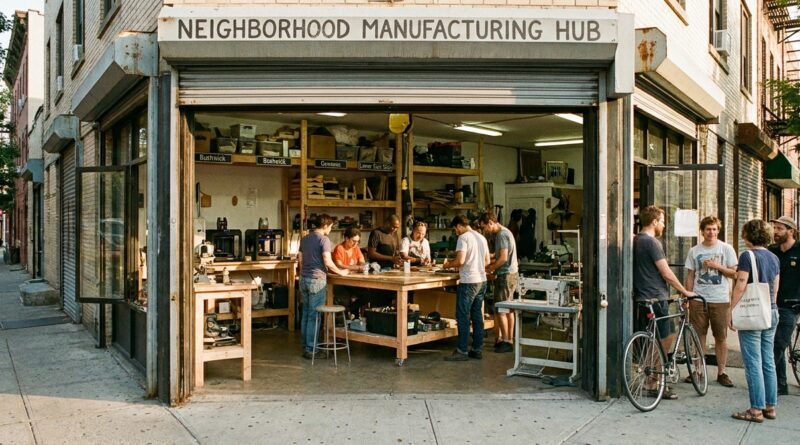
You can feel the frustration. Store shelves are less predictable, replacement parts take forever, and too many “local” goods turn out to be little more than imported products with a nicer label. At the same time, empty storefronts sit dark for months. That is why the rise of the neighborhood micro manufacturing hub matters. These are not hobby corners or craft fair tables. They are small, production-grade workshops tucked into old retail bays, garages, light industrial strips, and shared community spaces. They make real things close to the people who need them, from custom signs and metal brackets to small-batch food products, furniture, repair parts, and packaging. The shift is quiet, but it is changing how local economies work. It creates jobs people can actually see, shortens delivery times, and gives towns a practical way to turn underused space into useful production again.
⚡ In a Hurry? Key Takeaways
- A neighborhood micro manufacturing hub is a small local workshop space where businesses make, assemble, repair, or finish products close to customers.
- Look for hubs in vacant storefronts, shared maker spaces, garages, and light industrial units, then support them by buying useful items, requesting custom work, or spreading the word.
- The real value is resilience. Local production can cut wait times, reduce shipping risk, and keep more money and skills inside the community.
What a neighborhood micro manufacturing hub really is
Most people hear “local manufacturing” and picture a giant factory or a charming craft market. The truth sits in the middle.
A neighborhood micro manufacturing hub is usually a cluster of very small producers, or even one highly capable workshop, making goods at a useful commercial scale. Not huge scale. Not handmade-one-at-a-time-only scale either. Think laser cutting, sewing, woodworking, food prep, 3D printing, light metal work, electronics assembly, bike repair and fabrication, packaging, and short-run production.
The key idea is simple. It produces things people or nearby businesses actually need, and it does so close to home.
Why this is showing up now
Three pressures are pushing it forward.
First, global supply chains have felt fragile. People noticed. If you have ever waited six weeks for a basic part or seen a common item suddenly double in price, you already understand the problem. That is part of why articles like The Backyard Supply Chain: How Hyper‑Local Makers Are Quietly Replacing Global Brands On Your Block are hitting a nerve.
Second, tools got smaller and smarter. A compact CNC machine, a food-safe prep setup, or a digital embroidery station can fit into spaces that used to hold a cellphone store or a nail salon.
Third, landlords and cities need new uses for empty retail. A small production business often creates more repeat value than another short-lived shop trying to sell the same imported goods as everyone else.
Why micro-workshops are different from “cute local shops”
This is where people miss the story.
A gift shop mostly sells finished goods. A micro-workshop makes, modifies, repairs, or assembles them. That means it can respond faster when demand changes. It can make a short run of replacement cabinet doors for a contractor. It can produce restaurant shelving for a new tenant. It can bottle a local sauce, stitch uniforms, print labels, or fabricate brackets for a nearby installer.
That ability to do real production changes the economics of a place. It creates business-to-business relationships, not just walk-in sales. It brings steady work. It builds skills. It often supports other local firms you may never notice.
What these hubs can look like in real life
They do not all wear the same uniform.
Old retail bays turned active workshops
A former boutique becomes a sign shop with a design desk up front and production in the back. A dead strip-mall unit becomes a shared commercial kitchen for bakers, sauce makers, and meal prep businesses.
Garage-based production that grows up
A person starts with custom furniture or bike components at home, then moves into a small shared space with better power, ventilation, and room for staff.
Community maker spaces with a business layer
Some spaces begin as education or hobby centers but slowly become launchpads for actual local businesses. The strongest ones offer training, machines, safety rules, and small rentable production areas.
Light industrial spaces that finally become visible
Many neighborhoods already have tiny producers hidden in plain sight in back lots or side streets. What is changing is visibility. People are starting to connect those producers to local resilience, not just niche trade work.
How a neighborhood micro manufacturing hub helps a local economy
The benefits are not abstract. They show up fast.
Faster turnaround
If a restaurant needs branded packaging next week, local wins. If a contractor needs a custom part adjusted tomorrow, local wins again.
Money circulates closer to home
When production happens nearby, more spending stays in the area. That includes wages, maintenance, supplies, design work, and service contracts.
Vacant spaces become productive
Instead of waiting for the perfect retailer, a city can support uses that add jobs and practical value right away.
Local skills get stronger
Young people and career changers can see trades, digital fabrication, food production, and repair work up close. That matters more than another empty “for lease” sign.
Communities get more resilient
Not every product can be made locally, of course. But many can be finished, repaired, customized, assembled, or packed locally. That creates a backup layer when big supply systems wobble.
How to spot a real micro-manufacturing hub
Some places market themselves as “maker” spaces but are mostly event venues or hobby classrooms. Those have value too, but if you want to find production power, use this checklist.
Look for these signs
There is equipment, not just shelving. There are loading carts, worktables, ventilation, storage racks, or washdown areas. The place has regular business hours or scheduled production runs. It serves both everyday customers and other businesses. It can show examples of products made on-site.
Ask a few plain questions
What do you make here? Who buys it? Can you do short runs, custom jobs, or repairs? Are local businesses using your services? Those answers tell you quickly whether this is a true neighborhood micro manufacturing hub or just a retail front.
How residents can support one without turning it into a trend piece
You do not need to buy a handcrafted walnut table to help.
Buy useful things, not novelty things
Order the labels, shelving, uniforms, baked goods, repair parts, gifts, packaging, or signage that you already need. Regular demand is better than one viral weekend.
Use local producers for service work
If you run a small business, ask nearby workshops for custom fixtures, branded materials, or restocks before defaulting to a giant online supplier.
Share the boring wins
People love dramatic stories, but what keeps a hub alive is dependable business. Tell neighbors where you got the cabinet insert, the bike repair, the menu holder, or the batch of event favors that was finished in three days.
How cities and landlords can make these hubs easier to start
This is often where good ideas get stuck.
Fix zoning and permit confusion
Many tiny workshops are too “industrial” for retail zones and too “retail” for older industrial rules. Cities that create a clear small-production category make life easier for everyone.
Allow mixed front-of-house and back-of-house use
A lot of these businesses need a customer-facing area plus a production area. Rules should reflect that reality.
Support basic infrastructure
Good power, internet, drainage, ventilation, freight access, and noise rules matter more than fancy branding.
Offer short leases and shared space options
Small producers often cannot commit to long leases on day one. Shared commercial kitchens, fabrication bays, and modular units help them start small and grow.
Thinking of starting one? Start with a narrow need
This is not about trying to make everything locally. That usually fails.
The strongest micro-workshops solve a specific nearby problem. Maybe local cafes need custom pastry boxes. Maybe contractors need quick metal brackets. Maybe schools need team apparel in short runs. Maybe apartment owners need cabinet refacing instead of full replacements.
A simple starter checklist
Pick one product or service with repeat demand. Check local zoning first. Price the equipment honestly. Talk to five possible customers before signing anything. Figure out storage, waste, ventilation, and insurance early. Start with one reliable process you can repeat well.
Small is fine. In fact, small is often the point.
What to watch out for
Not every workshop belongs in every block. Noise, smells, truck access, and safety still matter. Good micro-manufacturing works because it fits the neighborhood, not because it ignores it.
There is also a branding trap. Some businesses wrap themselves in the word “local” while still importing nearly everything finished and ready to sell. Ask what is actually made, assembled, repaired, or finished on site.
And yes, local products are not always cheaper on sticker price. But the full math can still work in your favor when you count speed, customization, repairability, lower shipping risk, and less waste.
At a Glance: Comparison
| Feature/Aspect | Details | Verdict |
|---|---|---|
| Traditional retail shop | Mostly sells finished products brought in from elsewhere, with limited ability to customize or restock quickly. | Good for browsing. Weak on local production. |
| Neighborhood micro manufacturing hub | Makes, assembles, repairs, or finishes goods nearby using compact production tools and flexible space. | Best mix of local jobs, speed, and resilience. |
| Large distant supply chain | Often cheaper at massive scale, but slower to adapt and more exposed to shipping delays and shortages. | Still useful, but risky as the only option. |
Conclusion
The neighborhood micro manufacturing hub is not a nostalgic throwback. It is a practical answer to a very current problem. Cities and suburbs need better uses for empty storefronts. Residents want fair prices, faster turnaround, and less dependence on brittle supply chains. Small production spaces can help with all three. Once you know what to look for, you start seeing the opportunity everywhere: a vacant bay that could hold a shared kitchen, a garage workshop ready for its next step, a maker space that could become a real supplier. Support the ones that are already doing the work. Ask sharper questions about what is truly made nearby. And if your community has the space and the demand, consider starting small and building from there. That is how local jobs, visible skills, and a stronger close-to-home maker economy start to take root.