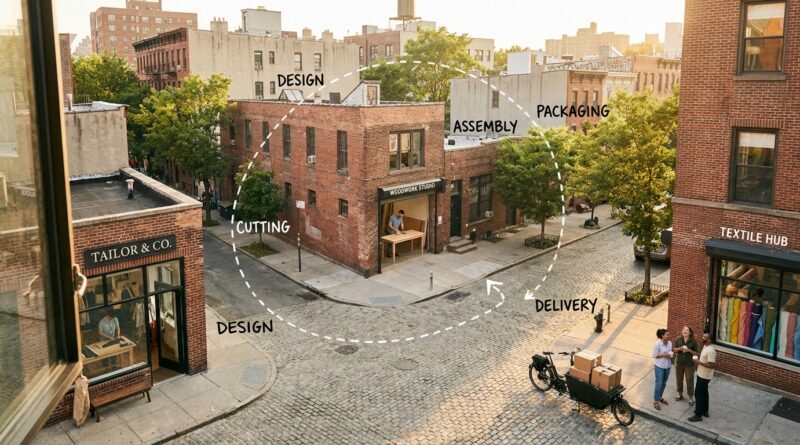
The 3‑Kilometer Factory: Why Micro‑District Workshops Are The Next Big Leap For Local Manufacturing
A lot of small makers are stuck in a painful spot. They are too rooted in their neighborhood to ship production across the world, but too small to build a full supply chain alone. So they end up doing everything themselves. Making, packing, sourcing, fixing machines, chasing invoices, and trying not to burn out. That is where the idea of the 3-kilometer factory comes in. It is not one giant building. It is a tight local network of workshops, suppliers, repair shops, shared tools, and delivery partners that sit close enough to work like one factory. In practical terms, hyper local manufacturing micro district workshops can turn one fragile studio into a resilient production loop. Instead of every maker reinventing the wheel, the neighborhood shares the load. That means faster turnaround, better transparency, more local jobs, and a real shot at keeping skills and money circulating on the same few streets where people actually live and work.
⚡ In a Hurry? Key Takeaways
- A 3-kilometer factory is a neighborhood-scale production network, not one huge plant, and it can help small makers grow without losing their local identity.
- Start by mapping who already does cutting, finishing, packing, repairs, storage, and delivery within a short distance, then build simple handoff agreements.
- The big win is resilience. If one shop has a problem, the whole local system does not have to stop.
What a 3-Kilometer Factory Actually Means
Think of it like this. A bakery does not need to mill its own flour, fix its own oven, print its own labels, and run its own courier fleet. It works because nearby businesses fill in the gaps.
Now apply that same idea to furniture makers, ceramic studios, textile shops, metalworkers, soap makers, bike builders, food producers, or small electronics assemblers. A micro-district workshop model creates a local production loop where each business specializes, but they still work together closely enough to feel like one system.
That is the heart of hyper local manufacturing micro district workshops. You stop asking one tiny studio to act like a mini version of a multinational company. Instead, you let a cluster of local businesses do the job together.
Why This Model Matters Right Now
People are tired of shaky supply chains and mystery sourcing. They want to know where things come from. They also want faster delivery and products with a human story behind them.
At the same time, small workshops are getting squeezed. Rent is up. Utilities are up. Skilled labor is hard to find. And if one machine breaks, a whole week can fall apart.
A micro-district approach helps because it spreads risk across a neighborhood. One shop can focus on prototyping. Another can do finishing. Another handles packaging. A nearby repair tech keeps the machines alive. A shared van or cargo bike service handles local drop-offs.
That setup is not just nice in theory. It solves very boring, very real problems. Those are usually the problems that sink small businesses.
The Core Parts of a Local Manufacturing Micro-District
1. Shared specialist capacity
Most small makers do not need every tool every day. They need access when it counts. A district works better when expensive or occasional-use tools are shared. Think laser cutters, CNC routers, commercial sewing equipment, kilns, spray booths, or food-safe packing stations.
2. Short-distance supplier links
If raw materials, packaging, labels, maintenance parts, and consumables come from nearby, lead times shrink. So does stress. You also get the simple benefit of being able to walk over, look at samples, and fix mistakes fast.
3. Reliable handoff points
This is where many local systems break down. The handoff from one shop to the next has to be easy. Clear labeling, pickup windows, standard file formats, packaging rules, and one shared contact list matter more than fancy software at the start.
4. Repair and maintenance support
Local manufacturing dies when tools sit broken. A district needs at least one dependable repair person, technician, or maintenance collective. It is not glamorous, but it is the glue.
5. Sales channels tied to place
A micro-district gets stronger when people can buy from it easily. That can mean a shared storefront, a neighborhood market, common branding, local business directories, or one online shop that routes orders to different makers.
How One Tiny Studio Becomes an Ecosystem
The shift usually starts small. One studio realizes it cannot keep doing everything alone. Instead of hiring a full internal team it cannot afford, it starts making a map.
Who nearby can do batch cutting? Who has storage space? Who owns the machine that sits idle half the week? Who already delivers around the neighborhood? Who can print labels in small runs? Who can handle overflow work during busy months?
That map is the beginning of the factory.
Not a giant one with loading docks and smokestacks. A neighborhood one. Flexible, modest, and much harder to wipe out with one bad quarter.
What Makers Should Do First
Start with a 3-kilometer audit
Pick a point on the map and draw a rough 3-kilometer radius. Then list every useful business or skill inside it. Do not just count makers. Count tool repair, couriers, storage, accountants who know production businesses, sign shops, material suppliers, packaging firms, and community colleges.
Find the repeated pain points
Ask local makers the same simple questions. What delays orders? What equipment is too expensive to own alone? What task drains the most time? What breaks most often? What forces people to outsource far away?
The answers show where a district should invest first.
Create one shared service before trying to build the whole system
Do not try to launch ten programs at once. Start with one thing people will actually use. Shared finishing space. Shared pickup and delivery. Joint material purchasing. A district repair day. Keep it boring and useful.
Use simple agreements
Even among friendly neighbors, confusion causes trouble fast. Write down lead times, quality standards, payment terms, damage rules, and pickup schedules. A one-page agreement beats a month of assumptions.
What City Officials and Local Groups Can Do
This is not only on makers. Local government, business groups, and property owners can either help this grow or quietly kill it.
Affordable light industrial space matters. Flexible permits matter. Loading access matters. Noise rules matter. If every workshop has to fight alone, many will lose on time and paperwork before they even start.
That is why zoning deserves real attention. If you want a deeper look at how rules shape local production, this piece on When Zoning Laws Meet Home Workshops: How Neighborhood Rules Are Quietly Deciding The Future Of Hyper-Local Making is worth your time. It gets at a frustrating truth. You can have demand, skills, and community support, then still get blocked by rules written for a different era.
What This Looks Like on the Ground
Imagine a neighborhood making small-batch home goods.
A textile studio designs and cuts fabric. A sewing workshop two blocks away handles assembly. A print shop adds tags and packaging. A local bike courier picks up finished orders twice a day. A shared storefront and online catalog sell everything under one district label. A repair technician services sewing machines every Friday morning. A co-op storage room keeps packaging and raw materials in stock.
No single business had to become huge. No one had to copy a giant factory. But together, they built factory-like reliability.
The Hidden Benefits People Forget
Skills stay local
When production happens close to home, younger workers can actually see how things are made. Apprenticeships become easier. Knowledge does not disappear behind a shipping container and a six-week lead time.
Cash circulates nearby
One maker pays a local finisher. The finisher pays a local repair tech. The repair tech buys lunch on the same block. That is not just feel-good economics. It helps neighborhoods stay alive.
Customers trust what they can see
People believe local claims more when they can visit the district, meet the maker, or at least know the product moved through real streets they recognize.
Small businesses can say yes to bigger orders
This is a big one. Many tiny studios turn down good work because they cannot scale without chaos. A district lets them spread the load across trusted partners.
The Risks, Because There Are Some
This model is promising, but it is not magic.
If there is no trust, it falls apart. If rents spike, workshops scatter. If local rules treat small production like a nuisance, the district gets pushed out. If nobody coordinates schedules and standards, missed handoffs become normal.
There is also the branding problem. Customers may love the idea of local production, but they still expect quality, consistency, and clear pricing. A district needs a shared standard, not just shared geography.
How to Keep It Practical Instead of Idealistic
Keep your eyes on operations. The strongest hyper local manufacturing micro district workshops are not built on slogans. They are built on repeatable systems.
- Use one simple order tracker everyone can access.
- Standardize file naming and product labels.
- Set fixed handoff times.
- Agree on quality checks before items move to the next shop.
- Track which tasks are always delayed and solve those first.
It is less romantic than talking about a maker revival. It is also what makes the revival real.
At a Glance: Comparison
| Feature/Aspect | Details | Verdict |
|---|---|---|
| Solo workshop model | One business handles sourcing, making, packing, and shipping mostly alone. | Flexible at first, but burnout and bottlenecks show up quickly. |
| Micro-district production loop | Nearby specialists share tools, tasks, logistics, and overflow capacity within a short radius. | Best balance of resilience, local identity, and manageable growth. |
| Far-away outsourced production | Lower unit costs can be possible, but lead times, minimum orders, and transparency issues are common. | Can work for scale, but often a poor fit for neighborhood-rooted makers. |
Conclusion
The big idea here is simple. Local manufacturing does not have to mean every maker doing everything alone. A neighborhood can act like a small factory if the right workshops, services, and rules line up. Right now communities are watching supply chains wobble, rents climb, and small workshops vanish, even as customers say they want to buy closer to home. Mapping out a micro-district production loop gives makers, city officials, and everyday residents a practical way to keep value, jobs, and skills on their own streets today. That is the real promise of the 3-kilometer factory. Not nostalgia. Not hype. Just a smarter way to make local production strong enough to last.