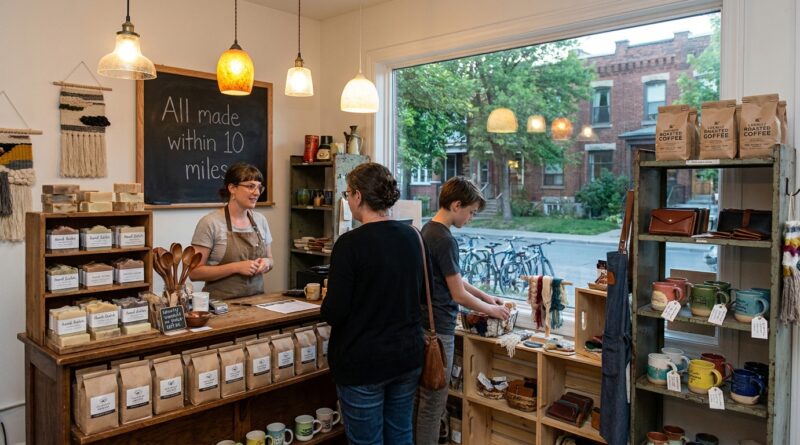
The Hyper-Local Corner Shop Comeback: How Neighborhood ‘Maker Stores’ Are Quietly Replacing Big-Box Browsing
You can feel the fatigue now. Another late-night scroll. Another page of nearly identical water bottles, candles, cutting boards, skin creams, and “artisan” gifts that somehow all seem to come from the same anonymous warehouse. People are not just tired of online shopping. They are tired of shopping that feels nowhere-based. That is why the hyper local maker store neighborhood shop is starting to matter again. Not as a cute throwback, but as a practical fix. When a corner shop gives shelf space to nearby makers, it turns browsing into discovery again. You can ask who made the soap. You can learn which baker supplies the crackers. You can actually see your town on the shelves. For neighborhoods with empty storefronts and small makers who need buyers, this is less about nostalgia and more about rebuilding a local shopping habit that feels human, useful, and surprisingly within reach.
⚡ In a Hurry? Key Takeaways
- A hyper local maker store neighborhood shop gives people a real-world alternative to endless online browsing by stocking goods made nearby.
- Start small. One shelf, one cooler, or one display table in an existing shop can test demand before anyone commits to a full store makeover.
- The big value is local trust and local money flow. More of each sale stays in the community, and shoppers know where products came from.
Why these neighborhood shops are coming back
Big-box stores still have scale. Online stores still have convenience. But both often miss something people quietly want more of now. Context.
Shoppers want to know why an item is here, who made it, and whether buying it helps someone nearby stay in business. A hyper local maker store neighborhood shop answers those questions without making people do homework.
The shelves do the explaining. Local honey from two miles away. Ceramics from the next neighborhood. Refillable cleaners made in town. Seasonal food gifts from a nearby kitchen.
That is a different kind of shopping. Less searching. More finding.
What a “maker store” really looks like
Do not picture a polished boutique with huge startup costs. In many places, this comeback is happening inside businesses that already exist.
The simple version
A convenience store adds a local pantry shelf. A gift shop swaps imported filler for goods made within 25 miles. A corner boutique creates a monthly rotation for neighborhood artists and small-batch producers.
That is enough to start.
The smart version
The best shops curate rather than cram. They do not try to stock everything. They pick categories people already buy.
- Snacks and pantry basics
- Soap, candles, and home goods
- Cards, prints, and gifts
- Coffee, tea, jams, and baked items
- Refillables and practical household products
This matters because local shopping only becomes a habit if it fits daily life. People love a hand-thrown mug. They return for coffee beans, bread, dish soap, and gifts they need by Saturday.
Why shoppers are responding
Part of it is emotional, yes. People like stories. They like buying from someone who lives where they live.
But part of it is practical too.
Local maker goods are often easier to restock, easier to ask questions about, and easier to trust. If something is wrong, you are not dealing with a seller that disappears after a weekend flash sale.
This is also why local production has become a backup plan in a lot of communities. If you want a wider look at that shift, The Hyper-Local Supply Chain Swap: How Neighborhood Makers Are Quietly Becoming the ‘Plan B’ for Broken Global Logistics makes the point clearly. When faraway supply chains wobble, nearby makers suddenly look a lot less like a niche and a lot more like common sense.
Why this helps empty storefronts without requiring a miracle
Here is the encouraging part. A neighborhood does not need ten new businesses to feel alive again. Sometimes it needs one existing shop to become more useful.
A maker-focused corner store creates foot traffic for itself first. Then nearby businesses benefit too. Someone comes in for local granola or a birthday gift and ends up getting coffee next door. That is how small retail streets recover. Not all at once. Bit by bit.
This approach also lowers the risk. Instead of asking one new entrepreneur to sign a big lease and build from scratch, the neighborhood can use space that already exists.
Low-cost ways to test the idea this month
- Give one shelf to products made within 10 or 20 miles.
- Run a weekend “made here” table near the register.
- Invite five makers to do a 30-day trial on consignment.
- Add clear shelf tags that name the maker and neighborhood.
- Bundle local products into easy gift sets.
None of that requires a huge build-out. It requires curation, a simple agreement, and a store owner willing to try.
What shop owners need to get right
This is where some good ideas go sideways. A hyper local maker store neighborhood shop works best when it is run like a retail business, not a hobby fair.
1. Make the selection easy to understand
Do not overload people with fifty tiny brands and no logic. Group products by use. Kitchen. Bath. Snacks. Gifts under $25. Things for kids. Fast decisions help sales.
2. Tell short stories, not long speeches
A shelf card should answer three things. Who made it. How far away they are. Why this product is worth picking up. That is enough.
3. Keep regular hours and reliable stock
If shoppers come once and the shelves are half empty, they stop checking. Local charm does not excuse bad retail basics.
4. Mix special items with everyday purchases
A store survives on repeat visits. Repeat visits come from useful products, not just occasional treats.
What makers need from these shops
Nearby makers often do not need a giant wholesale deal. They need consistent shelf space, fair terms, and a shop that presents their products well.
That means clear pricing, decent photos for social posts, simple reorder systems, and realistic packaging standards. If a product falls apart on the shelf or arrives without labels, the local angle will not save it.
The good news is that many makers can scale to this level faster than people assume. Especially if the first step is one neighborhood account instead of a region-wide rollout.
The hidden benefit: trust
This may be the most important piece. Local retail rebuilds trust in small ways.
You trust a product more when you know where it came from. You trust a shop more when the owner can tell you why they carry it. You trust your town a bit more when you can still point to places that feel specific to it.
That trust has value. It makes people spend locally with less hesitation. It also gives new makers a visible path into the market without forcing them to win an online ad auction first.
At a Glance: Comparison
| Feature/Aspect | Details | Verdict |
|---|---|---|
| Shopping experience | Big-box and online options offer volume, but a hyper local maker store neighborhood shop offers discovery, stories, and human help. | Better for people who want fewer, better choices. |
| Startup cost | Using an existing convenience store, gift shop, or boutique keeps costs low. One shelf can be enough to start. | Strong low-risk test for neighborhoods. |
| Community impact | More money stays local, makers get real shelf space, and empty retail space gains a clear purpose. | High value beyond the sale itself. |
Conclusion
The comeback of the hyper local maker store neighborhood shop is not really about rejecting technology or pretending online shopping will vanish. It is about fixing what modern shopping has made thin and forgettable. Cities and small towns are dealing with the same problem. Empty storefronts, weak local ties, and residents who rarely get to see what is actually made around them. Turning even one convenience store, gift shop, or corner boutique into a curated home for nearby products is a practical move, not a grand gesture. It creates income for local makers, keeps more spending on your own streets, and gives shoppers a visible alternative to faceless buying. Best of all, it can start small. One shelf. One cooler. One table by the register. That is enough to make “made here” feel real this month, not someday.