The Hyper-Local Supply Chain Swap: How Neighborhood Makers Are Quietly Becoming the ‘Plan B’ for Broken Global Logistics
You know the feeling. A part you need is suddenly backordered for six weeks, the cheaper replacement arrives flimsy, and your customer does not care that it got stuck on a ship three time zones away. They just want the shelf stocked, the fixture repaired, or the order filled on time. That is why the hyper local supply chain local manufacturing shift is getting real attention. Not as a feel-good slogan, but as a practical Plan B. In some neighborhoods, it is becoming Plan A. Small factories, fabricators, print shops, woodworkers, metal shops, and specialty makers within driving distance are quietly helping local businesses replace one vulnerable product line at a time. The trick is not finding a magical all-in-one supplier. It is building a simple process for testing local options without blowing up your margins, quality standards, or delivery promises. Start small. One item. One supplier. One low-risk win.
⚡ In a Hurry? Key Takeaways
- Yes, you can replace fragile imported products with nearby suppliers, but the safest move is to swap one SKU first, not your whole catalog.
- Start with products that are often late, easy to customize, expensive to ship, or embarrassing when quality slips.
- Local manufacturing can cost more per unit, but it often saves money through faster restocks, lower minimums, fewer failures, and better communication.
Why neighborhood makers matter now
For years, many businesses treated local manufacturers as a last resort. Maybe useful for a rush order. Maybe good for a custom sign or a short run. Not serious enough for core supply.
That view is changing fast.
Shipping is less predictable. Input costs swing around. Customers are asking where things come from and how they are made. Meanwhile, state and city programs are giving local production a real push. “Made in California” support, “Made in NYC” learning labs, regional contests, supplier directories, and small-business manufacturing grants are helping neighborhood production look a lot less niche.
The biggest shift is this. Buyers are starting to see nearby makers not as backup vendors, but as strategic partners who can solve problems quickly.
What counts as a hyper-local supply chain?
It does not have to mean every screw, label, and box comes from five blocks away.
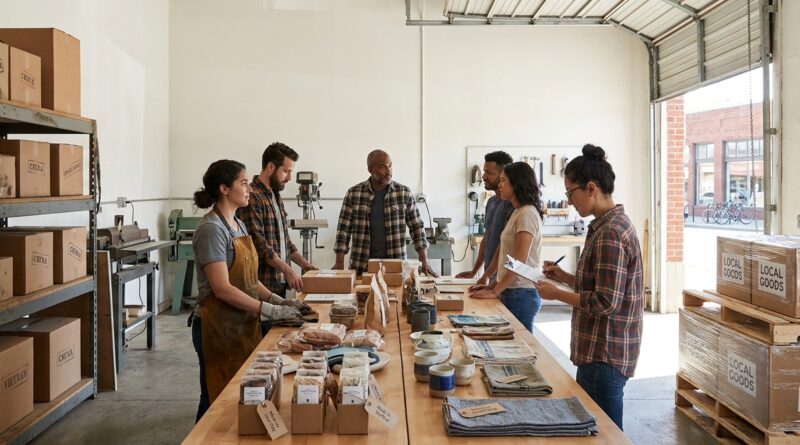
In practice, a hyper local supply chain local manufacturing plan usually means replacing at least one vulnerable link with a supplier close enough to visit in person. Think within your city, county, metro area, or a short drive.
Good candidates include:
- Packaging and printed materials
- Store fixtures and displays
- Uniforms, totes, and branded goods
- Replacement parts
- Wood, metal, or plastic components
- Small-batch food, personal care, or household goods
If you can drive there, tour the shop, and talk to the people making your order, you are in the right zone.
Start with the right product, not the right ideology
This is where many businesses get stuck. They try to “buy local” across the board, then panic when prices do not line up.
Do not do that.
Pick one product that already causes pain. The best item to move locally is usually one with at least two of these problems:
- Frequent stockouts
- Long lead times
- High shipping cost relative to item value
- Quality complaints or breakage
- Large minimum order quantities
- A need for seasonal or custom changes
A bulky metal bracket, a custom shelf insert, a branded retail display, or a fast-moving refill product often makes more sense to localize than a commodity item with razor-thin margins.
Your five-step playbook for switching suppliers safely
1. Map the risk in your current supply chain
Before you look for local vendors, look at your current weak spots.
Ask:
- Which products go out of stock most often?
- Which items tie up too much cash because you have to order huge batches?
- Which products create customer complaints when quality dips?
- Which SKUs become a crisis if delayed by two weeks?
Make a short list of three to five candidates. Keep it simple.
2. Build a neighborhood supplier list
You do not need a giant procurement platform. Start with local manufacturing directories, chamber of commerce lists, maker networks, trade schools, community colleges, industrial parks, city economic development offices, and regional “Made in” programs.
This is also where the local maker ecosystem matters. If you want to understand how small production capacity is growing from the ground up, The Hyper-Local Makerspace Boom: How Neighborhood Tool Libraries Are Quietly Building the Next Wave of Backyard Manufacturers gives a useful picture of how repair spaces, tool libraries, and small fabrication hubs are feeding the next generation of neighborhood suppliers.
Look for shops that already make something adjacent to what you need. A sign fabricator may be able to make fixtures. A machine shop may be able to make replacement hardware. A local contract packager may help with product assembly and labeling.
3. Vet them like a grown-up, not like a desperate buyer
Do not hand over an important order just because someone is nearby and enthusiastic.
Ask practical questions:
- What are your minimum order quantities?
- What materials do you use, and where do they come from?
- What is your normal turnaround time?
- Can you handle repeat orders, or only custom one-offs?
- How do you check quality?
- Can I see examples of similar work?
- What happens if a batch has defects?
If possible, visit the shop. You are not inspecting with a clipboard. You are checking whether the operation feels organized, honest, and capable.
4. Run a pilot order
This is the part that saves you.
Do not switch everything at once. Place a small test order for a low-risk item or subset of an existing product line. Measure:
- Actual lead time
- Unit cost
- Defect rate
- Packaging quality
- Communication speed
- How easily they handle changes
The pilot tells you whether the higher unit cost, if there is one, is offset by fewer headaches.
5. Compare total cost, not just invoice cost
This is where local sourcing often starts to make sense.
A nearby supplier may charge more per piece. But total cost can still come out better when you factor in:
- Lower freight charges
- Smaller, more frequent orders
- Less dead inventory
- Fewer damaged goods
- Faster problem solving
- Less time spent chasing updates
- More room for customization
If a local supplier lets you buy 200 units instead of 5,000, that flexibility alone can protect your cash flow.
How to talk about price without scaring everyone off
Many local makers are used to hearing one question first. “Can you match the overseas price?”
Usually, the answer is no.
That does not mean the conversation ends there. A better question is, “How can we design this so it works for both of us?”
Ways to make the numbers work:
- Simplify materials or finishes
- Standardize sizes
- Reduce packaging complexity
- Commit to a repeat schedule instead of one huge batch
- Use the local supplier for premium, fast-turn, or seasonal versions first
Sometimes the smart move is mixed sourcing. Keep the commodity version from your existing supplier. Use a neighborhood maker for the rush, custom, premium, or regional version.
Red flags to watch for
Local does not automatically mean good.
- No clear process for quality checks
- Unwillingness to document timelines or specs
- Prices that change wildly from one conversation to the next
- Promises that sound too big for a small shop’s capacity
- No samples, references, or proof of similar work
You are looking for reliability, not romance.
What city buyers and institutional purchasers can do
If you buy for a school system, city department, hospital network, or local program, your influence is bigger than you think.
A lot of local manufacturers never get considered because bid requirements are built for giant vendors. If your rules allow it, break projects into smaller chunks, create prequalified local vendor lists, hold supplier meetups, and make onboarding less painful.
Even replacing one imported category with local production can create a stable revenue stream for a nearby shop. That helps build capacity over time.
What small retailers and local brands can do this month
You do not need a task force. Try this in the next 30 days:
- Pick one problem product.
- Write down your current cost, lead time, and pain points.
- Find three local or regional suppliers.
- Ask each for a sample or a small pilot quote.
- Test one order and compare the real-world result.
That is enough to move from vague interest to an actual decision.
At a Glance: Comparison
| Feature/Aspect | Details | Verdict |
|---|---|---|
| Unit price | Local manufacturers may charge more per piece, especially on small runs or labor-heavy goods. | Looks worse on paper, but not always worse overall. |
| Lead time and flexibility | Nearby suppliers can often restock faster, accept smaller orders, and adjust designs with less delay. | A major win for fragile or fast-changing products. |
| Risk and resilience | Shorter supply lines mean fewer shipping shocks, easier site visits, and faster fixes when something goes wrong. | Often the strongest reason to switch at least one SKU. |
Conclusion
You do not need to rebuild your whole purchasing system to benefit from local manufacturing. You just need one good swap. Right now, governments and industry groups from California to New York and beyond are pouring money and attention into local manufacturing, from “Made in California” labeling and marketing support to city-backed “Made in NYC” learning labs and statewide contests that highlight the coolest things built nearby. That energy is meeting higher costs, shaky global logistics, and a real appetite for more resilient, values-based buying. For small businesses, shop owners, and city buyers, the opportunity is not abstract. Replace one fragile imported product with something made within driving distance. Keep more dollars circulating locally. Lower your risk. Give a neighborhood manufacturer a fair shot to become a trusted partner, not just the person you call when the container is late again.